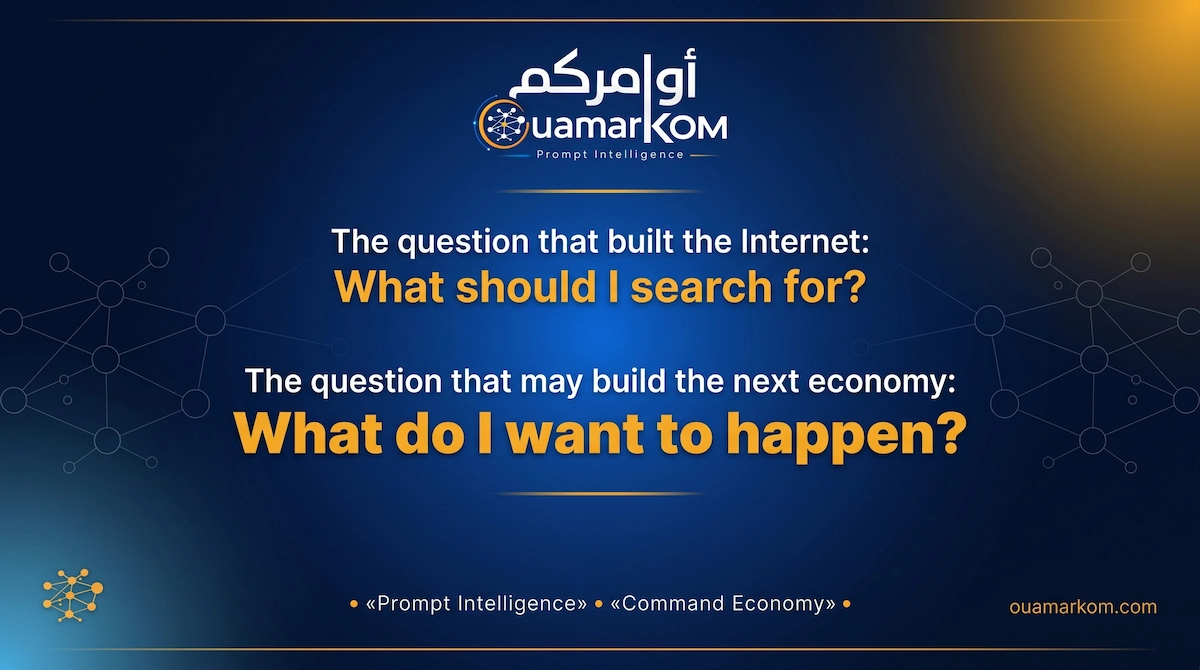
For the past three decades, the fundamental question that has defined computing and the internet has been remarkably simple: “What should I search for?”
Search engines, websites, databases, content platforms, and even the entire digital economy were built around this single question. People needed information, so they searched for it. They needed answers, so they read them. They needed skills, so they learned them. Information effectively became the raw material of the digital economy.
But what is happening today with artificial intelligence is not merely an incremental improvement to search engines or a shiny new user interface. It represents a structural change in the fundamental question itself. For the first time since the birth of the internet, the question is no longer: “What should I search for?” Instead, it becomes: “What do I want to happen?”
This seemingly simple shift may prove to be one of the most significant economic and technological transformations since the emergence of the web itself.
1. The Age of Search and Its Economic Friction
Over the past several decades, the world experienced what may be called the "Search Economy." In this paradigm, value was strictly created through:
- Owning critical information.
- Indexing distributed information.
- Organizing messy information.
- Making information universally accessible.
The world's most valuable companies became those capable of managing this massive process. Search became the primary gateway to the digital economy. If people wanted to travel, they searched. If they wanted to buy a product, they searched. If they wanted to learn a skill or build a company, they searched.
Knowledge became universally accessible, and the cost of obtaining information fell dramatically. However, generative artificial intelligence has revealed an important reality: The fundamental problem is no longer the lack of information. The problem is the cost of transforming that information into results.
2. The High Cost of Search
Search is not economically free. Typing words into a search engine may cost nothing vertically, but the complete end-to-end process remains extremely expensive for human capital. Traditional search requires heavy resources:
When someone wants to launch an online store, they do not truly need thousands of tutorial articles. They need a functioning business. When a company wants to increase sales, it does not necessarily need dozens of complex reports. It needs results. This is exactly where the sharp distinction between the Information Economy and the Results Economy begins to emerge.
3. From Information to Intention
In the traditional digital economy, information was the primary sovereign asset. In the emerging economy, intention becomes the supreme economic asset. Intention represents what people truly want, the specific goals they pursue, and the precise outcomes they seek.
Artificial intelligence therefore organically evolves from a simple passive answering system into a highly active, autonomous execution layer. This naturally triggers the complete collapse of the traditional search interface.
4. The End of the Traditional Interface
Search engines were interfaces for discovery; AI agents are rapidly becoming interfaces for execution. Previously, humans interacted heavily with static websites, applications, and search engines. In the future, they may increasingly interact almost exclusively with agents, commands, and goals.
The question is no longer: “Where can I find the answer?” The new question becomes: “How can I achieve the result?” This paradigm shift introduces us to a brand new terminology: The Command Economy.
An advanced economy in which human language becomes the absolute starting point of economic activity. A command is no longer merely a text query; it is an explicit economic intention.
When someone writes: “Build an online store,” that specific instruction may instantly trigger autonomous pipelines of design, development, marketing, analytics, and logistics management. Language therefore fundamentally evolves from a communication tool into a literal production system.
5. The Collapse of Coordination Costs
One of artificial intelligence's most disruptive economic effects is the systemic reduction of coordination costs. Modern organizations spend enormous capital and resources on meetings, management, follow-ups, and complex task coordination. In many legacy environments, coordination costs vastly exceed actual execution costs.
When intelligent systems can distribute, coordinate, and execute highly complex work autonomously, much of this severe economic friction completely disappears. This may become one of the single largest sources of productivity growth in the coming decades.
6. From the Tool Economy to the Agent Economy
Today's digital economy heavily relies on utilizing dozens of separate software applications, where each application performs a siloed function. In the Command Economy, autonomous agents become the fundamental units of execution.
Users no longer search for the right tool or software suite; they specify the desired outcome. The intelligent underlying system dynamically selects the appropriate tools, sub-agents, workflows, and actions. This directly resembles the monumental transition from operating individual machinery to owning a fully automated, state-of-the-art factory.
7. Intention as a New Economic Asset
If data was proudly crowned the "new oil" of the previous decade, intention may reliably become the definitive economic asset of the next. Systems capable of accurately understanding goals, context, micro-desires, and operational priorities will possess enormous economic advantages.
Competition among tech giants and startups will therefore shift rapidly from:
Consequently, the largest companies of the next decade may not be information companies at all. They will likely be execution companies—enterprises capable of seamlessly transforming desire into concrete plans, plans into actions, and actions into verified outcomes. Computing thus moves significantly closer to economics than to traditional software licensing.
8. Redefining Work & The Execution Revolution
If commands become the sovereign interface of the economy, the nature of human labor itself will radically change. Human labor will not magically disappear, but it will dramatically evolve.
The economic value of goal definition, strategic decision-making, core creativity, and holistic system design will skyrocket. Meanwhile, the relative importance of repetitive work, manual cross-platform coordination, extensive searching, and routine administrative operations will sharply decline.
Human civilization has experienced several major transformations: The Agricultural Revolution, The Industrial Revolution, and The Information Revolution. We are now officially entering The Execution Revolution.
If the Industrial Revolution drastically reduced the cost of physical production, and the Digital Revolution minimized the cost of global information distribution, artificial intelligence will fundamentally reduce the cost of transforming raw human intention into tangible results.
Conclusion
Since the emergence of the internet, the defining question of computing has been: “What should I search for?” With the rise of advanced artificial intelligence, agentic swarms, and autonomous execution frameworks, this question changes forever.
The new question is: “What do I want to happen?”
This transformation does not merely change how technology is written or used; it completely reshapes companies, global markets, production chains, human labor, and the core of the economy itself. The coming economy may not simply be an Information Economy or a Data Economy. It is an economy where human intention is the primary raw material, commands become the native language of production, and flawless execution becomes the ultimate source of value.
This is the beginning of the Command Economy.
Ready to Lead the Execution Era?
The transition has begun, and the infrastructure for trading and deploying high-value command structures is being built right here.
Ouamarkom is the premier global marketplace engineered specifically for language-based operating systems, prompt architectures, and intent validation frameworks.
Turn Your Intentions into Economic Assets NowOuamarkom - The First Arab Marketplace for the Command Economy. 🚀