For more than three decades, the digital economy has been organized around a simple, unyielding principle: Information creates value.
This single foundation built the entire web landscape we know today:
- Search engines helped people discover knowledge.
- Software applications helped people perform manual tasks.
- Platforms connected users, businesses, and fragmented markets.
- Data became the primary, sovereign asset of the internet economy.
Yet, a profound new transition is beginning to emerge. Artificial intelligence is changing not only how software works, but also how economic value itself is generated and captured.
1. The Fundamental Question Shifts
The core structural logic of the internet age vs the AI age can be summarized by a change in the central question we ask our interfaces:
This shift may appear subtle on the surface, but its long-term economic implications are absolutely profound.
2. Modalities of the New Era
As we cross this digital threshold, the core components of production are mutating into pure, objective-driven flows:
As software becomes increasingly capable, interfaces become increasingly invisible.
As language becomes the operating layer of digital systems, human intentions begin to function as economic inputs.
These rapid developments point directly to the emergence of a brand new structural framework: The Command Economy.
3. Pillars of The Command Economy
The Command Economy is an advanced economic model defined by five core foundational systemic pillars:
- Intentions become assets: A precisely articulated human goal is the starting point of capital production.
- Language becomes an interface: Natural language supersedes complex graphical user interfaces (GUIs).
- Agents become executors: Autonomous software structures take over the mechanical steps of workflows.
- Context becomes infrastructure: The quality, governance, and boundaries of data determine execution safety.
- Outcomes become the primary source of value: Pricing moves completely away from seat-licenses to verified results.
Under this framework, users no longer navigate rigid enterprise software. They express strategic objectives.
They do not search for tools; they issue commands. They do not purchase raw information; they purchase guaranteed results.
4. Organizing the Graph of Intent
The historical transition from search to execution may become as significant as the shift from desktop computing to mobile, or from local software to cloud-native platforms.
The companies that dominate the next era may organize human intentions.
Consider the structural evolution of digital moats:
- Search engines built massive indexes of global knowledge.
- Social networks built hyper-connected graphs of human relationships.
- The Command Economy is building dynamic, executable graphs of human intent.
5. Transforming Intention Into Value
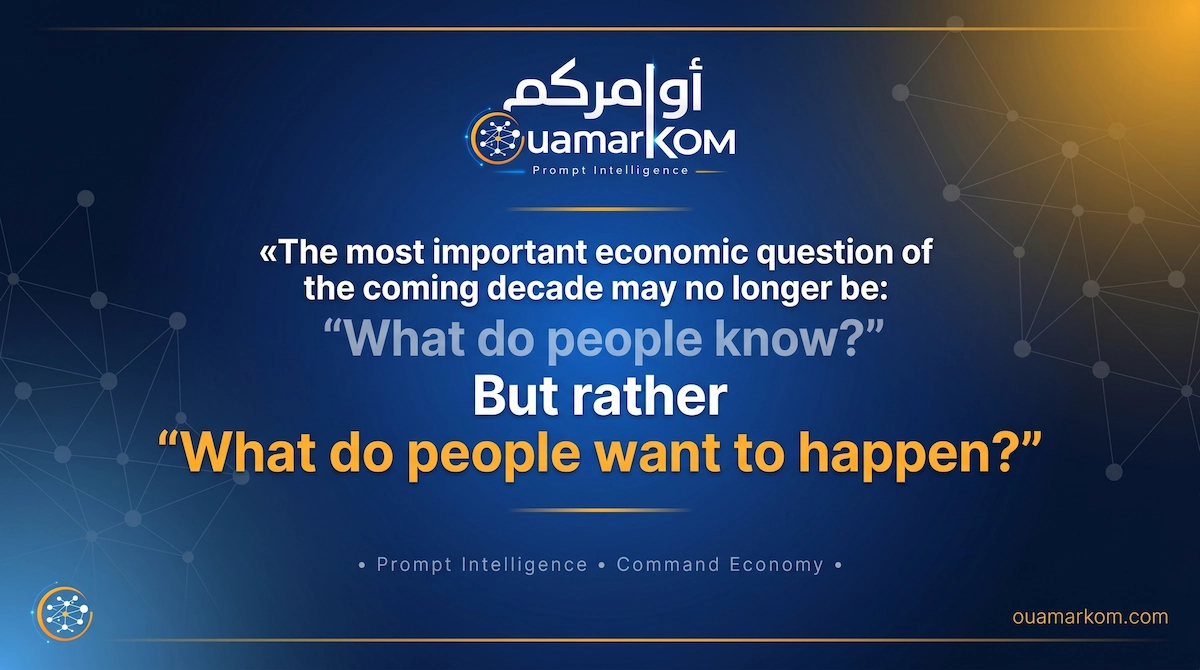
The critical economic question of the coming decade may no longer be: What do people know? It will inevitably become: What do people want to happen?
And more importantly, how can those raw intentions be seamlessly transformed into measurable outcomes through intelligent systems, agentic swarms, and fully automated execution pipelines?
The future definitely belongs not to those who possess or hoard the most information, but to those who can design systems that transform human intention into flawless execution.
This is the beginning of the Command Economy.
Ready to Lead the Execution Era?
The transition has begun, and the infrastructure for trading and deploying high-value command structures is being built right here.
Ouamarkom is the premier global marketplace engineered specifically for language-based operating systems, prompt architectures, and intent validation frameworks.
Turn Your Intentions into Economic Assets NowOuamarkom - The First Arab Marketplace for the Command Economy. 🚀