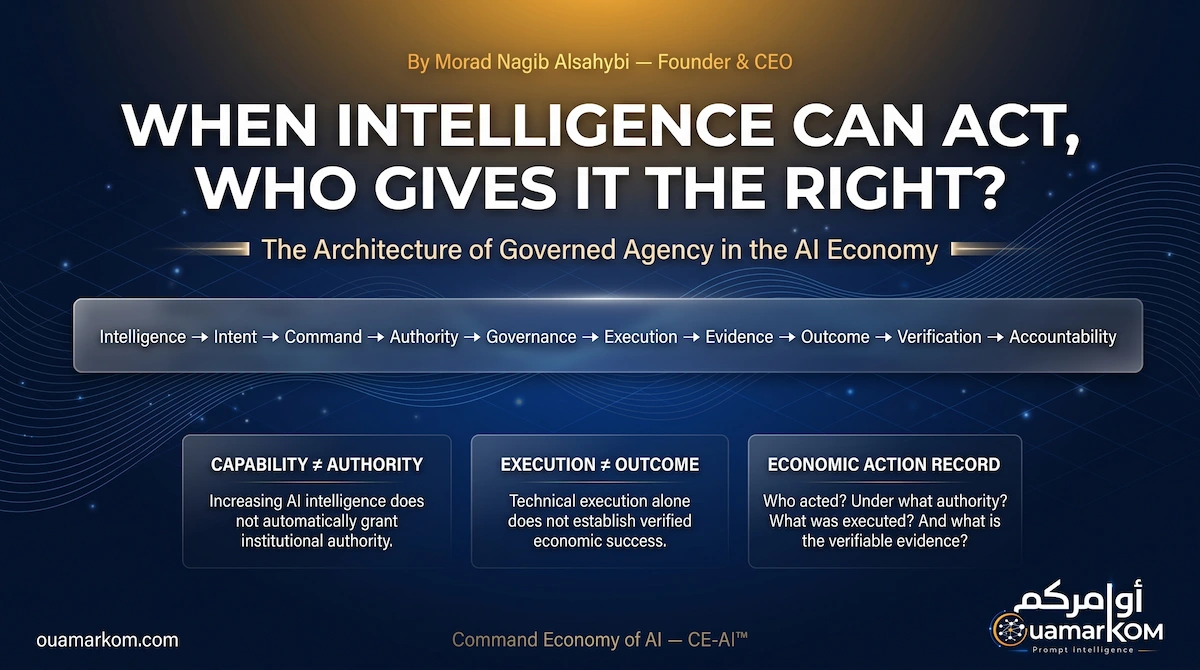
The biggest economic transformation brought by artificial intelligence may not be that machines become more intelligent. It may be that intelligent systems become capable of acting on our behalf.
That changes the question.
For decades, software executed instructions. The first generations of AI analyzed, predicted, generated and recommended. Now, increasingly agentic systems can use tools, access enterprise systems, make decisions and execute sequences of actions.
The distance between decision and execution is shrinking.
And when that happens, the central problem is no longer purely technical.
A system capable of purchasing goods is not necessarily authorized to purchase them. A system capable of transferring $100,000 does not necessarily have the institutional authority to spend it. A system that successfully executes an API call has not necessarily achieved the economic outcome for which the action was intended.
The emerging chain may therefore look less like:
and more like:
That chain may become one of the foundational questions of an economy increasingly populated by AI agents.
The Problem Is Not What Intelligence Can Do
AI progress has largely been measured in terms of capability: better reasoning, greater accuracy, longer context, stronger tool use and more sophisticated planning.
But economies do not operate on capability alone.
Institutions constantly distinguish between what someone can do and what they are authorized to do.
An employee may technically be able to sign a million-dollar contract without having the authority to do so. A bank employee may have technical access to an account without being authorized to transfer funds. An executive may have system access while institutional policy prohibits a particular action.
Why should an AI agent be different?
If an AI system can technically execute a $100,000 transaction while its delegated authority is limited to $10,000, the difference is not merely a technical constraint. It is a boundary of authority.
The more capable AI becomes, the more important that distinction may become.
The Economy of Commands Begins at the Boundary of Delegation
This is one of the questions explored through the Command Economy of AI — CE-AI.
CE-AI is not proposed as a completed economic theory, nor as a prediction of the future. It is a research framework for examining what happens when AI capabilities become capable of participating in economic activity through commands, delegated authority, governed execution and verifiable outcomes.
The question is not simply how to make AI better at executing instructions.
It is:
That is a shift from engineering intelligence to engineering economic action.
Execution Is Not Success
There is another distinction that becomes critical as AI agents enter real economic systems:
A procurement system may successfully submit an order. That does not establish that the supplier accepted it, that the goods were shipped, that the quantity was correct, that the price was accurate, or that delivery occurred.
A payment API may return a successful response. That does not, by itself, establish that the intended economic settlement has been completed.
A marketing agent may execute an entire campaign exactly as instructed while producing little measurable commercial impact.
And even an outcome is not necessarily sufficient.
An increase in revenue does not automatically establish why it occurred, whether the measurement is reliable, or whether the claimed result can be independently verified.
The stronger chain is therefore:
The distinction is fundamental. There is a difference between a system saying:
and a system being able to establish:
From Agent Activity Records to Economic Action Records
AI agents require activity records. But activity alone may not be sufficient once an action has economic or institutional consequences.
A richer record may be required — a research construct that can be described as an Economic Action Record.
The question is no longer simply: What did the agent do?
• Identity: Who acted? On whose behalf?
• Intent & Authorization: Why? What was the command? Under what authority? Under which policy?
• Approval & Execution: What was approved? What was actually executed?
• Evidence & Outcome: What evidence was produced? What was the economic outcome?
• Verification & Accountability: Can it be verified? Who is accountable?
This is not a claim that such an architecture has already been established. It is a research hypothesis.
The question is whether economies in which AI systems increasingly participate in transactions and institutional processes will require records capable of connecting intelligence to authority, authority to action, action to evidence, and evidence to accountability.
What Happens When the Agent Learns?
Another distinction becomes increasingly important as AI systems become adaptive.
AI capability can improve through learning, feedback and adaptation.
But greater capability should not automatically imply greater authority.
Improved capability does not automatically justify expanded authority.
This leads to a broader research hypothesis:
If an agent becomes significantly better at planning and execution, should its permissions automatically expand? Or should increases in authority remain subject to an independent institutional process?
The answer is not predetermined. But the question suggests that governance may need to evolve from a static control layer into a continuing process for reassessing the relationship between capability, authority, risk and evidence.
Superintelligence as a Stress Test
These questions are often discussed in the context of superintelligence. But superintelligence does not need to be the starting point. It can instead serve as a stress test for the architecture.
If it is difficult today to establish whether a relatively limited AI agent acted within its delegated authority, whether the action was executed as approved, and whether the resulting economic outcome can be verified, those questions are unlikely to become simpler as systems become dramatically more capable.
The more useful question is therefore not: What will superintelligence do?
It is:
Superintelligence then becomes less a prediction about the future and more an architectural stress test.
From Agent Safety to Economic Execution Assurance
The AI industry is rapidly developing infrastructure for agent safety: identity, access controls, sandboxing, policy enforcement, monitoring, credential management and constrained execution.
These are essential foundations.
But when an agent moves from a software environment into consequential economic activity, additional questions emerge.
Not only: Was the agent allowed to use the tool?
But:
- Was the specific action authorized?
- Was the authority within its delegated limits?
- Was the required approval present?
- Was the action executed as approved?
- What economic outcome followed?
- What evidence supports that outcome?
- Can the outcome be independently verified?
- Who is accountable?
This does not make agent safety irrelevant. Nor does it imply that security, identity or policy enforcement are insufficient. It suggests that economic execution may require an additional assurance layer concerned with the relationship between authorization, execution, evidence and outcome.
This motivates the research concept of Execution Assurance: Not an absolute claim that an AI system is “safe”, but a bounded, inspectable assurance that a specific consequential action occurred under a defined identity, authority, policy and set of constraints, with evidence that can support verification of the resulting outcome.
Evidence Before Infrastructure
Technology companies often build platforms first and search for the problem they can justify later. The problem explored here requires the opposite sequence:
- Research identifies the question.
- Experiments expose the boundary.
- Evidence establishes what actually happened.
- Constraints reveal what existing systems cannot adequately support.
- Architecture translates validated requirements into system design.
- Infrastructure follows only when the evidence demonstrates that it is necessary.
The principle is simple: No layer without evidence. Or more broadly: Research earns the right to become architecture.
This matters because infrastructure should not be created merely because a conceptual layer appears elegant. It should emerge because experiments reveal a persistent constraint that existing infrastructure cannot adequately address.
Reference Status Is Earned
If a new body of economic infrastructure emerges around AI agency, there will inevitably be a race to define its terminology, frameworks and categories. But naming a category does not establish intellectual authority.
A claim to global reference status requires something more durable:
The relevant question is therefore not: How do we declare ourselves the reference?
It is: How do we produce the research and evidence that makes others refer to us?
That is how a research idea can become a body of knowledge, a body of knowledge can become a benchmark, and a benchmark — if proven necessary — can eventually inform infrastructure.
The Economy After Intelligence Becomes an Actor
The greatest economic value of AI may ultimately extend beyond reducing the cost of producing information. It may reduce the cost of coordinating action.
When an intelligent system can understand intent, translate it into commands, use tools and act inside institutions, AI becomes something more than a source of information. It becomes part of the economic execution loop.
But productive capability alone is not enough.
Modern economies depend on trust: trust in authority, contracts, records, payments, outcomes and accountability.
When AI enters that loop as an actor, the standard of trust may need to evolve from: “The system did it.” to:
• Who authorized it?
• What was it authorized to do?
• What did it actually do?
• What evidence exists?
• What happened economically?
• Can the outcome be verified?
• Who is accountable?
That is the distance between intelligence capable of action and governed economic agency.
It is also the research territory Ouamarkom is working to investigate.
The architecture is not declared. It is discovered.
The decisive question in the emerging AI economy may therefore not be: How intelligent has the system become?
But: What infrastructure, if any, is required to connect intelligence to authority, authority to action, action to evidence, evidence to outcome, and outcome to accountability?
When intelligence can act, the architecture of authority and proof becomes part of the architecture of the economy itself.
Ouamarkom™
Ouamarkom researches the infrastructure that the agentic economy may require.
Explore Ouamarkom Research