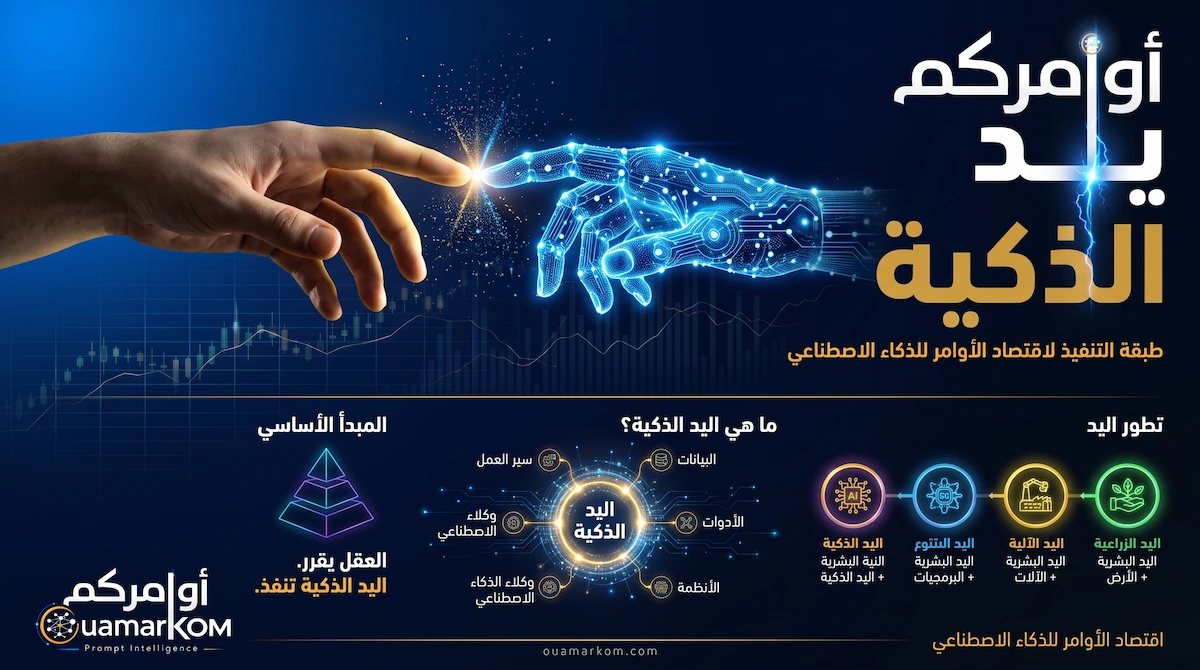
اليد الذكية: لماذا قد تتمحور الثورة الاقتصادية القادمة حول توجيه الذكاء بدلاً من تنفيذ العمل؟

بواسطة أوامركم - معمارية هندسة النوايا

مفهوم اليد الذكية في اقتصاد الأوامر وتوجيه الذكاء الاصطناعي الوكيلي

منذ بداية التاريخ الاقتصادي، ارتبط خلق القيمة بمن ينفذ العمل.

في المجتمعات الزراعية، كانت اليد البشرية تزرع وتحصد. وفي الثورة الصناعية، ضاعفت الآلات قدرة اليد على الإنتاج. وفي الاقتصاد الرقمي، أصبحت البرمجيات امتدادًا لقدرات العامل المعرفي، لكنها بقيت أدوات تحتاج إلى التشغيل والإدارة.

اليوم، ومع تطور الذكاء الاصطناعي الوكيلي (Agentic AI)، قد نكون أمام انتقال مختلف جذريًا.

فالسؤال لم يعد: كيف نجعل الإنسان يعمل بصورة أسرع؟

بل أصبح: من الذي سينفذ العمل الاقتصادي أصلًا؟

هذا السؤال يقود إلى مفهوم جديد داخل إطار اقتصاد الأوامر للذكاء الاصطناعي Command Economy of AI (CEAI) يمكن تسميته: The Smart Hand – اليد الذكية.

اليد الذكية ليست روبوتًا واحدًا، ولا نموذجًا لغويًا، ولا تطبيقًا بعينه. إنها استعارة اقتصادية تصف طبقة التنفيذ الذكي التي تربط بين الأهداف البشرية والنتائج الاقتصادية. فهي تمثل شبكة من الوكلاء الذكيين، والأنظمة، وسير العمل، والبنية التحتية القادرة على تحويل النية إلى تنفيذ.

«The Mind Decides. The Smart Hand Executes.
العقل يقرر، واليد الذكية تنفذ.»

في هذا التصور، لا يتراجع دور الإنسان، بل يعاد تعريفه. فعبر التاريخ كان الإنسان يفكر وينفذ في الوقت نفسه. أما في اقتصاد الأوامر، فقد يبدأ الانفصال بين هاتين الوظيفتين. يحتفظ الإنسان بالعقل الذي يحدد الاتجاه، بينما تتولى اليد الذكية تنفيذ الجزء الأكبر من العمليات التشغيلية.

هذا التحول لا يغير طريقة استخدام التكنولوجيا فحسب، بل قد يغير طبيعة الإدارة نفسها.

في المؤسسة التقليدية، يقضي المدير جزءًا كبيرًا من وقته في تنسيق الأشخاص، ومتابعة العمليات، وتوزيع المهام، ومراقبة التنفيذ. أما في المؤسسة المدعومة باليد الذكية، فقد يبدأ يوم العمل بسؤال واحد: "ما النتيجة التي نريد تحقيقها؟"

بعدها تقوم منظومة التنفيذ الذكية بتحليل البيانات، وبناء الخطة، وتوزيع المهام على الوكلاء، ومراقبة الأداء، وتقديم التقارير، بينما يركز المدير على صياغة الأهداف، وتحديد الأولويات، واتخاذ القرارات الاستراتيجية. وهنا تنتقل القيمة الاقتصادية من تنفيذ المهام إلى قيادة التنفيذ.

ولعل هذا يفسر لماذا قد تتغير الأسئلة داخل المؤسسات. بدلاً من السؤال:

  • من كتب التقرير؟
  • من صمم الحملة؟
  • من أعد التحليل؟

قد تصبح الأسئلة الاستراتيجية الناتجة:

  • من صاغ الهدف؟
  • من بنى السياق؟
  • من راجع النتائج؟
  • من يتحمل مسؤولية القرار؟

إنها ليست مجرد أتمتة، بل إعادة توزيع للأدوار داخل المؤسسة.

توضيح مشهدي: نموذج قطاع التجارة الإلكترونية

ولنأخذ مثالًا من قطاع التجارة الإلكترونية. إذا أرادت شركة اليوم زيادة معدل التحويل بنسبة 15%، فإنها غالبًا تشكل فريقًا من التسويق، وتحليل البيانات، والتصميم، والإعلانات، ويستغرق التنفيذ أسابيع.

أما مع اليد الذكية، فيمكن للمدير أن يحدد هدفًا واحدًا ومباشراً:

"ارفع معدل التحويل بنسبة 15% خلال الربع القادم مع الحفاظ على هامش الربح."

ثم تبدأ منظومة التنفيذ الذكية بتحليل سلوك العملاء، واختبار الأسعار، وإنشاء الحملات، وتحسين الإعلانات، وقياس النتائج بصورة مستمرة. في هذه الحالة، لم يعد المدير هو منفذ العمليات، بل أصبح قائدًا لمنظومة تنفيذ تعمل بصورة شبه مستقلة.

الامتداد الشامل للأنظمة: يتكرر المشهد في المستشفيات، حيث يمكن للأنظمة الذكية تنظيم المواعيد وتلخيص السجلات ومتابعة نتائج الفحوصات بينما يركز الطبيب على القرار الطبي. وفي المصانع، قد تراقب اليد الذكية خطوط الإنتاج وتتوقع الأعطال وتدير سلاسل الإمداد، بينما يركز المدير على التوسع والاستراتيجية.

كل هذه الأمثلة تشير إلى فكرة واحدة: كلما أصبحت الأنظمة أكثر قدرة على التنفيذ، أصبحت قيمة الإنسان أكثر ارتباطًا بقدرته على صياغة الأهداف. ومن هنا قد تظهر مهارات جديدة تصبح من أهم أصول الاقتصاد القادم:

  • تصميم الأهداف (Objective Design): تحديد الغايات الاستراتيجية والنهائية للمنظومات الذكية.
  • بناء السياق (Context Engineering): تزويد الوكلاء بالحدود والبيانات التي تضمن دقة العمل.
  • الإشراف على التنفيذ (Execution Supervision): مراقبة الأداء العام ومسارات التسيير الذاتي.
  • تقييم النتائج (Outcome Evaluation): التأكد من مطابقة مخرجات اليد الذكية للرؤية البشرية.

الأثر الاقتصادي وإعادة تعريف العمل

ومن المنظور الاقتصادي، قد يؤدي انتشار اليد الذكية إلى نتائج واسعة النطاق؛ فقد ترتفع إنتاجية الفرد الواحد لأنه يستطيع إدارة عشرات الوكلاء الذكيين في الوقت نفسه، وقد تنتقل الشركات من شراء أدوات منفصلة إلى شراء منصات تنفيذ متكاملة، تزامناً مع ظهور عناوين وظيفية جديدة تماماً في سوق العمل كـ (مدير الوكلاء الذكيين، مهندس السياق، ومصمم الأهداف).

لكن الأهم من ذلك كله أن مفهوم العمل نفسه قد يعاد تعريفه. فالإنسان لن يفقد دوره لأنه لم يعد ينفذ كل خطوة بنفسك، بل لأن دوره يصبح أكثر ارتباطًا بما لا تستطيع الأنظمة الذكية تحديده وحدها:

  • ما الهدف الصحيح؟
  • ما الأولوية؟
  • ما الحدود الأخلاقية والقانونية؟
  • ما مستوى المخاطرة المقبول؟

تبقى هذه الأسئلة في يد الإنسان، لأنها تتعلق بالمسؤولية والحوكمة والقيم، لا بالتنفيذ فقط. لهذا، فإن اليد الذكية ليست بديلًا عن الإنسان، بل هي امتداد متكامل لقدراته العقلية والاستراتيجية.

خاتمة

ضمن إطار Command Economy of AI (CEAI)، تمثل The Smart Hand طبقة التنفيذ الفعلي التي تجعل الاقتصاد القائم على الأوامر ممكناً عملياً. فإذا كان اقتصاد الأوامر يصف كيف تتحول النية إلى تنسيق اقتصادي، فإن اليد الذكية تصف كيف تتحول تلك النية إلى نتائج ملموسة وقابلة للقياس.

قد لا تكون الثورة الاقتصادية القادمة هي ثورة في الذكاء نفسه، بل ثورة في الطريقة التي يُستخدم بها الذكاء لتنفيذ العمل. وعندما تصبح القدرة على توجيه منظومات التنفيذ أهم من القدرة على تنفيذ كل مهمة يدويًا، فقد نكون بالفعل أمام بداية اقتصاد جديد، لا يقوم على تشغيل الأدوات، بل على قيادة الذكاء.

ابنِ معمارية النوايا والأوامر لمؤسستك مع "أوامركم"

إن الدلالة الأعمق لثورة اليد الذكية هي أن الكلمة الدقيقة والصياغة الموجهة أصبحت أصولاً إنتاجية حقيقية. بصفتنا المنصة الرائدة والأولى لهندسة وتداول أنظمة التشغيل القائمة على اللغة، تم تصميم "أوامركم" لتساعدك على تحويل خبراتك الاستراتيجية، وأطر عمل الأوامر، ومنطق تنسيق الوكلاء إلى أصول اقتصادية قابلة للتوسع اللانهائي.

أسس بنيتك التحتية لاقتصاد الأوامر الآن

أوامركم - السوق الأول والمنصة الرائدة لطبقة اقتصاد الأوامر. 🚀
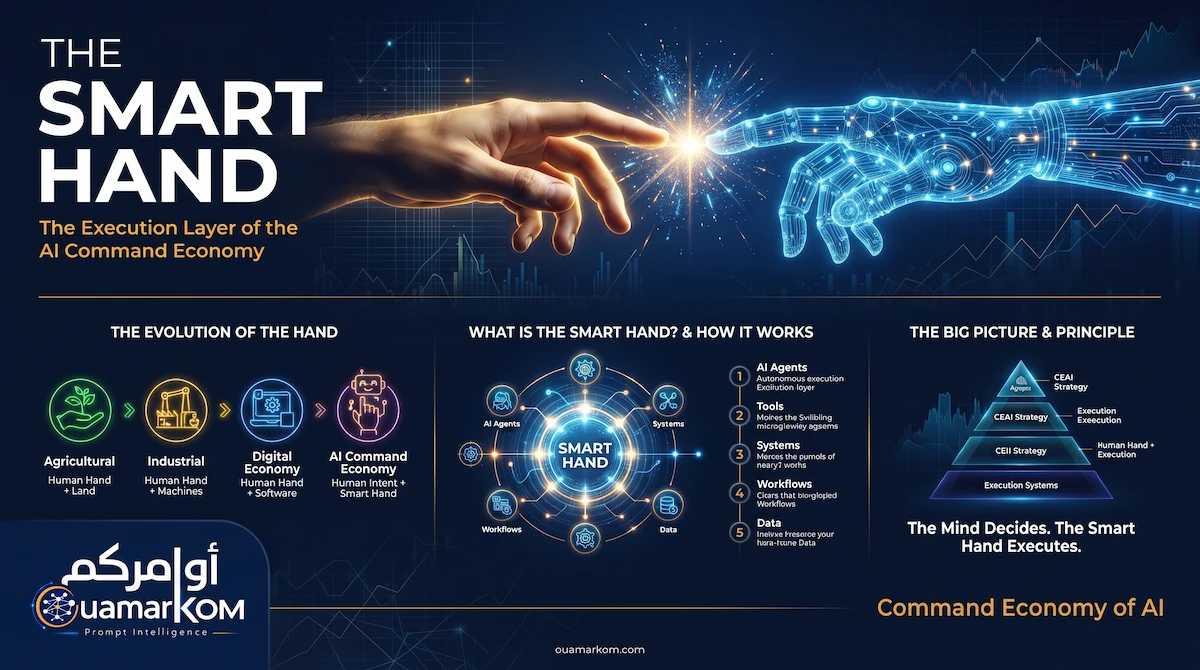
The Smart Hand: Why the Next Economic Revolution May Be About Directing Intelligence Instead of Performing Work

By Ouamarkom - The Architecture of Intention

The Concept of The Smart Hand in the Command Economy of AI and Agentic Orchestration

Throughout economic history, value creation has been fundamentally tied to those who perform the work.

In agricultural societies, human hands cultivated the land and harvested crops. During the Industrial Revolution, machines amplified the productive capacity of human labor. In the digital economy, software extended the capabilities of knowledge workers, yet it remained a collection of tools that people had to operate, manage, and coordinate.

Today, with the rapid emergence of Agentic AI, we may be witnessing a fundamentally different transition.

The central question is no longer: How can we make humans work faster?

Instead, it is becoming: Who will perform economic work in the future?

This question leads to a new concept within the Command Economy of AI (CEAI) framework: The Smart Hand.

The Smart Hand is neither a single robot, nor a language model, nor a software application. It is an economic metaphor describing the intelligent execution layer that connects human objectives with measurable economic outcomes. It represents an interconnected network of AI agents, intelligent systems, workflows, digital infrastructure, and autonomous execution capabilities capable of transforming human intent into economic action.

«The Mind Decides. The Smart Hand Executes.»

Within this perspective, the role of humans is not diminished. Rather, it is fundamentally redefined. For thousands of years, humans both conceived ideas and executed them. In the Command Economy of AI, these two functions may gradually separate. Humans remain the source of judgment, strategy, ethics, and purpose, while The Smart Hand becomes the mechanism through which execution occurs.

This transformation extends far beyond technology; it may redefine the very nature of management.

Traditionally, managers spend much of their time coordinating people, assigning tasks, monitoring operations, resolving bottlenecks, and supervising execution. Within organizations empowered by The Smart Hand, the workday may begin with a single strategic question: What outcome are we trying to achieve?

From there, intelligent execution systems analyze data, generate plans, coordinate specialized AI agents, execute workflows, monitor performance, and continuously improve results. The manager's primary responsibility shifts toward defining objectives, establishing priorities, evaluating outcomes, and making strategic decisions. Economic value therefore begins to move away from performing tasks toward directing intelligent execution.

This shift also changes the questions organizations ask. Instead of asking:

  • Who wrote the report?
  • Who designed the campaign?
  • Who analyzed the data?

Organizations may increasingly ask:

  • Who defined the objective?
  • Who designed the context?
  • Who supervised execution?
  • Who accepted responsibility for the final decision?

It represents more than automation. It represents a redistribution of economic roles.

Visualizing the Paradigm: Product Launch Scenario

Consider an e-commerce company. Today, increasing conversion rates by 15% often requires coordination between marketing teams, analysts, designers, advertising specialists, and project managers over several weeks.

With The Smart Hand, leadership may simply define the desired objective:

"Increase conversion rates by 15% this quarter while maintaining current profit margins."

The intelligent execution layer can then analyze customer behavior, optimize pricing, generate marketing campaigns, perform A/B testing, adjust advertising strategies, and monitor results continuously. The executive is no longer responsible for executing every operational activity; instead, they direct an intelligent execution system.

Cross-Industry Transformation: The same transformation occurs across many industries. In healthcare, intelligent systems can organize appointments, summarize medical records, and identify clinical risks, allowing physicians to concentrate on diagnosis and patient care. In manufacturing, The Smart Hand can monitor production lines, predict equipment failures, and optimize schedules, while executives focus on long-term strategy and innovation.

Across every industry, the underlying principle remains consistent: As intelligent systems become increasingly capable of execution, human value becomes increasingly centered on defining meaningful objectives. Consequently, entirely new economic skills may emerge:

  • Objective Design: Structuring concrete goals for highly complex AI ecosystems.
  • Context Engineering: Supplying specific constraints and frameworks to maximize agent accuracy.
  • Execution Supervision: Overseeing structural flows and systemic metrics.
  • Outcome Evaluation: Critically judging and auditing automated deliverables against human values.

The Gravitational Shift of Value

From an economic perspective, widespread adoption of The Smart Hand could produce profound structural effects. Individual productivity may increase dramatically as one person becomes capable of directing dozens—or even hundreds—of specialized AI agents simultaneously. Organizations may gradually shift from purchasing isolated software tools toward acquiring integrated execution platforms.

Most importantly, the very definition of work may evolve. Human value will increasingly depend not on manually performing every task, but on answering questions that intelligent systems cannot determine independently:

  • What objective truly matters?
  • Which priorities should guide execution?
  • What ethical and legal boundaries must be respected?
  • What level of risk is acceptable?

These questions remain inherently human because they concern responsibility, governance, values, and strategic judgment. The Smart Hand therefore should not be understood as a replacement for human capability. Rather, it is an extension of it.

Conclusion

Within the broader Command Economy of AI (CEAI) framework, The Smart Hand represents the intelligent execution layer that makes an intent-driven economy operational. If the Command Economy of AI explains how human intent becomes economic coordination, then The Smart Hand explains how that coordination becomes measurable execution and economic value.

The next economic revolution may ultimately be defined not by artificial intelligence itself, but by how intelligence is directed, coordinated, and transformed into productive action. As the ability to orchestrate intelligent execution becomes more valuable than performing every task manually, humanity may be entering a new economic era—one built not upon operating tools, but upon directing intelligence itself.

Build Your Enterprise Intention Architecture with Ouamarkom

The deepest implication of this shift is that language itself is becoming a core productive asset. As the premier marketplace for language-based operating systems, Ouamarkom is engineered to help you turn strategic expertise, prompt frameworks, and agent orchestration logic into scalable economic assets.

Establish Your Command Infrastructure Now

Ouamarkom - The Premier Marketplace for the Command Economy. 🚀