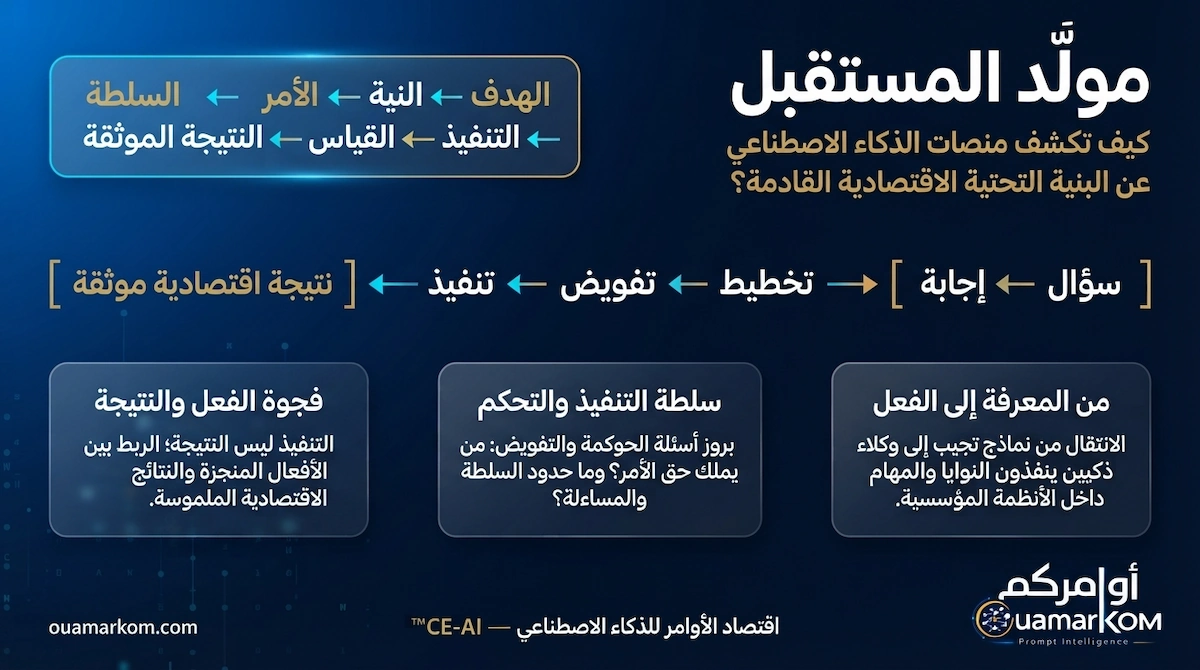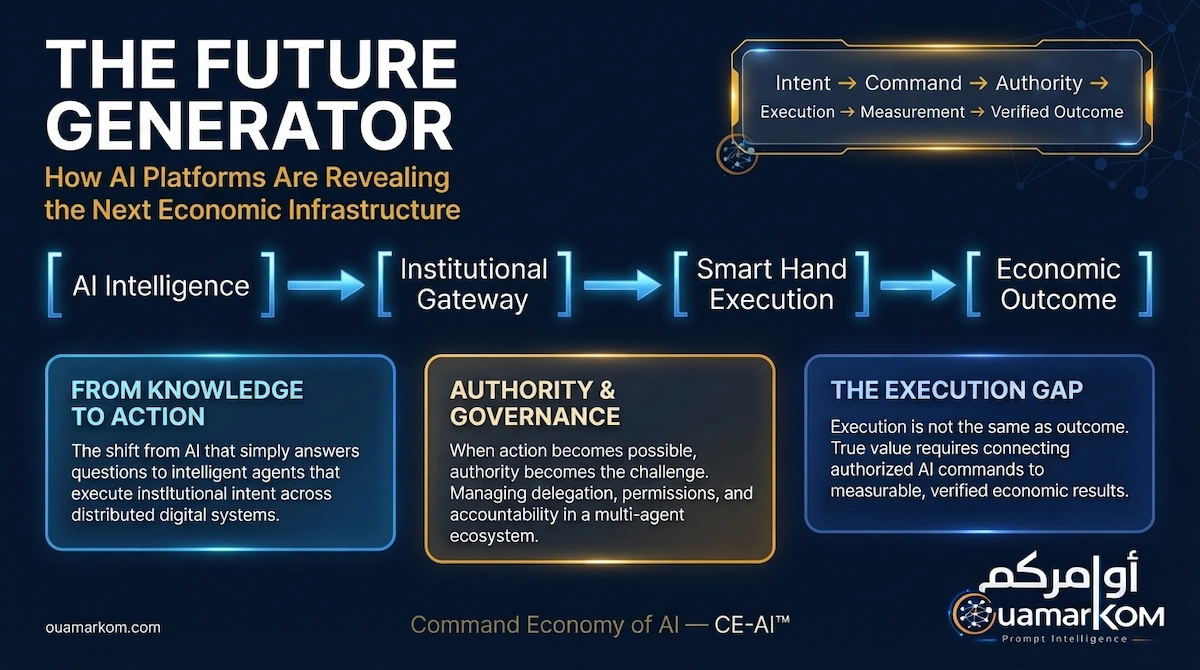
The transformation of artificial intelligence is no longer limited to improving machines’ ability to understand language or generate text, images, and software.
The more consequential economic shift is toward a world in which AI can execute intent, not merely interpret it or respond to it.
What happens when AI moves from being an information tool to becoming an actor capable of executing work across institutions, markets, and digital systems?
This may become one of the most consequential structural shifts in the digital economy over the coming decade.
Not simply because AI will become more intelligent, but because its ability to act may redefine the relationship between intent, decision, execution, and economic outcome.
From this perspective, the rapid expansion of enterprise AI platforms and intelligent agents can be viewed as an early signal that the world we are studying is beginning to take shape.
From AI That Answers to AI That Acts
The first phase of modern AI focused heavily on knowledge and information.
People asked questions, and systems produced answers.
Then models evolved to generate content, analyze data, write software, summarize documents, and support decisions.
The emergence of AI agents changes the equation.
Instead of:
we are moving toward:
Consider a simple executive objective:
In a traditional environment, that intent becomes meetings, reports, human decisions, and interaction with multiple operational systems.
In an agentic environment, the objective could potentially become a sequence of actions:
At that point, AI is no longer simply a knowledge engine.
It begins to approach the role of a digital economic actor.
And that is where a deeper problem emerges.
When Action Becomes Possible, Authority Becomes Part of the Problem
As AI becomes more capable of executing actions, it may seem that the problem is becoming easier.
From an institutional perspective, the opposite may happen.
The ability to act creates a new set of questions:
- Who has the authority to issue the instruction?
- Is the agent authorized to perform the operation?
- What are the limits of its delegation?
- What data can it access?
- What transaction value can it execute?
- When should a human intervene?
- How can the action be recorded?
- How can the institution prove that the action was authorized?
- And most importantly: Did the execution actually produce the intended economic outcome?
These are not merely questions about model intelligence. They are questions about the institutional architecture of execution.
The Market Signal: AI Is Moving Closer to Institutional Work
The developments emerging around LEAP 2026 in Riyadh provide a useful market signal for this transition.
Platforms such as HUMAIN are moving beyond models and compute toward broader enterprise environments spanning data, cloud infrastructure, models, agents, applications, and workflows.
Products such as HUMAIN Fabric, HUMAIN ONE, and HUMAIN Crew illustrate a broader direction: bringing AI into the institutional operating environment, connecting intelligence to enterprise data and workflows, and enabling AI systems to perform increasingly real tasks.
These developments do not prove Ouamarkom’s thesis.
But they provide something important at this stage: Evidence of market direction.
The technical and economic components required for a world in which AI can execute institutional work are beginning to appear. That makes the underlying question increasingly testable.
When AI Becomes Distributed
The challenge becomes more significant when an organization does not operate through a single AI platform.
An enterprise may use one model provider, agents from another platform, an ERP from a different vendor, a separate CRM, a different cloud environment, and independent financial and banking systems.
In such an environment, the question is no longer simply: Can the agent execute the task?
It becomes: How do we ensure that agents and systems operate within a unified institutional framework of authority, policy, and accountability?
This complexity may increase as enterprise AI becomes:
AI itself may become distributed across a heterogeneous technological and economic environment.
This leads to a deeper hypothesis: If AI becomes distributed, institutions may need a way to manage distributed execution.
That mechanism may not necessarily be a standalone product. It may never become an independent software layer. But the question is worth testing.
Command Economy of AI: When Intent Becomes a Unit of Economic Coordination
This is where the Command Economy of AI (CE-AI™) framework begins.
The idea is not that language will replace money, or that commands will literally become a new currency.
A more precise interpretation is that human intent expressed through natural language may become an increasingly important operational interface for coordinating economic activity.
An economic instruction can begin as:
In this sense, Command Economy of AI can be viewed as a framework for understanding a transition from an economy in which software primarily responds to direct human interaction toward one in which humans increasingly delegate execution to intelligent systems.
This is not merely a technical problem. It is an economic and institutional one.
What Happens Between Capability and Outcome?
This is where the deeper research question emerges.
A system may have an advanced model. An agent may have the ability to use tools. It may have defined permissions. It may connect to enterprise systems and execute workflows.
But: Execution is not the same as Outcome.
Executing a procurement order, for example, does not necessarily mean that the organization achieved its economic objective.
An action may be authorized but inefficient. It may be technically correct but strategically misaligned. The transaction may succeed while its economic impact remains difficult to prove.
This leads to a more fundamental question: How do we connect an action executed by AI to the economic outcome that action was intended to produce?
This suggests a broader sequence:
This is not presented as a final architecture. It is a research hypothesis about the functions institutions may require as AI systems become capable of acting at scale.
What Is Ouamarkom Testing?
Ouamarkom is not simply testing a world with better chatbots.
It is testing a world in which the following sequence becomes a normal part of institutional activity:
Historically, the process was closer to:
Human decides ↓
Human uses software ↓
Software executes
The world being studied by Ouamarkom is closer to:
AI interprets intent ↓
AI plans ↓
AI invokes agents and tools ↓
AI executes across systems ↓
The institution governs and monitors ↓
The economic outcome is measured and verified
That is the world Ouamarkom is testing.
The Real Bet
The real bet is not making Command Economy of AI a widely recognized term.
Nor is it giving Smart Hand™ the title of a new infrastructure layer.
The real bet is discovering whether an AI-driven economy will create a new institutional problem that individual platforms cannot efficiently solve when actions are distributed across models, agents, and systems.
That is why the philosophy of the project can be summarized in four principles:
- Defend the problem.
- Test the architecture.
- Measure the outcome.
- Let the market decide whether it deserves to become infrastructure.
The market is building increasingly capable AI actors.
Ouamarkom does not need to claim that it already knows the final architecture.
It only needs to ask the question that may become increasingly important with every step in AI’s evolution:
If the answer is simply another feature inside an existing platform, the experiments should reveal that.
But if a recurring, vendor-independent, generalizable problem emerges with clear economic value, Smart Hand may be more than a product. It may become the beginning of a new infrastructure layer.
The Future Generator
The world Ouamarkom is testing is no longer merely a future scenario.
The technical and economic conditions that make it possible are beginning to emerge in the market.
That does not prove the thesis. But it makes the thesis practically testable.
We are not assuming that an independent AI execution layer must exist. We are testing whether increasing AI agency, platform heterogeneity, and institutional complexity create enough economic value to make such a layer necessary.
This clarifies the role of Ouamarkom:
We are building the tools to test whether this future needs a new layer.
If the market demonstrates that this function can remain efficiently embedded within existing platforms, that is a result worth respecting.
If experimentation shows that institutions require an independent function for controlling execution, delegating authority, coordinating across agents and systems, and verifying outcomes, then we may be looking at a new structural function in the digital economy.
That is why the central question is not:
It is:
The future may not simply be an economy that relies more heavily on AI. It may be an economy in which AI itself increasingly participates in executing economic intent.
And the question that will shape that future is not only what AI can do. It is:
That is where the next economic infrastructure begins.
Ouamarkom™
Building the Infrastructure for AI-Executed Economies.
Establish Your Execution Infrastructure Now