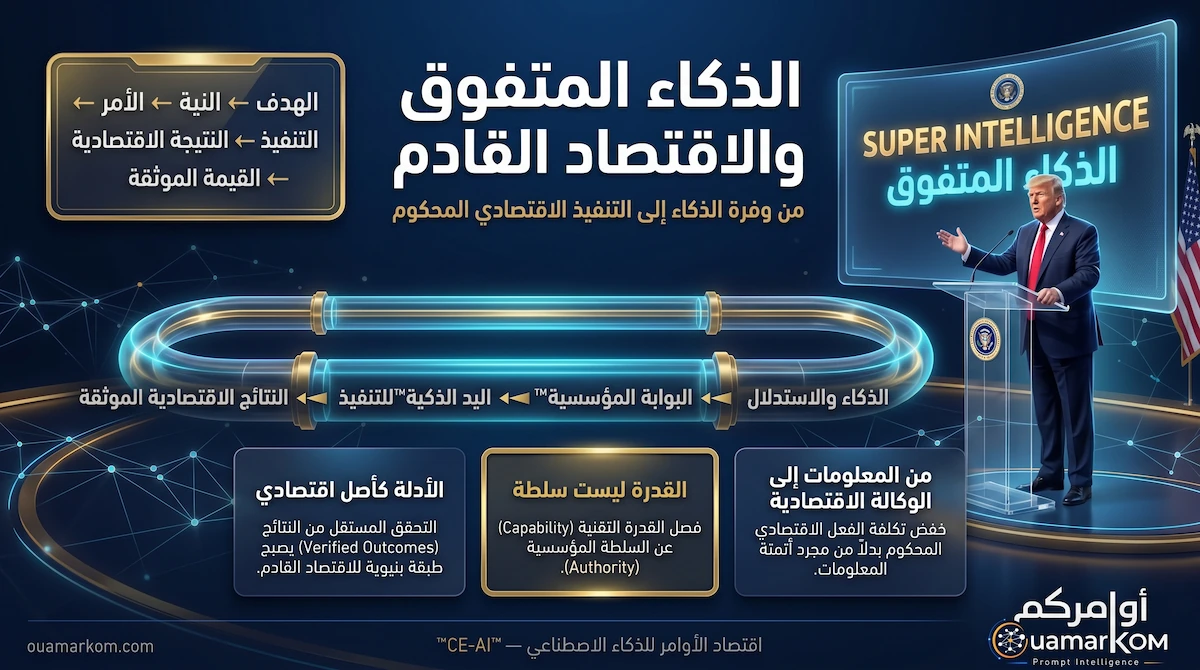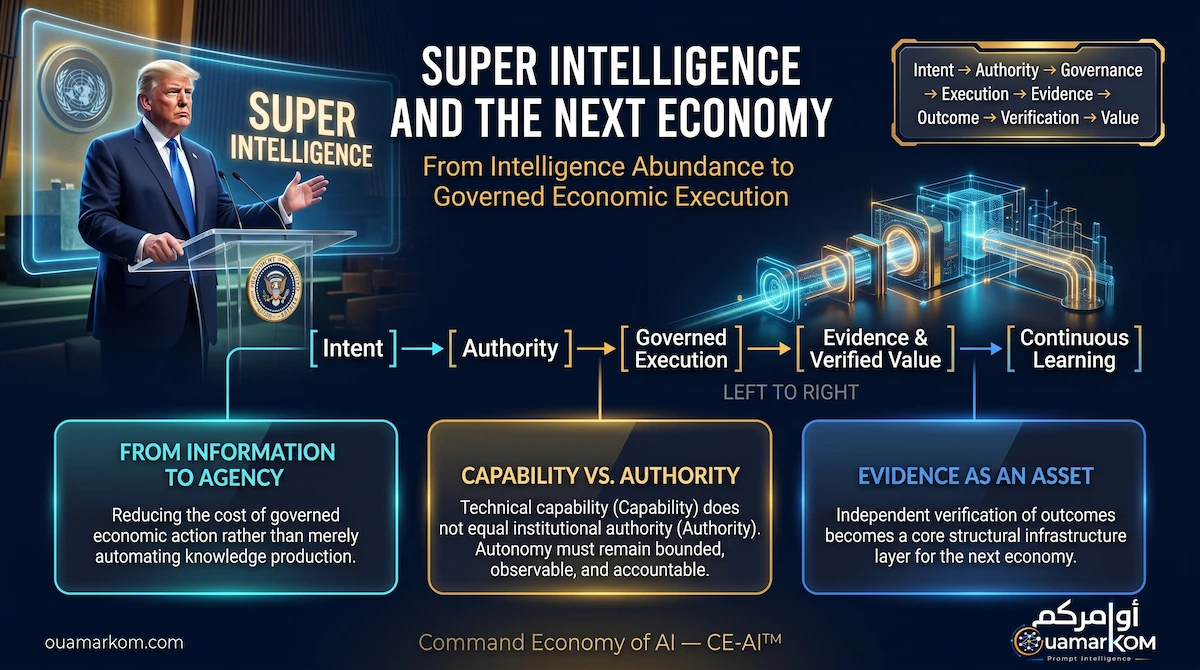
On September 22, 2026, U.S. President Donald Trump announced during his address to the United Nations General Assembly that Artificial Intelligence (AI) would henceforth be called Super Intelligence, describing it as a change in terminology that he said would be adopted officially, including in U.S. documents.
But changing the name is not the most important transformation.
The deeper question is:
As intelligence moves closer to the ability to act, the question is no longer simply how intelligent a system is.
A new economic question begins to emerge:
This opens a broader question: how can intelligence become authorized economic action, governed execution, measurable outcomes, verifiable value, and continuous learning?
For decades, economic progress has been driven by expanding access to capital, labor, resources, information, computing, and technology. With AI, a new layer of productive capacity has begun to emerge: scalable intelligence.
As these capabilities continue to develop, a deeper economic question comes into view: What happens when intelligence itself becomes more abundant, more capable, faster, less costly, and able to participate in economic activity?
The Core Thesis
The economic significance of superior intelligence will not be determined by intelligence alone. It will be determined by the ability of systems and institutions to convert increasingly capable intelligence into authorized economic action, governed execution, measurable outcomes, verifiable value, and continuous learning.
This could create a fundamental economic transition: from an economy in which AI primarily supports human decision-making to one in which increasingly capable intelligent systems participate directly in economic execution within clearly defined boundaries of authority and governance.
The economic question may therefore gradually shift from:
to:
This distinction matters because intelligence does not automatically become economic value.
- A system can be highly capable without being authorized to act.
- It can be authorized to act while remaining constrained by financial, legal, or operational boundaries.
- It can execute an action successfully without producing the intended economic outcome.
- And an outcome can occur without demonstrating that the system caused it.
The emerging economic architecture therefore needs to connect:
This may be one of the deeper economic transformations associated with the emergence of increasingly capable intelligent systems.
From Information to Economic Agency
The internet produced a profound transformation by reducing the cost of accessing and exchanging information. AI introduced another transformation by reducing the cost of producing, analyzing, and processing knowledge. The next potential transformation concerns what happens when intelligence becomes capable of participating directly in economic activity.
Information alone does not create economic value. Intelligence alone does not automatically create value either.
Value emerges when intelligence can influence decisions, participate in execution, produce measurable outcomes, and operate within systems capable of defining authority, responsibility, and boundaries.
The relationship can be represented as:
• Information provides the raw material.
• Intelligence interprets and reasons over it.
• Decision determines what should be done.
• Authority determines what may be done.
• Execution changes the economic environment.
• Outcome measures what actually happened.
• Verification determines whether the outcome can be trusted.
• Value emerges when the result is economically meaningful and attributable.
This suggests a potentially important economic shift: As intelligence becomes more abundant, governed economic execution may become increasingly important.
Intelligence as a New Factor of Production
Traditional economic production relies on combinations of labor, capital, resources, technology, and organizational capability. Advanced AI introduces another form of productive capacity: scalable cognitive capability.
A small organization may increasingly gain access to analytical, programming, research, marketing, forecasting, and operational capabilities that previously required large human teams.
Intelligent systems can operate continuously, process large quantities of information, compare multiple scenarios, and assist with increasingly complex decisions.
If these capabilities continue to develop, intelligence may become more than software or a tool. It may become a layer of productive infrastructure for the economy.
Yet this development creates an important distinction:
- A system may be capable of making a decision without being authorized to execute it.
- It may be authorized to execute, but only within defined boundaries.
- It may execute an action successfully without being able to demonstrate its economic impact.
Therefore, the economic significance of advanced intelligence cannot be understood through intelligence alone. It must be understood through the relationship between: Intelligence, Authority, Execution, Evidence, and Outcome.
From Intelligent Assistant to Economic Participant
The early image of AI was that of an assistant. It answers questions, generates text, summarizes information, writes software, analyzes documents, and recommends decisions.
The next stage may be more economically significant: intelligent systems participating directly in real economic workflows.
Consider a company giving an intelligent system a simple objective:
A conventional AI assistant might analyze customer data and recommend a strategy. A more capable economic system could potentially identify opportunities, propose a pricing adjustment, verify whether the action is authorized, request additional authorization when necessary, execute the permitted action, monitor the results, measure the economic impact, and provide the supporting evidence.
At that point, AI is no longer producing information alone. It has become part of an economic loop:
The distinctions are fundamental:
- A command does not automatically constitute authority.
- A recommendation does not constitute execution.
- Execution does not constitute an outcome.
- An outcome does not automatically constitute verified value.
- And learning does not mean that the system has acquired new authority.
These distinctions may become fundamental principles in the architecture of AI-enabled economies.
Capability Is Not Authority
One of the most important principles for an economy increasingly shaped by intelligent systems may be the separation between:
A system may technically be capable of purchasing $1 million of inventory while being authorized to spend only $10,000. It may be capable of changing thousands of prices while being authorized to modify them by no more than 5%. It may be capable of drafting and negotiating a contract while lacking authority to alter legal terms or sign the agreement.
The gap between capability and authority is not necessarily a limitation that should be eliminated. It may be an essential feature of future institutional design.
As intelligent capabilities increase, institutions may need to define increasingly precise questions:
- Who delegated the system?
- What is the scope of that delegation?
- What are the financial limits?
- What risks are acceptable?
- When is human approval required?
- Which actions can be executed automatically?
- What must be recorded?
- How can an action be stopped or reversed?
This leads to a simple institutional principle: Technical capability does not automatically confer economic authority.
The Rise of the Execution Economy
If intelligence becomes more abundant, part of economic competition may shift from possessing the ability to produce decisions toward the ability to convert those decisions into reliable execution.
The question may move from: “Who has the most capable model?” to a broader set of questions:
- Who can connect intelligence to real economic systems?
- Who can manage delegated authority?
- Who can execute decisions within clearly defined boundaries?
- Who can measure outcomes?
- Who can produce evidence?
- Who can verify economic value?
- And who can allow systems to learn and adapt without allowing learning to become uncontrolled expansion of authority?
This creates the possibility of a new infrastructure layer between intelligence and the economy.
From Models to Economic Systems
The future of AI may therefore depend on more than the performance of individual models. Economic systems require identity, permissions, policies, financial limits, approvals, escalation mechanisms, records, evidence, measurement, verification, and accountability.
In other words, as intelligence becomes more capable, the institutional environment in which it operates may become increasingly important. This is where the concept of Governed Economic Agency becomes relevant.
Governed Economic Agency can be understood as the ability of intelligent systems to participate in economic action under delegated authority, explicit boundaries, enforceable constraints, observable execution, and verifiable outcomes.
This is different from simply making AI “autonomous.” The deeper question is: How can intelligence become economically consequential without making authority ambiguous?
The Human Role in the Next Economy
This transformation does not necessarily mean the disappearance of human involvement. It may mean a change in its nature.
As intelligent systems become capable of performing more operational tasks, humans may gradually move from executing every decision toward designing the environment in which decisions are made and executed:
- From manually issuing every instruction to defining objectives.
- From approving every operation to defining approval thresholds.
- From monitoring every step to designing escalation mechanisms.
- From performing every operation to determining who has the authority to perform it.
One of the most important human roles in the next economy may therefore become engineering the boundaries of decision and authority.
Verification May Become an Economic Layer
In conventional software, it is often possible to determine whether a technical operation succeeded. Economic execution is more complex.
- A transaction may occur without producing the intended outcome.
- A campaign may generate sales without proving what caused the increase.
- A price increase may raise revenue while reducing profit margins.
- And a decision may appear successful in one market but fail when applied in another context.
Therefore, evidence and verification may become an essential part of the infrastructure of an AI-enabled economy. The questions become:
- Was the decision within its authorized scope?
- Was the action executed as authorized?
- What actually happened?
- What was the economic outcome?
- Can it be measured?
- Can the causal relationship be supported?
- Can the result be reproduced?
- Can the system learn from it?
Verification may therefore move from being a downstream auditing activity to becoming a potential layer of the economic infrastructure itself.
The Intelligence-to-Execution Gap
The most important economic consequence of increasingly capable intelligence may not be intelligence itself. It may be the gap between what intelligence can determine and what economic systems can safely allow it to execute.
An intelligent system may generate thousands of high-quality decisions while only a fraction can be authorized. A larger fraction may be technically executable but economically undesirable. Some actions may occur without sufficient evidence. Some outcomes may be measurable without being clearly attributable. And learning may improve system performance without granting the system the right to expand its own authority.
This creates an important research and economic question: The intelligence-to-execution gap.
The future of the economy may therefore depend not only on increasing machine intelligence, but on building the technical, institutional, and economic infrastructure capable of converting that intelligence into trusted outcomes.
From Artificial Intelligence to Intelligence with Economic Impact
The terminology surrounding AI may continue to evolve: Artificial Intelligence, Advanced Intelligence, Superior Intelligence, Superintelligence. But terminology alone does not establish an economic transformation.
The deeper question is: What happens when increasingly capable intelligence enters real economic systems?
This question takes us beyond model performance toward:
This is where the contours of a new economic architecture may begin to emerge.
The defining transition may not simply be from less intelligent machines to more intelligent machines. It may be from intelligence that provides information to support economic decisions to intelligence that participates in economic execution under governed authority and observable, verifiable conditions.
Conclusion
The next economy may be shaped by a fundamental paradox: Intelligence may become increasingly abundant while the ability to convert it into trusted economic execution remains constrained by authority, governance, infrastructure, evidence, and verification.
The central economic question may therefore change. Not simply: How do we build more intelligent systems? But: How do we build economic systems that allow increasingly capable intelligence to create value responsibly, measurably, verifiably, and under clearly defined authority?
This question sits at the intersection of AI, economics, governance, infrastructure, and institutional design.
The future may not be determined simply by who possesses the most capable intelligence. It may increasingly depend on who can build the systems that transform intelligence into:
This points to a potential transition: From an economy powered by intelligence to an economy organized around governed intelligence-to-execution loops.
The terminology may change. The models may evolve. The capabilities may expand. But the fundamental economic question remains:
That question may become one of the defining infrastructure questions of the next economy.
Ouamarkom™
Ouamarkom researches the infrastructure that the superior intelligence economy may require.
Explore Ouamarkom Research