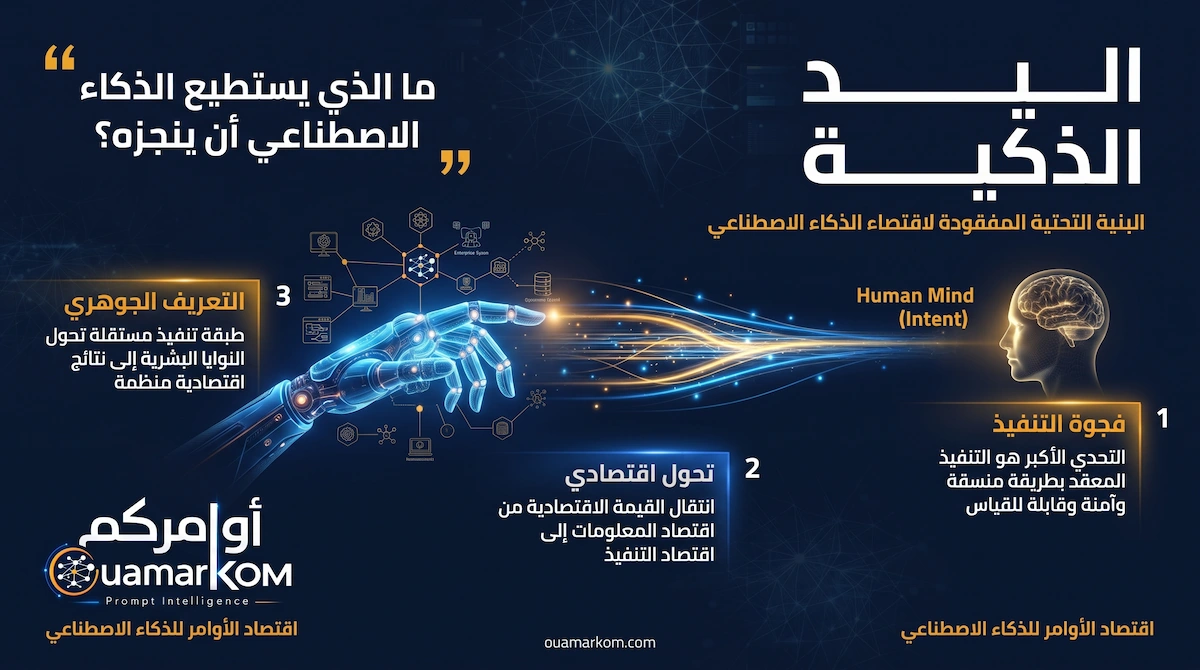
اليد الذكية: البنية التحتية المفقودة لاقتصاد الذكاء الاصطناعي

لماذا قد يكون التحدي الحقيقي للذكاء الاصطناعي هو التنفيذ وليس الذكاء؟

بواسطة أوامركم - معمارية هندسة النوايا

مفهوم اليد الذكية في اقتصاد الذكاء الاصطناعي والتنفيذ الذكي

على مدار التاريخ، لم تُقاس الثورات الاقتصادية بعدد الابتكارات التي أنتجتها، بل بقدرتها على تغيير طريقة العمل وخلق القيمة. فقد أعادت الثورة الصناعية تعريف الإنتاج من خلال الآلات، وأعادت الثورة الرقمية تعريفه عبر البرمجيات والإنترنت، أما اليوم، فإن الذكاء الاصطناعي يقود العالم نحو مرحلة جديدة تتجاوز إنتاج المعرفة إلى تنفيذ الأعمال.

ورغم القفزات الهائلة التي حققتها النماذج اللغوية ووكلاء الذكاء الاصطناعي، فإن التحدي الأكبر لم يعد تتمثل في قدرة الأنظمة على التفكير أو الإجابة، بل في قدرتها على تنفيذ الأعمال المعقدة داخل المؤسسات بطريقة منسقة وآمنة وقابلة للقياس.

ومن هنا تبرز فكرة "اليد الذكية" (The Smart Hand) بوصفها مفهومًا لبنية تحتية تنفيذية يمكن أن تصبح إحدى الطبقات الأساسية في الاقتصاد المعتمد على الذكاء الاصطناعي.

من اقتصاد المعلومات إلى اقتصاد التنفيذ

خلال العقود الماضية، ركز الاقتصاد الرقمي على الوصول إلى المعلومات. كانت محركات البحث، وقواعد البيانات، ومنصات البرمجيات تهدف إلى مساعدة الإنسان على العثور على المعرفة واتخاذ القرار.

لكن مع تطور الذكاء الاصطناعي، بدأت القيمة الاقتصادية تتحرك تدريجيًا من إنتاج المعرفة إلى تنفيذها.

فالمدير التنفيذي لم يعد يبحث فقط عن تقرير يشرح المشكلة، بل عن نظام يستطيع تنفيذ الحل، ومتابعة نتائجه، وتحسينه بصورة مستمرة.

وهذا التحول يعكس انتقالًا من اقتصاد يعتمد على الوصول إلى المعلومات، إلى اقتصاد يعتمد بصورة متزايدة على تنسيق التنفيذ الذكي.

الذكاء وحده لا يكفي

تمتلك النماذج اللغوية الحديثة قدرات متقدمة في التحليل والاستنتاج وتوليد المحتوى، إلا أن معظمها يعمل بوصفه طبقة معرفية.

فهي تستطيع اقتراح خطة تسويقية، أو تحليل تقرير مالي، أو كتابة سياسة تشغيل، لكنها لا تتحمل بمفردها مسؤولية تنفيذ تلك الخطط داخل بيئات العمل المعقدة.

في المؤسسات الحديثة، يتطلب التنفيذ الحقيقي تنسيق أنظمة متعددة، ووكلاء متخصصين، وبيانات موزعة، وسياسات حوكمة، ومراقبة مستمرة للنتائج.

وهنا تظهر ما يمكن تسميته فجوة التنفيذ (Execution Gap)؛ وهي الفجوة بين معرفة ما ينبغي القيام به، وبين القدرة على تحويل تلك المعرفة إلى نتائج اقتصادية قابلة للقياس.

ما هي اليد الذكية؟

«يمكن تعريف اليد الذكية بأنها: طبقة تنفيذ مستقلة تنسق عمل وكلاء الذكاء الاصطناعي، وتربطهم بالأنظمة والبيانات، وتطبق الحوكمة، وتقيس النتائج، بهدف تحويل النوايا البشرية إلى تنفيذ اقتصادي منظم وقابل للتحسين.»

وبهذا المعنى، فهي ليست نموذجًا لغويًا جديدًا، ولا وكيلًا منفردًا، ولا تطبيقًا إضافيًا، بل طبقة تشغيل تقع بين الإنسان والأنظمة التنفيذية.

إذا كانت النماذج اللغوية تمثل "العقل"، فإن اليد الذكية تمثل المنظومة التي تنقل هذا العقل من التفكير إلى الفعل.

كيف تعمل؟

لنفترض أن الرئيس التنفيذي لشركة يقول:

«"أريد زيادة الإيرادات بنسبة 20% خلال الربع القادم."»

في النموذج التقليدي، يحصل على تقرير أو قائمة من التوصيات.

أما في نموذج اليد الذكية، فتبدأ دورة تنفيذ متكاملة.

تقوم الطبقة التنفيذية بتفسير الهدف، ثم توزيع المهام على وكلاء متخصصين؛ أحدهم لتحليل بيانات العملاء، وآخر لدراسة المنافسين، وثالث لتحسين التسعير، ورابع لإدارة الحملات التسويقية، مع ربط جميع الوكلاء بأنظمة المؤسسة مثل إدارة علاقات العملاء (CRM)، والتخطيط المؤسسي (ERP)، وأدوات التحليل.

وفي الوقت نفسه، تتابع مؤشرات الأداء، وتقارن النتائج بالأهداف، وتقترح تعديلات مستمرة عند الحاجة.

جوهر التحول: بدلًا من مجرد إنتاج المعرفة، تنسق المنظومة عملية التنفيذ كلياً؛ وبهذا تصبح النية هي نقطة البداية، والتنفيذ هو القيمة الحقيقية.

لماذا قد تمثل هذه الطبقة فرصة اقتصادية؟

في تاريخ التكنولوجيا، ظهرت موجات من الشركات بنت قيمتها على إنشاء طبقات أساسية مكّنت الآخرين من الابتكار.

  • بروتوكولات الإنترنت: مكنت اقتصاد الويب.
  • الحوسبة السحابية: مكنت الاقتصاد الرقمي الحديث وروافد البرمجيات.
  • أنظمة المدفوعات الرقمية: وفرت البنية الأساسية للتجارة الإلكترونية.

ومع انتشار وكلاء الذكاء الاصطناعي، قد تظهر الحاجة إلى طبقة مشابهة تنظم العلاقة بين الإنسان، والوكلاء، والأنظمة.

وإذا أصبحت المؤسسات تعتمد على عشرات أو مئات الوكلاء الذكيين، فإن التحدي لن يكون في امتلاك الوكلاء أنفسهم، بل في تنسيقهم، وإدارة صلاحياتهم، وربطهم بالأنظمة، وقياس أثرهم الاقتصادي.

وهنا يمكن أن تصبح البنية التحتية للتنفيذ سوقًا قائمة بذاتها ومستقلة تماماً.

اقتصاد الأوامر واليد الذكية

من المفيد التمييز بين المفهومين:

اقتصاد الأوامر للذكاء الاصطناعي (CEAI): يمثل إطارًا فكريًا يصف تحول اللغة الطبيعية إلى نقطة انطلاق للنشاط الاقتصادي، حيث تتحول النية البشرية إلى أوامر تشغيلية يمكن للأنظمة الذكية التعامل معها.

اليد الذكية (Smart Hand): هي المنتج أو البنية التحتية التي يمكن أن تجسد هذا الإطار عمليًا.

بعبارة أخرى، يشرح اقتصاد الأوامر سبب تغير الاقتصاد، بينما تقدم اليد الذكية تصورًا لـ كيفية تنفيذ هذا التغيير داخل المؤسسات. أحدهما إطار فكري، والآخر هو البنية التحتية المبنية عليه.

مستقبل المنافسة

قد لا تكون المنافسة في السنوات القادمة بين الشركات التي تمتلك أكبر نموذج لغوي فقط، بل بين الشركات التي تستطيع بناء أفضل طبقة تنفيذ.

فالنماذج ستستمر في التطور، والوكلاء سيزدادون تخصصًا، لكن المؤسسات ستحتاج دائمًا إلى طبقة تنسق هذا التنوع وتحوله إلى قيمة اقتصادية حقيقية.

ولهذا، قد تنتقل القيمة تدريجيًا من بيع أدوات الذكاء الاصطناعي إلى بيع القدرة على إدارة التنفيذ الذكي وتحقيق النتائج.

الخاتمة

يمر الذكاء الاصطناعي اليوم بمرحلة تشبه المراحل الأولى للحوسبة السحابية والويب؛ مرحلة تتشكل فيها الطبقات الأساسية التي ستحدد شكل الاقتصاد القادم.

وفي هذا السياق، يمكن النظر إلى "اليد الذكية" بوصفها تصورًا لبنية تحتية تنفيذية تهدف إلى سد الفجوة بين النية البشرية والتنفيذ الاقتصادي.

وسواء أصبح هذا المفهوم معيارًا واسع الانتشار أو اتخذ أشكالًا مختلفة مع تطور الصناعة، فإن الاتجاه العام يبدو واضحًا:

قيمة الذكاء الاصطناعي لن تُقاس فقط بقدرته على التفكير أو إنتاج المعرفة، ولا بما يستطيع قوله.. بل بقدرته على تحويل الأهداف إلى نتائج، والقرارات إلى أعمال، والنوايا إلى قيمة اقتصادية قابلة للقياس.

وفي نهاية المطاف، قد يكون السؤال الأهم في عصر الذكاء الاصطناعي ليس:
«"ما الذي يستطيع الذكاء الاصطناعي أن يعرفه؟"»

بل بالأحرى:
«"ما الذي يستطيع أن ينجزه؟"»

ابنِ معمارية النوايا والأوامر لمؤسستك مع "أوامركم"

إن الدلالة الأعمق لثورة اليد الذكية هي أن الكلمة الدقيقة والصياغة الموجهة أصبحت أصولاً إنتاجية حقيقية. بصفتنا المنصة الرائدة والأولى لهندسة وتداول أنظمة التشغيل القائمة على اللغة، تم تصميم "أوامركم" لتساعدك على تحويل خبراتك الاستراتيجية، وأطر عمل الأوامر، ومنطق تنسيق الوكلاء إلى أصول اقتصادية قابلة للتوسع اللانهائي.

أسس بنيتك التحتية لاقتصاد الأوامر الآن

أوامركم - السوق الأول والمنصة الرائدة لطبقة اقتصاد الأوامر. 🚀
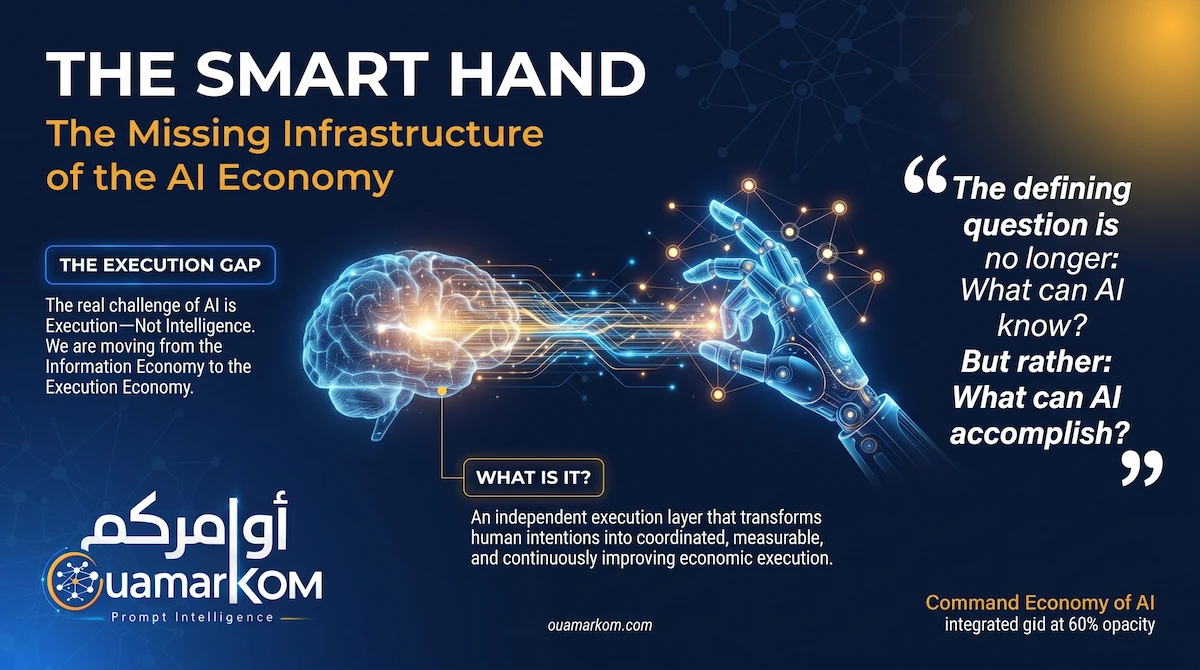
The Smart Hand: The Missing Infrastructure of the AI Economy

Why the Real Challenge of Artificial Intelligence May Be Execution—Not Intelligence

By Ouamarkom - The Architecture of Intention

The Concept of The Smart Hand in the AI Economy and Execution Layer

Throughout history, technological revolutions have not been defined solely by the innovations they introduced, but by their ability to reshape how economies create value. The Industrial Revolution transformed production through machines. The Digital Revolution redefined it through software and the internet. Today, artificial intelligence is driving the next transformation—one that extends beyond generating knowledge to executing work.

Despite the extraordinary advances in large language models and AI agents, the greatest challenge is no longer whether machines can think or answer questions. The real challenge is whether they can execute complex business operations in a coordinated, secure, and measurable way.

This is where the concept of the Smart Hand emerges—as an execution infrastructure that could become one of the foundational layers of the AI economy.

From the Information Economy to the Execution Economy

For decades, the digital economy focused on information access. Search engines, databases, and software platforms were designed to help people find knowledge and make better decisions.

With the rise of artificial intelligence, however, economic value is beginning to shift from generating knowledge to executing it.

Business leaders are no longer looking only for reports that explain problems. They increasingly seek systems capable of carrying out solutions, monitoring outcomes, and continuously improving performance.

This transition signals a broader economic shift—from an economy centered on information access to one increasingly driven by intelligent execution.

Intelligence Alone Is Not Enough

Modern language models possess remarkable capabilities in reasoning, analysis, and content generation. Yet, in most enterprise environments, they remain primarily cognitive systems.

They can propose marketing strategies, analyze financial reports, draft business policies, and answer sophisticated questions. But they do not, by themselves, execute those strategies across complex organizational environments.

True enterprise execution requires the coordination of multiple AI agents, business systems, distributed data sources, governance policies, and continuous performance monitoring.

This creates what may be called the Execution Gap—the gap between knowing what should be done and actually delivering measurable economic outcomes.

What Is the Smart Hand?

«The Smart Hand can be defined as: An independent execution layer that orchestrates AI agents, connects enterprise systems and data, enforces governance, and measures outcomes—transforming human intentions into coordinated, measurable, and continuously improving economic execution.»

In this sense, the Smart Hand is not another language model.

It is not a single AI agent.

It is not simply another software application.

Instead, it is an execution layer positioned between human intention and operational systems. If language models represent the brain, then the Smart Hand represents the infrastructure that turns intelligence into action.

How Does It Work?

Imagine a CEO stating:

«"Increase company revenue by 20% over the next quarter."»

In today's AI workflow, the response is often a report, a strategic plan, or a list of recommendations.

Within a Smart Hand architecture, however, that objective becomes the starting point of an execution cycle.

The system interprets the objective, decomposes it into operational tasks, assigns specialized AI agents, connects them to enterprise platforms such as CRM, ERP, analytics, and marketing systems, and continuously monitors execution against measurable business outcomes.

Core Impact: Instead of merely producing knowledge, the system coordinates execution. Human intention becomes operational reality.

Why Could This Become a Major Economic Opportunity?

History shows that many of the world's most valuable technology companies were built not around end-user applications, but around foundational infrastructure.

  • Internet Protocols: Enabled the web economy.
  • Cloud Computing: Enabled the software economy.
  • Digital Payment Networks: Enabled global e-commerce.

Likewise, the emerging AI Agent Economy may require a new foundational layer capable of coordinating intelligent agents, enterprise systems, governance, and execution.

As organizations increasingly rely on hundreds of specialized AI agents, competitive advantage may shift away from owning the agents themselves toward managing, orchestrating, and measuring their collective performance.

Execution infrastructure could therefore become an entirely new category within the AI economy.

The Command Economy of AI and the Smart Hand

It is important to distinguish between these two concepts:

The Command Economy of AI (CEAI): Is a conceptual framework describing how natural language intentions may become the starting point of economic activity, where human objectives are translated into executable digital operations.

The Smart Hand: By contrast, is the infrastructure designed to make that transformation possible.

Simply put: The Command Economy of AI explains why the economy is changing. The Smart Hand explains how that change can be executed. One is a thesis; the other is the infrastructure built upon that thesis.

The Next Competitive Frontier

The next generation of competition may not revolve around who owns the most powerful language model. Instead, it may revolve around who builds the most effective execution layer.

Language models will continue to improve, and AI agents will become increasingly specialized. But organizations will still require a trusted infrastructure capable of coordinating those systems, governing their behavior, and transforming distributed intelligence into measurable business outcomes.

The greatest value may therefore shift from selling AI tools to enabling intelligent execution.

Conclusion

Artificial intelligence appears to be entering a stage similar to the early days of cloud computing and the internet—when foundational infrastructure began shaping entire industries.

Within this transformation, the Smart Hand represents a vision for the execution infrastructure of the AI economy.

Whether this concept evolves into an industry standard or takes different forms over time, one trend appears increasingly clear:

The long-term value of artificial intelligence will not be measured solely by what it knows, nor by what it can say. It will ultimately be measured by what it can execute.

And perhaps the defining question of the AI economy will no longer be:
«"What can artificial intelligence know?"»

But rather:
«"What can artificial intelligence accomplish?"»

Build Your Enterprise Intention Architecture with Ouamarkom

The deepest implication of this shift is that language itself is becoming a core productive asset. As the premier marketplace for language-based operating systems, Ouamarkom is engineered to help you turn strategic expertise, prompt frameworks, and agent orchestration logic into scalable economic assets.

Establish Your Command Infrastructure Now

Ouamarkom - The Premier Marketplace for the Command Economy. 🚀