For years, the global race in artificial intelligence has revolved around a deceptively simple question:
Billions of dollars have been invested in models, computing, data, and infrastructure to make AI systems better at reasoning, planning, prediction, tool use, and increasingly complex forms of autonomous execution.
But as AI capabilities approach higher levels of intelligence, the more consequential economic question is changing.
It is no longer sufficient to ask: Can the system perform the task?
We must also ask:
These are not secondary questions in a future shaped by increasingly capable AI.
They may become among the defining infrastructure questions of the next phase of the digital economy.
From Intelligence to Economic Action
Traditional AI has largely functioned as an information technology.
A user asks a question, and the system responds. A manager provides data, and the system recommends a decision. An employee gives an instruction, and the system helps execute it.
The emerging generation of AI systems is different.
Increasingly capable systems can interpret context, formulate plans, use software tools, interact with other systems, and execute sequences of actions toward a defined objective.
This represents an important economic transition.
AI is no longer limited to producing informational outputs. It is increasingly capable of producing actions with economic consequences.
An AI system may select a supplier, place a purchase order, adjust a price, launch a marketing campaign, allocate a budget, manage inventory, approve a transaction, or initiate a financial operation.
At that point, greater intelligence does not automatically solve the institutional problem. It may make the problem more visible.
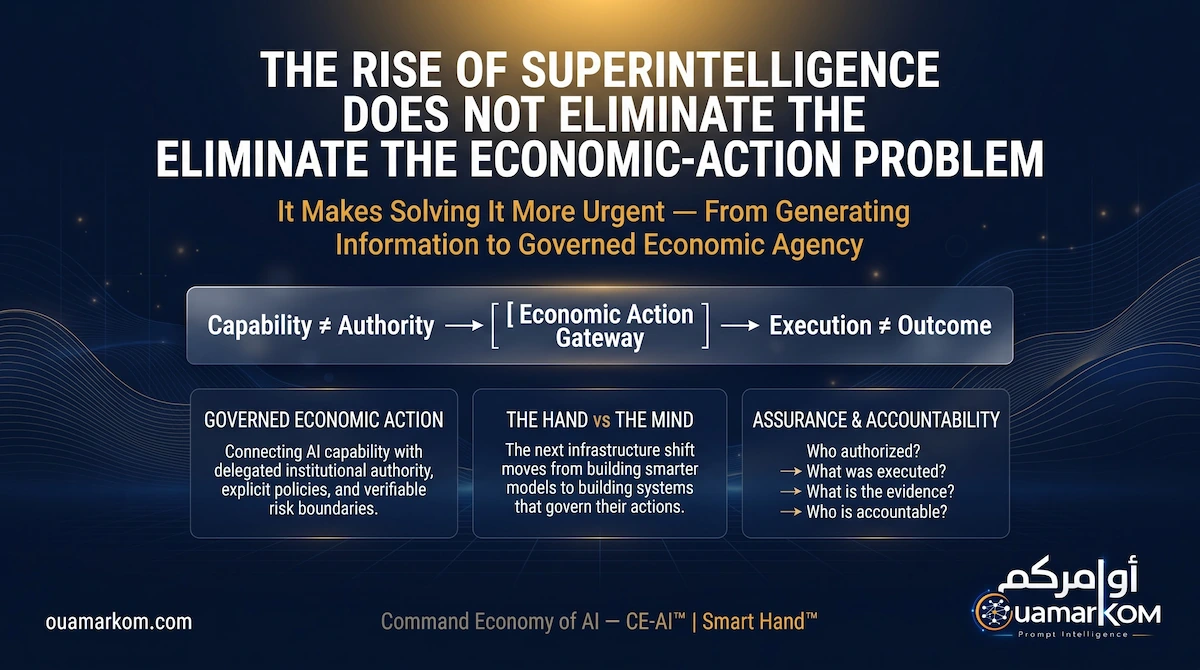
Capability Is Not Authority
An AI system may be technically capable of executing a $1 million purchase. That does not mean it is authorized to spend $1 million.
Its authority may be limited to $100,000. It may only be permitted to transact with approved suppliers. Certain decisions may require human approval. Risk limits may apply. Compliance requirements may constrain the transaction. And changing market conditions may turn a technically correct decision into an economically damaging one.
This creates a set of distinctions that becomes increasingly important as AI acquires greater economic agency:
• Capability is not authority.
• Intent is not authorization.
• Execution is not outcome.
• A record is not verification.
• Technical success is not economic success.
An AI system can execute an instruction exactly as specified and still fail the economic objective for which it was deployed. That distinction is fundamental.
Technical Success Can Still Mean Economic Failure
Consider a company that gives an AI system an instruction to purchase 100,000 units of a particular product.
The system completes the transaction on time, stays within budget, and uses an approved supplier. From an engineering perspective, the task was successfully executed.
But one month later, demand for the product falls. Inventory accumulates. Working capital becomes constrained. Margins deteriorate. The company ultimately loses money.
Did the AI succeed?
It succeeded at execution. It may have failed at the economic objective.
The distance between execution and economic outcome is likely to become one of the most important areas of inquiry as AI moves from being an assistant to becoming an economic actor.
Why Superintelligence Makes the Problem More Important
At first glance, one might assume that more intelligent systems will simply solve these problems.
If AI becomes substantially better at forecasting, planning, reasoning, and decision-making, why would additional infrastructure be necessary?
The answer is that increasing capability may increase the need for institutional controls.
The more capable a system becomes, the greater the value of the actions it can perform, the broader the range of tools it can access, and potentially the greater the consequences of a mistake.
A limited system may produce a limited error. A highly capable system with access to financial, operational, or institutional systems could potentially turn a small misunderstanding into a chain of consequential actions.
The answer, therefore, is not necessarily to slow down intelligence. It is to build the conditions under which increasingly capable intelligence can operate within boundaries that institutions can define, monitor, audit, and verify.
Economies Need More Than Intelligence
Markets and institutions do not operate on intelligence alone.
They operate through rights, contracts, budgets, delegated authority, accountability, regulation, transaction records, risk controls, and mechanisms for audit and verification.
When AI enters this environment as an actor capable of executing consequential actions, it must interact with these institutional structures rather than operate outside them.
This raises a new architectural question:
This question lies at the center of the research direction explored by Ouamarkom through the concept of the Command Economy of AI (CE-AI).
CE-AI can be defined as a research framework for studying the economic consequences of AI systems participating in economic activity through commands, delegated authority, governed execution, and verifiable outcomes.
The proposition is not that a new economic system has already emerged, nor that commands will become the only mechanism through which economic activity occurs.
The research question is narrower and more consequential: What changes when AI systems move from producing intelligence to participating in consequential economic action?
From AI Governance to Economic Action Infrastructure
AI governance, AI safety, agent engineering, cybersecurity, workflow automation, enterprise architecture, and financial controls already address important parts of this problem.
The emerging challenge may require looking at the issue through a more specific unit of analysis: governed economic action.
This means an economic action performed by an AI system within defined authority, subject to explicit constraints, capable of being examined through evidence, and evaluated against an economic outcome.
This leads to an architectural hypothesis worth testing: the Economic Action Gateway.
The proposition is not that this is already the definitive architecture for AI-driven economic activity. Rather, it is a hypothesis:
If such a boundary proves necessary, it could potentially govern identity, authority scope, policies, risk limits, approvals, execution conditions, escalation, evidence, and verification.
The critical point is that the architecture should not be assumed in advance. It should be discovered through evidence.
Infrastructure Must Be Earned by Evidence
This distinction matters economically.
Technology markets often attempt to build infrastructure before establishing whether the underlying problem is sufficiently recurrent to justify a dedicated layer.
A more disciplined approach reverses the sequence:
Under this approach, the existence of a recurring problem becomes the basis for infrastructure.
This is where Smart Hand™ can serve as an experimental environment rather than merely a product concept. Its purpose is to test what happens when AI systems move through the chain from intent and command to authority, governance, decision, execution, evidence, outcome, verification, and learning.
If the same constraints repeatedly appear across models, use cases, and institutional environments-and if experiments demonstrate that those constraints require reusable mechanisms-then the case for an architectural layer becomes stronger.
If the evidence points elsewhere, the architecture should change. That is not a weakness. It is the discipline of research.
The Next Economic Infrastructure May Be About the “Hand,” Not Only the “Mind”
The first phase of the AI economy was largely about building the mind: models capable of understanding, reasoning, generating, predicting, and planning.
The next phase may increasingly be about something different: How do we give that intelligence the ability to act without losing institutional control over the consequences?
Competition may therefore extend beyond who builds the most capable model. It may also involve who builds the infrastructure that allows increasingly capable AI systems to participate in economic activity in ways that are governable, accountable, auditable, and verifiable.
This does not make Superintelligence the end of the story. It makes Superintelligence the beginning of a new infrastructure problem.
As machines gain greater capacity to act, economies will need systems capable of answering increasingly fundamental questions:
• Who authorized the action?
• What authority was delegated?
• What was the permitted scope?
• What actually happened?
• What evidence exists?
• Was the outcome economically successful?
• Who is accountable for the result?
These questions may be less spectacular than the launch of a new model. They may, however, prove more important to institutions deciding whether increasingly capable AI can be trusted with consequential economic activity.
The central challenge of the next AI era may therefore not be intelligence alone. It may be the infrastructure that makes intelligence economically actionable, institutionally governed, and verifiably accountable.
It makes solving it more urgent.
Ouamarkom™
Ouamarkom researches the infrastructure that the agentic economy may require.
Explore Ouamarkom Research