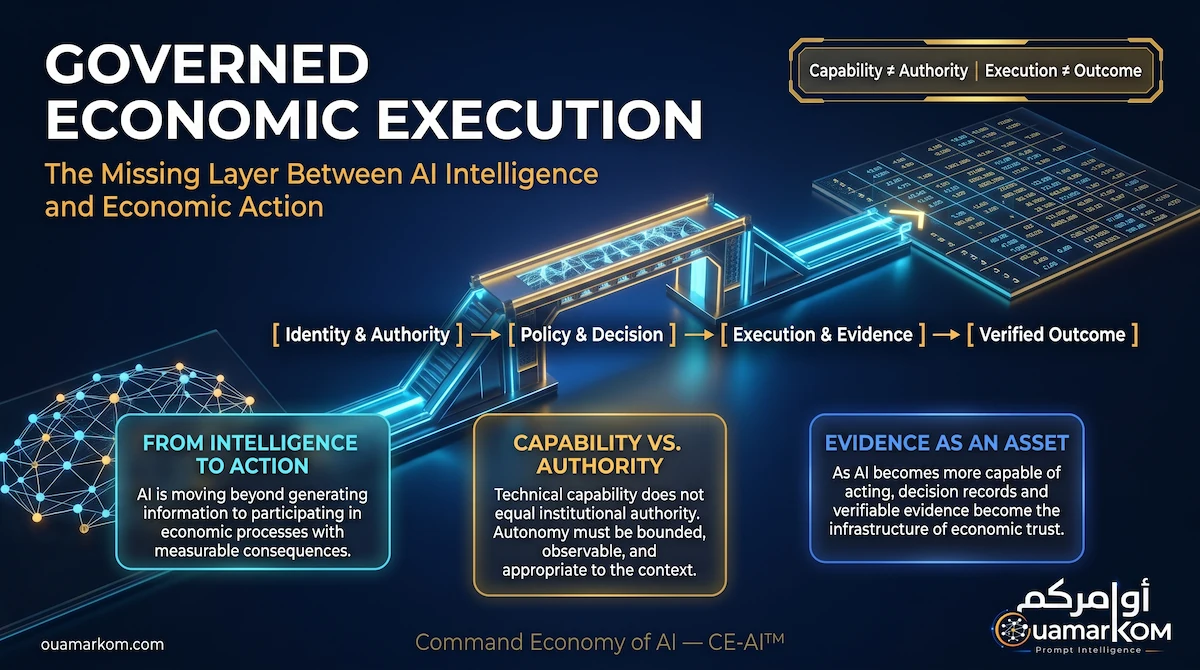
Governed Economic Execution: The Missing Layer Between AI Intelligence and Economic Action

Moving beyond intelligence generation: Examining the authority boundaries, decision records, and outcome verification required for AI to participate safely in real-world economic processes.

By Morad Nagib Alsahybi - Founder & CEO, Ouamarkom™

Governed Economic Execution: The Missing Layer Between AI Intelligence and Economic Action

For more than a decade, the economic story of artificial intelligence has largely been a story of intelligence augmentation. AI systems have become increasingly capable of generating text, analyzing data, writing software, producing forecasts, and supporting human decisions. The dominant value proposition has been straightforward: give organizations more intelligence, more speed, and more automation.

The next economic question is different.

What happens when artificial intelligence moves beyond generating information and begins executing actions that have real economic consequences?

The Transition to Economic Participation

An AI system that recommends a supplier is an information system.

An AI system that selects the supplier, negotiates within defined limits, issues a purchase order, records the transaction, and verifies delivery is participating in an economic process.

That transition-from intelligence to economically consequential action-introduces a layer that has received far less attention than model capability itself: Governed Economic Execution.

From Intelligence to Action

The distinction matters because economic activity is not simply a sequence of decisions. It is a system of decisions, authority, execution, accountability, evidence, and outcomes.

Consider a simple instruction:

«“Reduce procurement costs by 10%.”»

A conventional AI system might analyze purchasing data and recommend alternative suppliers. A more capable agent might identify suppliers, prepare negotiations, and draft purchase orders.

But an economically executable system must answer a different set of questions:

  • Who authorized the action?
  • What is the agent permitted to spend?
  • Which suppliers are eligible?
  • What policies apply?
  • When is human approval required?
  • What exactly did the system decide?
  • What did it actually execute?
  • What evidence was produced?
  • What economic outcome followed?
  • Can that outcome be independently verified?

These questions become increasingly important as AI systems gain access to enterprise systems, financial infrastructure, customer platforms, supply chains, and other environments where actions create measurable consequences.

The central challenge is therefore not simply making AI more autonomous. It is making AI capable of acting within clearly defined economic boundaries.

Capability Is Not Authority

One of the most important distinctions in this emerging landscape is the difference between capability and authority.

An AI system may technically be capable of executing a million-dollar transaction. That does not mean it should be authorized to do so.

A system might have access to an API capable of transferring $100,000 while being legitimately authorized to spend only $5,000.

This distinction seems obvious in human institutions. Employees, executives, financial officers, and organizations operate under delegated authority. Their technical ability to perform an action does not automatically grant them the institutional right to perform it.

AI systems entering economic workflows create the same problem in software form.

Governed Economic Execution therefore requires mechanisms that connect:

Identity Authority Policy Decision Execution Evidence Outcome Verification

The purpose is not to eliminate autonomy. It is to make autonomy bounded, observable, accountable, and appropriate to the context.

The Economics of Execution

The economic significance of this transition extends beyond enterprise automation.

Much of modern economic activity contains a hidden cost: the cost of turning intention into execution.

A manager decides to purchase equipment. Someone must search for suppliers, compare prices, obtain approvals, negotiate terms, issue the order, process payment, track delivery, reconcile invoices, and verify the result.

The same pattern appears across multiple functional domains:

  • Sales & Marketing
  • Finance & Accounting
  • Logistics & Supply Chain
  • Procurement & Sourcing
  • Customer Service
  • Operations

AI has already reduced the cost of producing information within these processes. The emerging question is whether it can also reduce the cost of economic execution.

If the cost of turning a decision into an authorized and verified action falls dramatically, organizations may change in ways that are difficult to predict today. Decision cycles could become shorter. Operational capacity could become more scalable. Coordination costs could decline. Smaller teams could potentially manage larger volumes of economic activity.

«When an organization can execute thousands of actions simultaneously, a small policy error can scale just as quickly as a successful strategy. The economics of AI execution are therefore inseparable from the economics of control.»

Evidence Becomes an Economic Asset

In human organizations, many actions are accompanied by records: approvals, contracts, invoices, receipts, transaction logs, and audit trails.

AI-driven economic execution creates a new requirement: systems must be able to establish not only what an agent intended to do, but what it actually did and what happened afterward.

This creates an important distinction between an Action Log and a Decision Record.

An action log may tell us that an API call occurred.

A decision record can potentially capture the broader context:

  • The objective
  • The relevant policy
  • The authority available
  • The alternatives considered
  • The decision
  • The action
  • The evidence generated
  • The resulting outcome

The distinction matters because economic value is ultimately connected to outcomes, not merely actions.

If an AI agent is instructed to increase revenue by 15%, successful execution of a marketing campaign does not automatically establish that the campaign caused a 15% increase in revenue. Execution must therefore be connected to measurement and verification.

«As AI becomes more capable of acting, evidence becomes part of the infrastructure of economic trust.»

From Automation to Governed Agency

The emerging concept of Governed Economic Execution should not be confused with unrestricted AI autonomy. The objective is not an AI system operating without humans, institutions, or constraints. It is an AI system operating within an explicit economic environment.

That environment may define:

  • What the agent can access
  • What decisions it can make
  • What resources it can use
  • What risks it can accept
  • What actions require approval
  • What evidence must be retained
  • How outcomes are verified

This creates a more useful way of thinking about AI agency.

Instead of asking only:

«“Can the AI act?”»

We can ask:

«“Under what conditions can AI act economically, legitimately, measurably, and verifiably?”»

That is a substantially different question.

The Infrastructure Question

If this transition becomes economically significant, organizations may require infrastructure between AI models and the systems where economic actions occur.

The model provides intelligence. Enterprise systems provide the operational environment.

But between them may be a missing layer responsible for identity, delegated authority, policy enforcement, risk controls, execution, evidence, and verification.

The architecture of that layer should not be assumed in advance. It should emerge from evidence.

This is particularly important because today's AI ecosystem is evolving rapidly. Models will change. Agent frameworks will change. Enterprise platforms will change. New interfaces will emerge. Infrastructure that depends on one model or one application may therefore be less durable than infrastructure organized around persistent economic requirements.

The enduring question may not be which model performs the best. It may be:

«What must be true for an AI system to participate reliably in economic execution?»

A Research Agenda, Not a Finished Category

Governed Economic Execution should therefore be approached as an emerging research and infrastructure question rather than as an established market category.

The evidence must determine how broad the phenomenon is, where the boundaries lie, what customers actually need, which controls are essential, and whether a distinct infrastructure layer is economically justified.

This approach also changes how companies building in this space should think about innovation.

Observe Phenomenon Formulate Hypotheses Run Experiments Generate Evidence Evolve Architecture

In this model, a smaller architecture supported by stronger evidence is not a failure. It is progress.

The category is not assumed. It is discovered.

The architecture is not declared. It is earned.

The Emerging Economic Question

The most consequential shift in AI may ultimately be measured not by how much information machines can generate, but by how reliably they can convert intelligence into authorized economic action.

That transition introduces a new set of economic variables: delegated authority, execution cost, evidence quality, outcome verification, and the scalability of controlled action.

Governed Economic Execution provides one way to frame this emerging question. It does not assume that AI will replace economic institutions, nor does it require unrestricted machine autonomy.

Instead, it asks a more practical question:

«What infrastructure will be required when intelligence becomes capable of acting inside the economy?»

The answer is still being discovered.

But as AI moves from advising economic actors toward participating directly in economic processes, the infrastructure connecting intelligence, authority, execution, evidence, and outcomes may become as important as the intelligence itself.

The next phase of AI economics may therefore be less about teaching machines to know more-and more about determining how machines can act responsibly when knowing is no longer enough.

Ouamarkom™

Building the Infrastructure for AI-Executed Economies.

Establish Your Execution Infrastructure Now

التنفيذ الاقتصادي الخاضع للحوكمة: الطبقة المفقودة بين ذكاء الذكاء الاصطناعي والفعل الاقتصادي

من إنتاج المعلومات إلى الفعل الاقتصادي: دراسة الحدود التنظيمية وسجلات القرارات والتحقق من النتائج المطلوبة لمشاركة الذكاء الاصطناعي في العمليات الاقتصادية.

بقلم مراد نجيب الصهيبي - المؤسس والرئيس التنفيذي لـ Ouamarkom™

التنفيذ الاقتصادي الخاضع للحوكمة: الطبقة المفقودة بين ذكاء الذكاء الاصطناعي والفعل الاقتصادي

على مدى أكثر من عقد، ارتبطت القصة الاقتصادية للذكاء الاصطناعي بصورة أساسية بتعزيز الذكاء البشري. فقد أصبحت أنظمة الذكاء الاصطناعي أكثر قدرة على توليد النصوص، وتحليل البيانات، وكتابة البرمجيات، وإعداد التنبؤات، ودعم القرارات. وكان عرض القيمة الأساسي واضحًا: مزيد من الذكاء، ومزيد من السرعة، ومزيد من الأتمتة.

لكن السؤال الاقتصادي القادم قد يكون مختلفًا.

ماذا يحدث عندما ينتقل الذكاء الاصطناعي من إنتاج المعلومات إلى تنفيذ أفعال ذات آثار اقتصادية حقيقية؟

التحول نحو المشاركة الاقتصادية الفعالة

النظام الذي يوصي بمورد هو نظام معلوماتي.

أما النظام الذي يختار المورد، ويتفاوض ضمن حدود محددة، ويصدر أمر الشراء، ويسجل العملية، ويتحقق من وصول المنتج، فهو يشارك فعليًا في عملية اقتصادية.

هذا الانتقال - من الذكاء إلى الفعل ذي الأثر الاقتصادي - يطرح طبقة جديدة من الأسئلة لم تحظَ بالقدر نفسه من الاهتمام الذي حظيت به قدرات النماذج نفسها: التنفيذ الاقتصادي الخاضع للحوكمة (Governed Economic Execution).

من الذكاء إلى الفعل

تكمن أهمية هذا الانتقال في أن النشاط الاقتصادي ليس مجرد سلسلة من القرارات. إنه منظومة تجمع بين القرار، والسلطة، والتنفيذ، والمساءلة، والأدلة، والنتائج.

لنفترض أن مديرًا أصدر تعليمات بسيطة:

««خفّض تكاليف المشتريات بنسبة 10%.»»

يمكن لنظام ذكاء اصطناعي تقليدي تحليل بيانات المشتريات واقتراح موردين بديلين. ويمكن لوكيل أكثر قدرة أن يبحث عن الموردين، ويعد التفاوض، ويجهز أوامر الشراء.

لكن النظام القابل للتنفيذ اقتصاديًا يحتاج إلى الإجابة عن مجموعة مختلفة من الأسئلة:

  • من الذي منحه صلاحية التنفيذ؟
  • ما الحد المالي المسموح له؟
  • ما الموردون الذين يمكن التعامل معهم؟
  • ما السياسات التي تنطبق على العملية؟
  • متى تصبح الموافقة البشرية إلزامية؟
  • ما القرار الذي اتخذه النظام؟
  • ماذا نفذ بالفعل؟
  • ما الأدلة التي نتجت عن التنفيذ؟
  • ما النتيجة الاقتصادية التي حدثت؟
  • وهل يمكن التحقق بصورة مستقلة من هذه النتيجة؟

كلما أصبحت أنظمة الذكاء الاصطناعي أكثر اتصالًا بأنظمة المؤسسات والبنية المالية وسلاسل الإمداد ومنصات العملاء، أصبحت هذه الأسئلة أكثر أهمية.

لذلك لا يتمثل التحدي في جعل الذكاء الاصطناعي أكثر استقلالية فحسب، بل في جعله قادرًا على الفعل داخل حدود اقتصادية واضحة وقابلة للضبط والتحقق.

القدرة ليست سلطة

من أهم التمييزات التي تفرض نفسها في هذا السياق الفرق بين القدرة (Capability) والسلطة (Authority).

قد يكون النظام قادرًا تقنيًا على تنفيذ معاملة بقيمة مليون دولار. لكن هذه القدرة التقنية لا تعني بالضرورة أنه مخول بتنفيذها.

قد تمتلك واجهة برمجية القدرة على تحويل 100 ألف دولار، بينما تكون الصلاحية المفوضة للوكيل لا تتجاوز 5 آلاف دولار.

هذا الفرق مألوف في المؤسسات البشرية. فامتلاك الموظف أو المدير القدرة التقنية على تنفيذ إجراء معين لا يعني تلقائيًا امتلاكه الحق المؤسسي في تنفيذه.

وعندما تدخل أنظمة الذكاء الاصطناعي في العمليات الاقتصادية، ينتقل هذا المبدأ المؤسسي إلى البرمجيات.

ومن هنا يصبح التنفيذ الاقتصادي الخاضع للحوكمة قائمًا على منظومة تربط بين:

الهوية السلطة السياسات القرار التنفيذ الأدلة النتيجة التحقق

والهدف ليس إلغاء استقلالية الأنظمة، وإنما جعل هذه الاستقلالية محددة، وقابلة للمراقبة، وخاضعة للمساءلة، ومتناسبة مع السياق.

اقتصاد التنفيذ

الأهمية الاقتصادية لهذا التحول تتجاوز مجرد أتمتة العمليات المؤسسية.

فجزء كبير من النشاط الاقتصادي الحديث يتضمن تكلفة غير ظاهرة بما يكفي: تكلفة تحويل النية إلى تنفيذ.

يريد مدير شراء معدات جديدة. لكن تحقيق هذا الهدف يتطلب البحث عن الموردين، ومقارنة الأسعار، والحصول على الموافقات، والتفاوض، وإصدار أمر الشراء، وإتمام الدفع، ومتابعة الشحن، وتسوية الفواتير، والتحقق من النتيجة.

والنمط نفسه يظهر في مجالات عدة:

  • المبيعات والتسويق
  • التمويل والمحاسبة
  • الخدمات اللوجستية وسلاسل الإمداد
  • المشتريات والعقود
  • خدمة العملاء
  • العمليات المؤسسية

لقد بدأ الذكاء الاصطناعي بالفعل في خفض تكلفة إنتاج المعلومات داخل هذه العمليات.

أما السؤال الناشئ فهو:

«هل يستطيع الذكاء الاصطناعي أيضًا خفض تكلفة التنفيذ الاقتصادي نفسه؟»

إذا أصبحت المسافة بين القرار والتنفيذ أقصر بكثير، فقد تتغير بعض خصائص المؤسسات والعمليات الاقتصادية. قد تصبح دورات اتخاذ القرار أقصر، وقد تنخفض بعض تكاليف التنسيق، وقد تتمكن فرق أصغر من إدارة أحجام أكبر من النشاط التشغيلي.

لكن انخفاض تكلفة التنفيذ يجعل الحوكمة أكثر أهمية في الوقت نفسه. فعندما يصبح بإمكان مؤسسة تنفيذ آلاف الأفعال في وقت واحد، فإن الخطأ في السياسة أو الصلاحيات يمكن أن يتوسع بالسرعة نفسها التي يتوسع بها النجاح. لذلك فإن اقتصاد تنفيذ الذكاء الاصطناعي لا ينفصل عن اقتصاد الرقابة والثقة.

عندما تصبح الأدلة أصلًا اقتصاديًا

تعتمد المؤسسات الحديثة على سجلات متعددة لإثبات النشاط الاقتصادي: الموافقات، والعقود، والفواتير، والإيصالات، وسجلات المعاملات، وعمليات التدقيق.

ومع انتقال الذكاء الاصطناعي إلى تنفيذ الأفعال الاقتصادية، تظهر حاجة إضافية: يجب ألا نعرف فقط ما الذي كان النظام ينوي فعله، بل ما الذي فعله بالفعل، وماذا حدث بعد ذلك.

وهنا يظهر فرق مهم بين سجل الإجراء (Action Log) وسجل القرار (Decision Record).

قد يخبرنا سجل الإجراء بأن استدعاءً لواجهة برمجية قد حدث.

لكن سجل القرار يمكن أن يقدم سياقًا أوسع:

  • الهدف
  • السياسة المطبقة
  • السلطة المتاحة
  • البدائل المطروحة
  • القرار المتخذ
  • الإجراء المنفذ
  • الأدلة الناتجة
  • النتيجة المحققة

وهذا الفرق مهم لأن القيمة الاقتصادية ترتبط في النهاية بالنتائج، وليس بالأفعال المجردة.

إذا تلقى وكيل ذكاء اصطناعي هدفًا يتمثل في زيادة الإيرادات بنسبة 15%، فإن إطلاق حملة تسويقية لا يثبت تلقائيًا أن الحملة تسببت في زيادة الإيرادات بنسبة 15%. لذلك يجب ربط التنفيذ بالقياس والتحقق.

«كلما أصبح الذكاء الاصطناعي أكثر قدرة على الفعل، أصبحت الأدلة جزءًا من البنية التحتية للثقة الاقتصادية.»

من الأتمتة إلى الوكالة المحكومة

لا ينبغي الخلط بين التنفيذ الاقتصادي الخاضع للحوكمة وبين الاستقلالية غير المقيدة للذكاء الاصطناعي. الهدف ليس نظامًا يعمل بمعزل عن الإنسان أو المؤسسات أو القيود، بل نظام يعمل داخل بيئة اقتصادية محددة المعالم.

يمكن لهذه البيئة أن تحدد:

  • ما الذي يستطيع الوكيل الوصول إليه
  • ما القرارات التي يمكنه اتخاذها
  • ما الموارد التي يستطيع استخدامها
  • ما مستوى المخاطر المسموح به
  • ما الإجراءات التي تحتاج إلى موافقة
  • ما الأدلة التي يجب الاحتفاظ بها
  • كيف يتم التحقق من النتائج

وهذا يقود إلى طريقة مختلفة لفهم الوكالة الاقتصادية للذكاء الاصطناعي.

فبدل أن نسأل فقط:

««هل يستطيع الذكاء الاصطناعي أن يتصرف؟»»

يمكن أن نسأل:

««تحت أي شروط يستطيع الذكاء الاصطناعي تنفيذ أفعال اقتصادية بصورة مشروعة، وقابلة للقياس، وقابلة للتحقق؟»»

وهذا سؤال مختلف جوهريًا.

سؤال البنية التحتية

إذا أصبح هذا الانتقال ذا أهمية اقتصادية، فقد تحتاج المؤسسات إلى طبقة تربط بين نماذج الذكاء الاصطناعي والأنظمة التي تنفذ فيها الأفعال الاقتصادية.

النموذج يوفر الذكاء، والأنظمة المؤسسية توفر البيئة التشغيلية.

لكن بينهما قد تظهر حاجة إلى طبقة مسؤولة عن: الهوية، والسلطة المفوضة، والسياسات، وضوابط المخاطر، والتنفيذ، والأدلة، والتحقق.

ولا ينبغي افتراض الشكل النهائي لهذه الطبقة مسبقًا، بل ينبغي أن ينشأ من الأدلة.

فالبيئة الحالية للذكاء الاصطناعي تتغير بسرعة. النماذج ستتغير، وأطر الوكلاء ستتغير، ومنصات المؤسسات ستتغير، وواجهات التفاعل ستتطور. لذلك قد تكون البنية التحتية الأكثر استدامة هي تلك المبنية حول المتطلبات الاقتصادية المستمرة، لا حول نموذج ذكاء اصطناعي بعينه.

وهنا يظهر سؤال أكثر عمقًا:

«ما الذي يجب أن يكون صحيحًا لكي يتمكن نظام ذكاء اصطناعي من المشاركة بصورة موثوقة في التنفيذ الاقتصادي؟»

برنامج بحثي لا فئة مكتملة

ينبغي التعامل مع مفهوم التنفيذ الاقتصادي الخاضع للحوكمة في هذه المرحلة باعتباره سؤالًا بحثيًا وبنيويًا ناشئًا، لا باعتباره فئة سوقية مكتملة ومثبتة مسبقًا.

يجب أن تحدد الأدلة:

  • مدى اتساع الظاهرة وندرتها
  • حدودها التشغيلية
  • الاحتياجات الفعلية للعملاء
  • الضوابط الضرورية
  • الحالات التي تظهر فيها القيمة الاقتصادية
  • وما إذا كانت هناك حاجة فعلية إلى طبقة بنية تحتية مستقلة

وهذا يغير أيضًا الطريقة التي ينبغي أن تتعامل بها الشركات مع الابتكار في هذا المجال.

ملاحظة الظاهرة صياغة الفرضية إجراء التجربة إنتاج الأدلة اكتشاف البنية

وفي هذا النموذج، لا يمثل الوصول إلى بنية أصغر تدعمها أدلة أقوى فشلًا، بل يمثل تقدمًا.

الفئة ليست افتراضًا مسبقًا؛ بل تُكتشف.

والبنية ليست إعلانًا؛ بل تُكتسب بالأدلة.

السؤال الاقتصادي القادم

قد لا يتمثل التحول الأكثر أهمية في الذكاء الاصطناعي في مقدار المعلومات التي تستطيع الآلات إنتاجها، وإنما في مدى قدرتها على تحويل الذكاء إلى فعل اقتصادي مصرح به وقابل للملاحظة والتحقق.

هذا الانتقال يضيف مجموعة جديدة من المتغيرات إلى النقاش الاقتصادي حول الذكاء الاصطناعي: السلطة المفوضة، وتكلفة التنفيذ، وجودة الأدلة، والتحقق من النتائج، وقابلية توسيع نطاق الفعل المحكوم.

ويوفر مفهوم التنفيذ الاقتصادي الخاضع للحوكمة إطارًا للنظر في هذه المسألة الناشئة. إنه لا يفترض أن الذكاء الاصطناعي سيحل محل المؤسسات الاقتصادية، ولا يتطلب استقلالية آلية مطلقة.

بل يطرح سؤالًا أكثر عملية:

«ما البنية التحتية التي سيحتاج إليها الاقتصاد عندما يصبح الذكاء قادرًا على الفعل؟»

لا تزال الإجابة قيد الاكتشاف.

لكن مع انتقال الذكاء الاصطناعي من تقديم المشورة إلى المشاركة المباشرة في العمليات الاقتصادية، قد تصبح البنية التحتية التي تربط بين الذكاء، والسلطة، والتنفيذ، والأدلة، والنتائج مهمة بقدر أهمية الذكاء نفسه.

وقد يكون الفصل القادم من اقتصاد الذكاء الاصطناعي أقل ارتباطًا بتعليم الآلات كيف تعرف أكثر، وأكثر ارتباطًا بتحديد كيف يمكن للآلات أن تتصرف بصورة مسؤولة عندما لا يعود امتلاك المعرفة كافيًا.

أوامركم™

نبني البنية التحتية للتنفيذ الاقتصادي في عصر الذكاء الاصطناعي.

ابنِ بنيتك التحتية للتنفيذ الآن