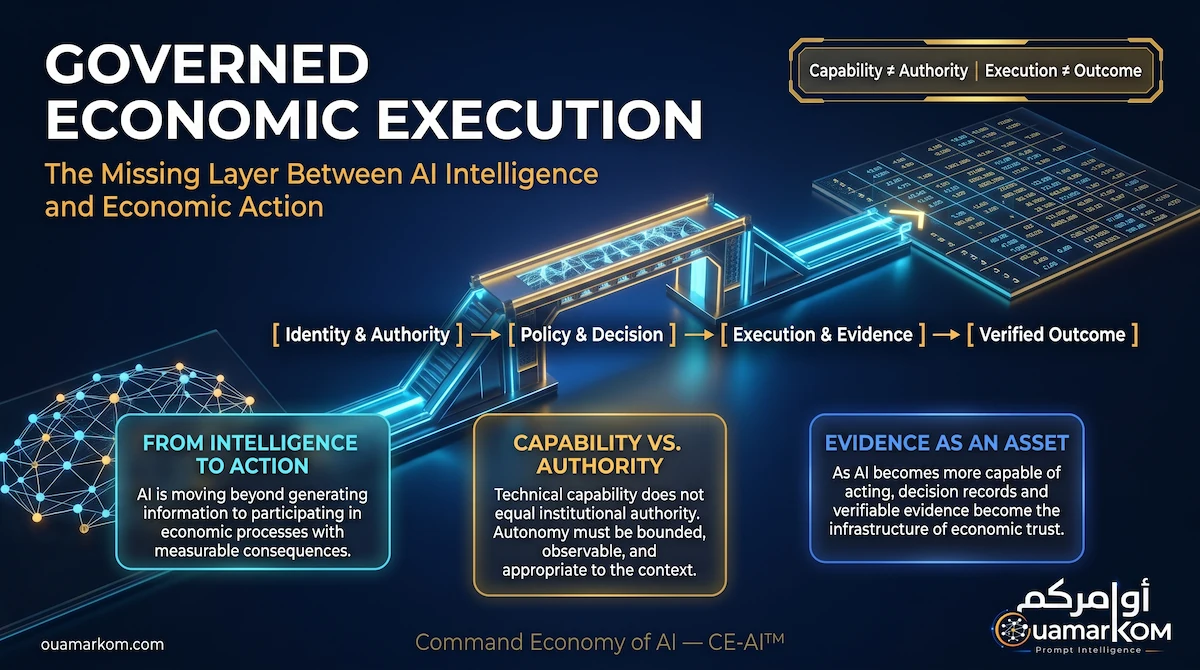
For more than a decade, the economic story of artificial intelligence has largely been a story of intelligence augmentation. AI systems have become increasingly capable of generating text, analyzing data, writing software, producing forecasts, and supporting human decisions. The dominant value proposition has been straightforward: give organizations more intelligence, more speed, and more automation.
The next economic question is different.
What happens when artificial intelligence moves beyond generating information and begins executing actions that have real economic consequences?
An AI system that recommends a supplier is an information system.
An AI system that selects the supplier, negotiates within defined limits, issues a purchase order, records the transaction, and verifies delivery is participating in an economic process.
That transition-from intelligence to economically consequential action-introduces a layer that has received far less attention than model capability itself: Governed Economic Execution.
From Intelligence to Action
The distinction matters because economic activity is not simply a sequence of decisions. It is a system of decisions, authority, execution, accountability, evidence, and outcomes.
Consider a simple instruction:
A conventional AI system might analyze purchasing data and recommend alternative suppliers. A more capable agent might identify suppliers, prepare negotiations, and draft purchase orders.
But an economically executable system must answer a different set of questions:
- Who authorized the action?
- What is the agent permitted to spend?
- Which suppliers are eligible?
- What policies apply?
- When is human approval required?
- What exactly did the system decide?
- What did it actually execute?
- What evidence was produced?
- What economic outcome followed?
- Can that outcome be independently verified?
These questions become increasingly important as AI systems gain access to enterprise systems, financial infrastructure, customer platforms, supply chains, and other environments where actions create measurable consequences.
The central challenge is therefore not simply making AI more autonomous. It is making AI capable of acting within clearly defined economic boundaries.
Capability Is Not Authority
One of the most important distinctions in this emerging landscape is the difference between capability and authority.
An AI system may technically be capable of executing a million-dollar transaction. That does not mean it should be authorized to do so.
A system might have access to an API capable of transferring $100,000 while being legitimately authorized to spend only $5,000.
This distinction seems obvious in human institutions. Employees, executives, financial officers, and organizations operate under delegated authority. Their technical ability to perform an action does not automatically grant them the institutional right to perform it.
AI systems entering economic workflows create the same problem in software form.
Governed Economic Execution therefore requires mechanisms that connect:
The purpose is not to eliminate autonomy. It is to make autonomy bounded, observable, accountable, and appropriate to the context.
The Economics of Execution
The economic significance of this transition extends beyond enterprise automation.
Much of modern economic activity contains a hidden cost: the cost of turning intention into execution.
A manager decides to purchase equipment. Someone must search for suppliers, compare prices, obtain approvals, negotiate terms, issue the order, process payment, track delivery, reconcile invoices, and verify the result.
The same pattern appears across multiple functional domains:
- Sales & Marketing
- Finance & Accounting
- Logistics & Supply Chain
- Procurement & Sourcing
- Customer Service
- Operations
AI has already reduced the cost of producing information within these processes. The emerging question is whether it can also reduce the cost of economic execution.
If the cost of turning a decision into an authorized and verified action falls dramatically, organizations may change in ways that are difficult to predict today. Decision cycles could become shorter. Operational capacity could become more scalable. Coordination costs could decline. Smaller teams could potentially manage larger volumes of economic activity.
Evidence Becomes an Economic Asset
In human organizations, many actions are accompanied by records: approvals, contracts, invoices, receipts, transaction logs, and audit trails.
AI-driven economic execution creates a new requirement: systems must be able to establish not only what an agent intended to do, but what it actually did and what happened afterward.
This creates an important distinction between an Action Log and a Decision Record.
An action log may tell us that an API call occurred.
A decision record can potentially capture the broader context:
- The objective
- The relevant policy
- The authority available
- The alternatives considered
- The decision
- The action
- The evidence generated
- The resulting outcome
The distinction matters because economic value is ultimately connected to outcomes, not merely actions.
If an AI agent is instructed to increase revenue by 15%, successful execution of a marketing campaign does not automatically establish that the campaign caused a 15% increase in revenue. Execution must therefore be connected to measurement and verification.
From Automation to Governed Agency
The emerging concept of Governed Economic Execution should not be confused with unrestricted AI autonomy. The objective is not an AI system operating without humans, institutions, or constraints. It is an AI system operating within an explicit economic environment.
That environment may define:
- What the agent can access
- What decisions it can make
- What resources it can use
- What risks it can accept
- What actions require approval
- What evidence must be retained
- How outcomes are verified
This creates a more useful way of thinking about AI agency.
Instead of asking only:
We can ask:
That is a substantially different question.
The Infrastructure Question
If this transition becomes economically significant, organizations may require infrastructure between AI models and the systems where economic actions occur.
The model provides intelligence. Enterprise systems provide the operational environment.
But between them may be a missing layer responsible for identity, delegated authority, policy enforcement, risk controls, execution, evidence, and verification.
The architecture of that layer should not be assumed in advance. It should emerge from evidence.
This is particularly important because today's AI ecosystem is evolving rapidly. Models will change. Agent frameworks will change. Enterprise platforms will change. New interfaces will emerge. Infrastructure that depends on one model or one application may therefore be less durable than infrastructure organized around persistent economic requirements.
The enduring question may not be which model performs the best. It may be:
A Research Agenda, Not a Finished Category
Governed Economic Execution should therefore be approached as an emerging research and infrastructure question rather than as an established market category.
The evidence must determine how broad the phenomenon is, where the boundaries lie, what customers actually need, which controls are essential, and whether a distinct infrastructure layer is economically justified.
This approach also changes how companies building in this space should think about innovation.
In this model, a smaller architecture supported by stronger evidence is not a failure. It is progress.
The category is not assumed. It is discovered.
The architecture is not declared. It is earned.
The Emerging Economic Question
The most consequential shift in AI may ultimately be measured not by how much information machines can generate, but by how reliably they can convert intelligence into authorized economic action.
That transition introduces a new set of economic variables: delegated authority, execution cost, evidence quality, outcome verification, and the scalability of controlled action.
Governed Economic Execution provides one way to frame this emerging question. It does not assume that AI will replace economic institutions, nor does it require unrestricted machine autonomy.
Instead, it asks a more practical question:
The answer is still being discovered.
But as AI moves from advising economic actors toward participating directly in economic processes, the infrastructure connecting intelligence, authority, execution, evidence, and outcomes may become as important as the intelligence itself.
The next phase of AI economics may therefore be less about teaching machines to know more-and more about determining how machines can act responsibly when knowing is no longer enough.
Ouamarkom™
Building the Infrastructure for AI-Executed Economies.
Establish Your Execution Infrastructure Now