The global economy is entering a new phase in the development of artificial intelligence. AI systems are moving beyond information retrieval, content generation, and analytical assistance toward planning tasks, using digital tools, interacting with enterprise systems, and increasingly participating in the execution of economic activities.
This transition raises a question that extends beyond the intelligence of individual models: How can intelligent capability be translated into governed economic action, operating within defined authority, with outcomes that can be measured and verified?
This question provides the starting point for Engineering Economics of AI, an emerging research and engineering direction that Ouamarkom™ is exploring to investigate the foundations required to govern AI systems as they move from generating recommendations to executing actions with real economic consequences.
The objective is not to assume that an entirely new infrastructure is necessarily required. It is to identify the underlying problems, test existing approaches, and determine whether additional engineering mechanisms are justified by evidence.
Beyond the Economics of Artificial Intelligence
A substantial part of the economic discussion surrounding AI focuses on productivity, cost reduction, resource allocation, labor-market transformation, and the creation of new business models. In parallel, engineering disciplines address system reliability, cybersecurity, access control, software execution, and operational governance.
As AI systems assume greater operational responsibilities, however, an important research question emerges: what is the relationship between what a system can do, what it is authorized to do, what it actually executes, and what can be demonstrated about the resulting outcome?
An AI agent may identify the most suitable supplier for a procurement request without possessing the authority to complete the purchase. It may receive permission to execute a transaction within a defined financial limit, while that permission remains subject to modification or revocation. Even when a transaction is completed, recording an execution event does not, by itself, establish that the transaction complied with every applicable requirement.
These distinctions point to a challenge that cannot be reduced to model intelligence alone. They concern the mechanisms connecting capability, authority, execution, and verification.
Engineering Economics of AI, as proposed here, seeks to investigate these relationships through a combination of economic reasoning, engineering design, and empirical experimentation.
It is important to distinguish this proposed direction from the established field of AI economics, which examines the economic implications of developing and deploying AI. The focus here is narrower in one respect and potentially complementary in another: the engineering of controls and mechanisms governing economic actions performed by AI-enabled systems.
Whether this focus ultimately warrants recognition as a distinct discipline will depend on the clarity of its contribution, its relationship to existing research, and the evidence produced through systematic investigation.
The Emerging Challenge: When Intelligence Becomes Action
Consider a company that delegates procurement activities to an AI agent. The agent can compare suppliers, evaluate prices, and recommend the most suitable offer. The company authorizes purchases up to a specified amount, subject to approved supplier lists and other conditions.
The agent may perform the analytical task successfully. Yet the integrity of the economic operation depends on additional questions.
Does the system enforce the limits of its delegated authority? What happens if the purchasing conditions change? Can the authorization be revoked while an operation is in progress? At what point does the transaction become binding? And what evidence is available to reconstruct the sequence of events and establish whether the applicable rules were enforced?
These are not merely questions about the quality of an AI-generated response. They concern the integrity of the economic action executed by the broader system.
Their importance may increase across procurement, financial operations, supply chains, enterprise resource management, and other environments where automated actions can create contractual, financial, or operational consequences.
Nevertheless, the existence of these questions does not establish that current systems are universally inadequate. Identity and access management platforms, policy engines, workflow systems, transaction controls, and other established technologies may already address many relevant requirements.
The research challenge is therefore to identify specific limitations, compare available approaches, and determine where additional mechanisms could deliver measurable value.
Four Dimensions of Governed Economic Action
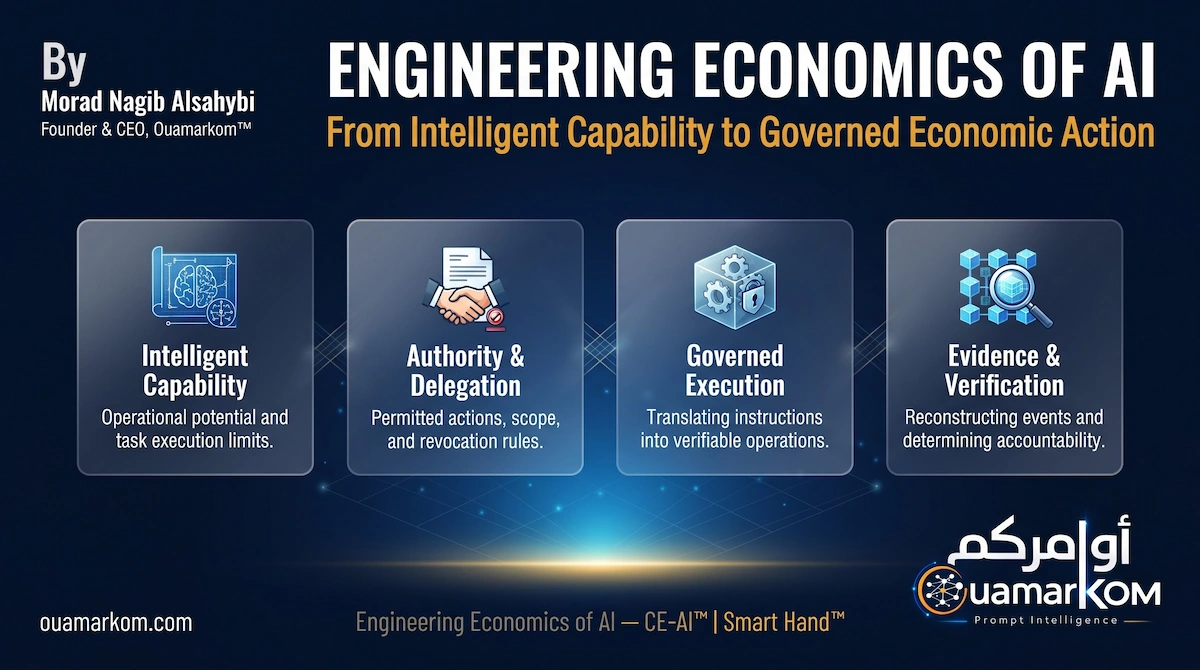
Engineering Economics of AI can initially be organized around four interconnected dimensions:
What can the AI system perform, under what conditions, and with what reliability? Capability establishes the system's operational potential, but it does not independently confer permission to act.
2. Authority and delegation
Which actions are permitted, within what limits, and subject to whose approval? This dimension includes the scope, duration, conditions, and potential revocation of delegated authority.
3. Execution
How are authorized instructions translated into actual operations? How can the system prevent actions outside the permitted scope, particularly when several tools, services, or distributed components are involved?
4. Evidence and verification
How can an operation be reconstructed, its compliance assessed, and its outcome evaluated? What evidence is needed to distinguish an attempted action from a completed action, and a recorded event from a verified result?
The distinction between these dimensions is fundamental. Capability does not establish authority. Authority does not prove execution. Execution does not guarantee the intended economic outcome. Recording an event does not, on its own, establish its correctness.
From an economic perspective, these distinctions may help organizations evaluate operational risk, potential losses, delegation limits, and the conditions under which greater automation becomes justified. Their practical value, however, must be demonstrated against appropriate baselines and existing alternatives.
Ouamarkom: From Analytical Framework to Experimental Validation
Ouamarkom™ is developing a research program focused on the foundations of governed economic execution by AI systems.
At the analytical level, Command Economy of AI (CE-AI™) serves as a framework for organizing questions concerning commands, delegated authority, execution, and economic outcomes. It is a framework under development, not an established industry standard or a claim that an entirely new academic discipline has already been validated.
At the experimental level, Smart Hand™ is conceived as a controlled environment for investigating how AI-enabled systems behave when executing economic actions under defined constraints.
The Governed Economic Action Benchmark (GEAB) workstream is intended to support structured testing, measurement, and comparison across scenarios, including cases involving authorization revocation and the enforceability of execution boundaries.
Within this program, Command Execution Protocol (CEP™) represents an engineering hypothesis under investigation, rather than a completed or recognized technical standard. Its role is to be evaluated through experiments that determine whether a dedicated protocol or mechanism offers meaningful advantages over existing approaches.
The governing methodology is straightforward:
This sequence is designed to ensure that architectural decisions follow evidence rather than precede it.
The objective is not to confirm a predetermined technical design. It is to establish whether a meaningful problem exists, identify the limitations of current solutions, and determine which components—if any—merit further development.
Negative results are valuable within this process. If existing mechanisms adequately address a tested problem, that finding can prevent unnecessary infrastructure development and redirect resources toward more consequential research questions.
The Economic and Investment Implications
As AI agents participate in more complex economic operations, organizations may increasingly require effective ways to define authority, constrain execution, assess exposure, and verify operational outcomes.
This creates potential opportunities for enterprise software, execution protocols, testing and auditing tools, and reusable infrastructure components. Such opportunities could extend across multiple industries if the underlying problems are sufficiently common and the proposed solutions demonstrate measurable advantages.
However, the commercial value of this opportunity cannot be inferred from the scope of the vision alone. It will depend on the severity of customer problems, the performance of proposed mechanisms relative to alternatives, integration costs, reliability, repeatability, and customers' willingness to pay.
For Ouamarkom, a disciplined investment pathway therefore begins with funding research and experimental validation. It can then progress toward engineering development where evidence justifies it, followed by industrial validation with relevant design partners and prospective customers.
This approach positions the current effort as a program to discover and validate engineering foundations, rather than as a claim that a new infrastructure layer is already indispensable to the global AI economy.
Saudi Arabia as an Initial Experimental Base
Saudi Arabia offers a potentially important setting for investigating these questions, given its ongoing digital transformation, AI initiatives, and ambitions to develop advanced technological capabilities.
Financial services, procurement, supply chains, and enterprise operations may provide relevant settings for identifying measurable use cases, subject to appropriate partnerships, permissions, and regulatory requirements.
Yet the value of an experimental result depends on more than where the experiment begins. It also depends on whether the findings can be reproduced in different environments, evaluated independently, and assessed against alternative technical approaches.
Research may begin in Saudi Arabia; the broader applicability of its findings must be earned through replication.
This principle connects a locally grounded research program with international scientific cooperation while avoiding the assumption that results from a single environment are sufficient to establish universal applicability.
From Intelligent Capability to Verifiable Economic Action
The next phase of AI development will be shaped not only by what models can understand or generate, but also by how AI-enabled systems are permitted to act within economic environments, how their authority is enforced, and how their actions and outcomes can be verified.
Engineering Economics of AI seeks to turn these questions into a structured program of research and engineering. Its contribution must emerge through clear definitions, falsifiable hypotheses, reproducible experiments, and comparisons with existing approaches—not through terminology alone.
For Ouamarkom, the objective is to investigate the foundations that could make AI-driven economic action more governable, measurable, and verifiable, and to translate validated findings into technical assets with demonstrable economic value.
In an economy where intelligent systems are increasingly capable of acting, the defining question may no longer be only what AI can do.
It may also be this:
Answering that question will require disciplined research, reproducible experiments, and evidence that distinguishes promising ideas from engineering mechanisms genuinely worth building.
About Ouamarkom™
Ouamarkom™ is developing a research and engineering initiative focused on the foundations of governed economic execution by AI systems. Its work explores the relationship between analytical frameworks, controlled experimentation, measurable evidence, and the potential engineering mechanisms required to support reliable economic action.
The concepts and technical initiatives described in this article are under development. References to potential infrastructure, protocols, and commercial opportunities describe research directions and hypotheses, not claims of completed validation or established industry standards.