From Artificial Intelligence That Generates Information to Artificial Intelligence That Performs Economic Actions
The global economy is undergoing a profound transformation driven by the rapid advancement of artificial intelligence. The first wave of AI adoption focused largely on data analysis, task automation, content generation, and decision support. Today, however, AI systems are moving toward more advanced forms of operational autonomy. Increasingly, they can use digital tools, interact with enterprise systems, manage workflows, and initiate processes that may carry financial, contractual, or operational consequences.
This transition represents a significant development in the relationship between artificial intelligence and economic activity. The future economic value of AI will not be measured solely by its ability to generate accurate responses or reduce the time required to complete tasks. It will also depend on its capacity to participate in economic operations within clearly defined boundaries of authority, accountability, and oversight.
This raises a question that extends beyond the capabilities of models and algorithms:
How can an AI system move from proposing an economic action to executing that action in a governed, controlled, auditable, and verifiable manner?
Addressing this question requires viewing artificial intelligence not merely as a technology for generating information, but as an emerging participant in economic activity. Such a shift calls for infrastructure capable of governing the relationship between economic commands, delegated authority, governance, execution, and outcome verification.
From Task Automation to Economic Agency
Economic institutions have historically relied on systems of relationships and controls that determine who holds decision-making authority, who may issue instructions, who executes transactions, and how outcomes are recorded, reviewed, and attributed.
In a conventional institutional environment, for example, a procurement manager may be authorized to purchase equipment within a defined budget, while expenditure beyond that limit requires additional approval. Similarly, a financial manager may be permitted to authorize transfers within specified limits, subject to verification, documentation, and audit procedures.
The introduction of AI agents into these environments changes the nature of interaction with economic systems. An AI agent may identify suppliers, compare prices, prepare purchase requests, communicate with enterprise platforms, and potentially submit transactions for execution.
However, the technical ability to perform these operations does not automatically confer the economic authority required to perform them.
A fundamental distinction must therefore be maintained between capability and authority, between delegation and transaction authorization, and between execution and the verification of its outcome. An AI agent may be technically capable of initiating a financial transfer, but that capability should not automatically grant it the right to determine the transfer amount, select its beneficiary, or exceed institutionally defined limits.
This distinction is not merely a technical consideration. It is one of the essential conditions for establishing institutional trust in increasingly autonomous AI systems.
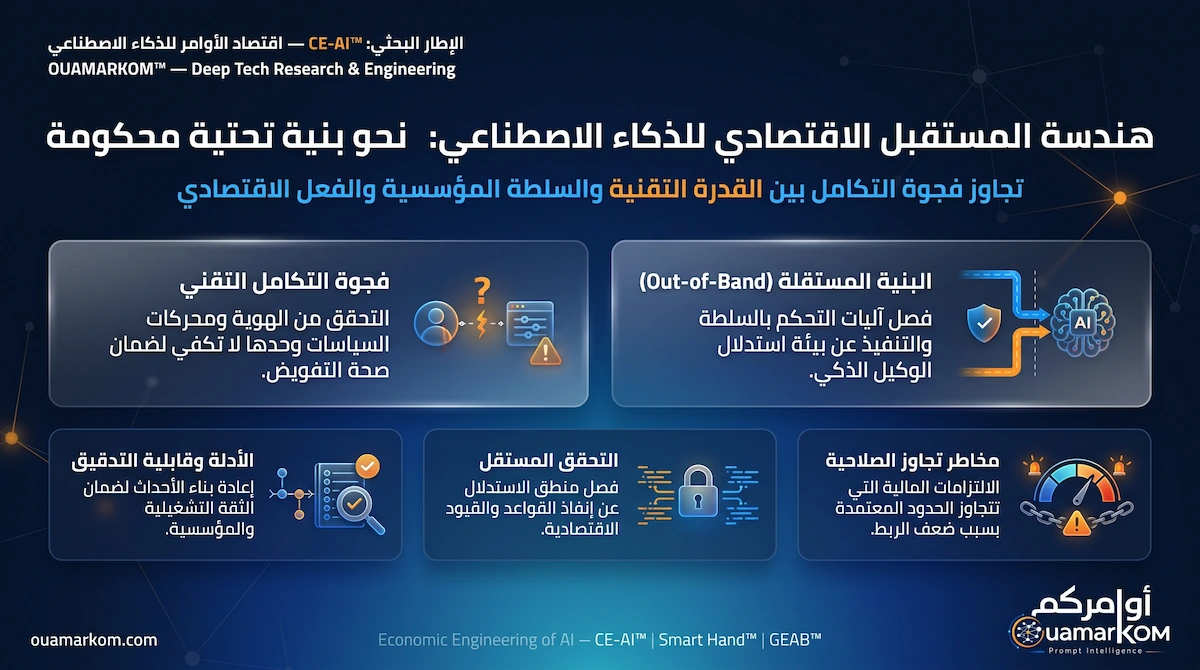
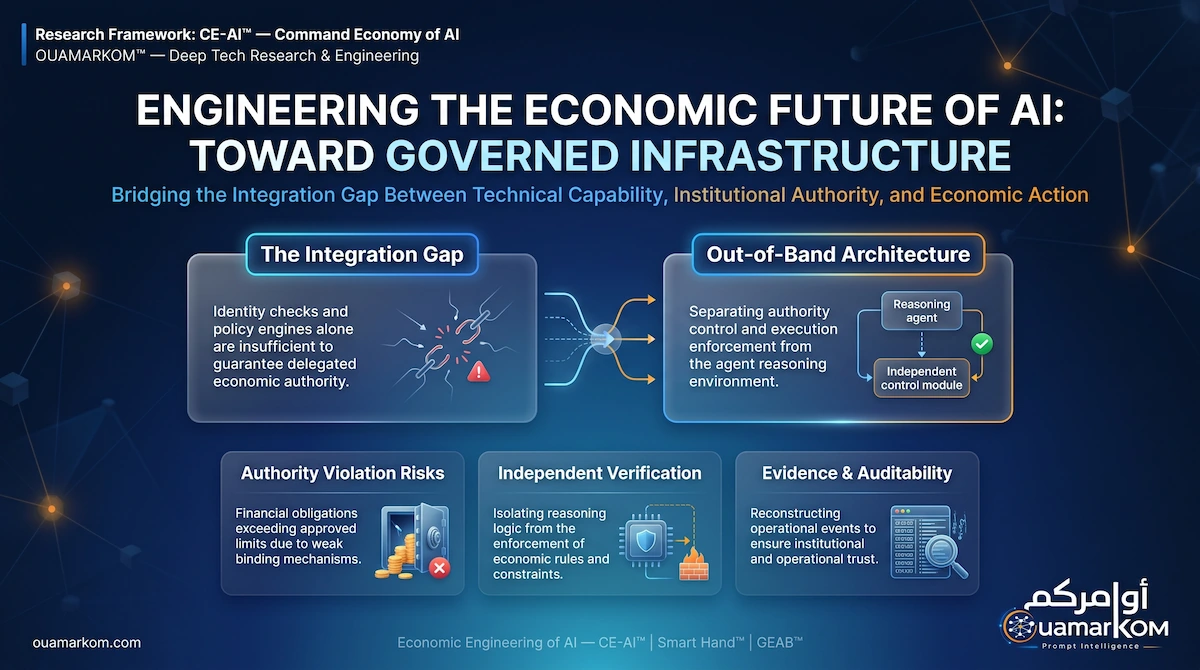
The Integration Gap in Governed Economic Action
Despite progress in AI governance, information security, identity management, access control, and workflow automation, an important research and engineering question remains: how can these mechanisms be integrated into a coherent economic action lifecycle?
A policy engine does not, by itself, demonstrate that every execution channel is subject to its decisions.
Recording system events does not necessarily establish that the resulting economic outcomes have been independently verified.
The challenge lies in designing an integrated sequence that begins with an economic command, proceeds through delegated economic authority, governance and enforcement, and controlled execution, and concludes with evidence capable of supporting outcome verification.
This challenge can be examined as an Integration Gap: the absence, insufficiency, or lack of demonstrated coordination among mechanisms connecting AI-proposed economic actions to explicit authority, enforceable policies, controlled execution, lifecycle management, and independently verifiable outcomes.
This should be treated as a research proposition requiring systematic investigation, rather than as a predetermined claim that existing research or technologies provide no relevant solutions. The central question is how these mechanisms can operate together coherently while preserving independent oversight, auditability, and accountability.
Command Economy of AI: Toward a Foundational Research Framework
It is within this context that OUAMARKOM™ established its vision and research direction through Command Economy of AI (CE-AI™), a proposed foundational research framework within the broader field of Economic Engineering of AI.
CE-AI investigates the relationship between economic commands, delegated economic authority, governance and enforcement mechanisms, governed economic execution, and independent outcome verification.
Its focus extends beyond improving an AI agent's decision-making capabilities. It examines the technical, operational, and institutional conditions under which proposed AI decisions can be translated into controlled economic actions within explicitly defined and enforceable boundaries.
This vision can be expressed through an integrated sequence:
The significance of this sequence lies in distinguishing stages that may appear technically connected but carry different institutional and economic responsibilities.
Delegated authority does not imply automatic approval of every request.
Approval does not guarantee successful execution.
Successful execution, in turn, does not eliminate the need to verify the actual outcome.
CE-AI therefore proposes a research and engineering direction for investigating how these stages can be connected within an integrated, testable, and continuously developable infrastructure.
Governed Infrastructure: A Condition for Economic Scale
The transition toward an economy in which intelligent systems participate in executing economic actions requires more than increasingly capable models or sophisticated interfaces. It requires technical and institutional infrastructure capable of managing authority, constraints, risks, and outcomes.
Consider an enterprise that allows an AI agent to manage routine procurement activities. The agent may analyze organizational requirements, compare suppliers, and recommend suitable offers. However, if its delegated purchasing limit is USD 10,000, it should not be able to exceed that limit simply because its analysis recommends a transaction worth USD 15,000.
Such a scenario requires an independent authority validation mechanism, a policy enforcement engine, controlled execution capabilities, an evidence recording mechanism, and a means of verifying the final outcome. This need extends across multiple sectors, including enterprise procurement, financial services, supply chain management, contractual operations, and digital commerce.
From an economic perspective, such infrastructure could contribute to reducing manual oversight costs, improving operational efficiency, limiting execution errors, and increasing the traceability of institutional responsibilities. However, these benefits depend on the quality of the architecture, experimental validation, and integration with existing systems. They must be measured rather than assumed.
From Principles to Engineering and Verification
Translating this vision into economic value requires a methodology that combines research, engineering development, and experimental testing. Within this direction, OUAMARKOM™ explores a set of proposed technical components and experimental environments:
- Out-of-Band Control Plane: a proposed architecture intended to separate authority enforcement and execution control from the AI agent's reasoning environment.
- UEARM: a proposed framework for coordinating the lifecycle of economic action requests.
- Smart Hand™: an experimental environment for developing and evaluating governed economic action mechanisms.
- GEAB: a proposed benchmark and experimental testing program for evaluating authorization enforcement, budget controls, duplicate prevention, concurrency safety, revocation effectiveness, evidence completeness, and outcome verification.
The value of these components does not lie in their terminology or architectural descriptions alone. Their significance must be established through their development into implementable specifications, followed by reproducible experiments and independent evaluations that identify their strengths, limitations, and operational boundaries.
The methodology guiding this process should follow a disciplined sequence:
This approach makes the development of governed economic infrastructure a long-term research and engineering undertaking, rather than simply an additional software layer placed on top of existing systems.
The Economic and Institutional Dimension of the Future
The growing adoption of AI agents in economic environments may create new business opportunities and reshape relationships among institutions, digital systems, and service providers. At the same time, expanding operational autonomy will increase the importance of accountability, delegation, regulatory compliance, risk management, asset protection, and transaction verification.
The ability to govern AI-driven economic actions reliably may become an important factor in determining whether institutions are prepared to extend AI adoption into sensitive and consequential operations. From this perspective, governed infrastructure is not merely a response to technological risk. It may also become an enabling condition for responsible economic expansion.
Institutional trust does not arise solely from a system's ability to make decisions. It also depends on whether an institution can determine who authorized the system, what it was permitted to do, how the action was executed, and what evidence establishes the resulting outcome.
Conclusion: Engineering an Economy in Which Intelligent Systems Can Operate
The economic future of artificial intelligence will not be determined solely by advances in model intelligence, processing speed, or reasoning capabilities. It will also depend on the maturity of the infrastructure that enables AI systems to participate in economic activity within explicit, enforceable, and verifiable boundaries.
Through CE-AI™, OUAMARKOM™ advances a research and engineering direction focused on investigating and developing the foundations of infrastructure for Governed AI Economic Action. The ambition is not simply to make intelligent systems more capable of acting. It is to investigate how their economic actions can become properly delegated, governed, controlled, traceable, and verifiable.
The future of AI-driven economic activity requires more than intelligence capable of making decisions. It requires infrastructure capable of defining the limits of its authority, enforcing those limits, and establishing evidence of what has actually occurred.
From intelligence to governed economic action. From the ability to execute to the infrastructure that makes execution accountable and verifiable.
Research and Institutional Attribution
OUAMARKOM™ - Research & Engineering for Governed AI Economic Action.
Deep Tech Research & Engineering
Research Direction: Economic Engineering of AI
Foundational Research Framework: CE-AI™ - Command Economy of AI
This article presents a conceptual research perspective and proposed architectural direction. It does not claim independently established experimental results, formal standardization, or demonstrated universal superiority over existing architectures.