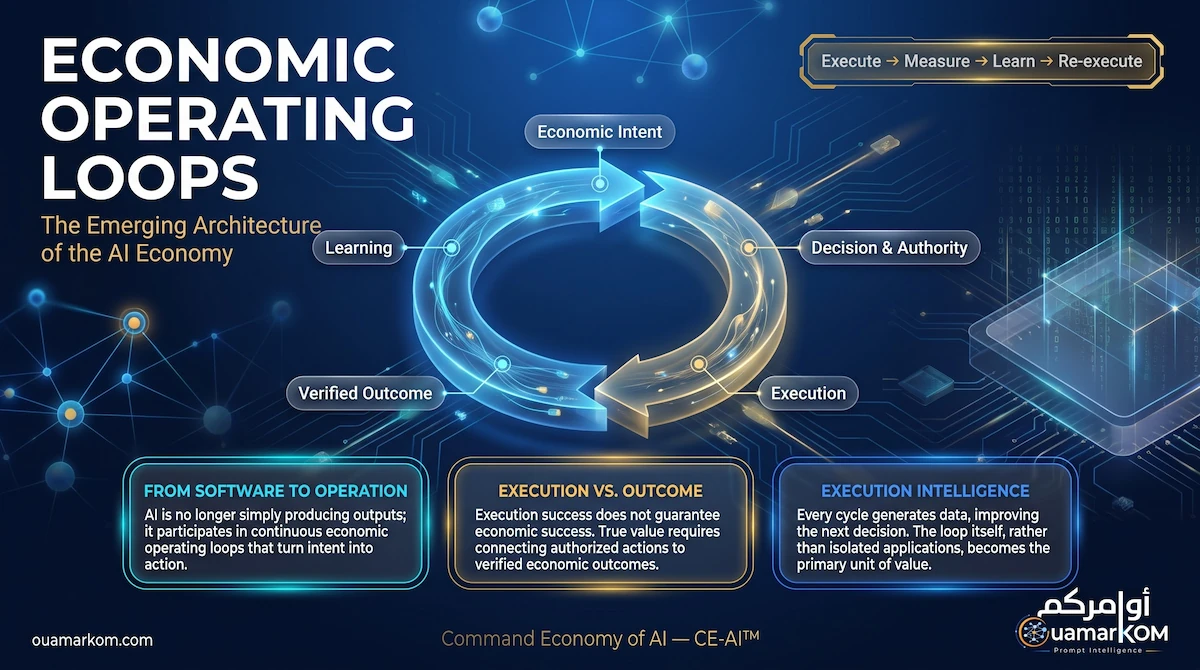
Introduction: When AI Moves from Answering to Acting
Over the past several decades, the digital economy has fundamentally transformed how organizations produce information, make decisions, and operate their businesses.
Generative AI has accelerated this transformation by dramatically reducing the cost of producing knowledge, analysis, content, and recommendations.
Yet the more consequential transformation may not be AI’s ability to produce information.
It may be its growing ability to participate in economic execution.
When an intelligent system can analyze a market, identify opportunities, select customers, prepare an offer, communicate with them, measure the response, adjust its strategy, and initiate the next action based on observed results, it is no longer simply producing an output.
It is participating in an ongoing economic operating loop.
1. «What happens when intelligence becomes executable?»
2. «What happens when execution itself becomes a continuous, measurable, and learning economic process?»
This is where the concept of Economic Operating Loops becomes useful as a framework for understanding a potential next stage of the AI economy.
From Software to Operation
Traditional software was largely designed to help people perform tasks.
A user entered information, initiated an action, received an output, and decided what to do next.
Automation extended this model. Systems could execute predefined sequences:
AI introduces a potentially different operating model:
The distinction is fundamental.
In the traditional model, humans determine what should happen and software executes it.
In the emerging model, AI systems may increasingly participate — within defined boundaries — in determining what should happen next.
This creates the possibility of a new type of economic system: one that does not merely execute workflows, but continuously responds to economic conditions.
What Is an Economic Operating Loop?
An Economic Operating Loop can be defined as:
Conceptually:
The distinction begins with the nature of the objective.
The objective is no longer simply: «“Send a marketing campaign.”»
It becomes: «“Increase qualified leads by 20% within a defined budget.”»
The system is therefore not merely given a task. It is given an economic objective.
The challenge becomes determining how that objective can be translated into decisions, authorized actions, measurable outcomes, and subsequent adjustments.
Execution Is Not the Same as Outcome
One of the most important distinctions in an AI-driven economy is the difference between successful execution and economic success.
An AI system may successfully send 100,000 marketing messages. That is execution success.
But if the campaign generates no meaningful commercial value, it is not necessarily economic success.
Suppose the campaign generates 500 purchases. That represents an economic outcome.
But another question remains: «Can the organization reliably establish that the outcome was caused by the execution?»
This introduces a third layer:
This distinction could become increasingly important as AI systems begin operating directly against business objectives.
Why Loops May Matter More Than Individual Tasks
As AI capabilities become increasingly accessible, many individual AI tasks may become commoditized.
- An AI system can write an email.
- Another can analyze a spreadsheet.
- Another can create an advertisement.
- Another can qualify a lead.
- Another can enter information into an enterprise system.
These capabilities may increasingly become standard features of broader platforms.
The more strategic question may therefore shift from: «Who has the best AI agent?» to: «Who controls the economic operating loop in which AI agents create value?»
Consider procurement. The economic objective is not simply: «“Find a supplier.”»
It may be: «“Reduce procurement costs while maintaining quality, compliance, and delivery requirements.”»
That objective can generate a continuous loop:
The system is no longer performing an isolated task. It is participating in a recurring economic process.
Each cycle can generate additional information about costs, suppliers, decisions, failures, constraints, and outcomes. Over time, that information may become a source of execution intelligence.
From Automation to Learning Economies
The deeper significance of an economic operating loop lies in what happens between cycles.
A one-time automated workflow is still primarily automation. A system that repeatedly executes, measures, learns, and adjusts represents something different:
Consider a marketing system. Its objective is to increase qualified leads. It tests several channels, measures acquisition costs and conversion rates, discovers that one channel consistently performs better under certain conditions, reallocates resources, measures the new results, and changes its strategy again.
The value is not simply the automation of individual actions. The system begins accumulating knowledge about how economic execution behaves in a particular environment.
This remains a hypothesis rather than a universally established economic category. But it is an important direction to investigate.
Autonomy Is Not the Objective
The emergence of increasingly capable AI systems naturally creates pressure toward greater autonomy.
But institutions face a more fundamental question: «How much authority can an organization safely delegate to an AI system?»
Technical capability does not equal institutional authority.
An AI agent may technically be capable of transferring $100,000. That does not mean it should be authorized to do so.
A more robust model therefore requires a control boundary between AI capability and institutional action:
AI can propose an action. Institutional infrastructure determines whether the action is authorized, within policy, appropriate to the risk level, and permitted under the relevant conditions.
This distinction may become fundamental to the architecture of AI-driven economic execution:
The future of AI autonomy may therefore depend less on removing human control than on building better mechanisms for bounded delegation.
The Emergence of the Command Economy of AI
This transition can also be understood through the broader concept of the Command Economy of AI™ (CE-AI).
In this framework, commands and intentions are no longer merely linguistic instructions. They can become entry points into economic execution:
The command becomes connected to a system capable of interpreting intent, determining actions, operating within institutional boundaries, and measuring what happened afterward.
This raises a much larger economic question: «What happens when human and institutional intent becomes increasingly executable by intelligent systems?»
The implications extend beyond technology. They touch organizational design, delegation of authority, productivity, capital allocation, risk management, governance, and potentially the architecture of firms themselves.
The Infrastructure Behind Economic Operating Loops
If Economic Operating Loops become widespread, new infrastructure requirements may emerge around them. Potential infrastructure layers could include:
- Economic intent interpretation
- Agent and tool orchestration
- Identity and authorization
- Policy enforcement
- Risk management
- Human approval and escalation
- Decision and execution records
- Evidence collection
- Outcome verification
- Cross-system coordination
- Performance benchmarking
- Economic attribution
This creates the possibility of an emerging infrastructure category: AI Execution Infrastructure.
However, this should be treated as an architectural hypothesis rather than an established market fact. Markets will determine which capabilities become independent infrastructure, which become embedded platform features, and which ultimately prove unnecessary.
The critical question is therefore not simply how many layers can be designed. It is: «Which layers repeatedly solve high-value problems that organizations cannot efficiently solve elsewhere?»
The Strategic Opportunity May Not Be Another AI Agent
If AI agents become increasingly commoditized, building yet another agent may not represent the deepest strategic opportunity.
The more important question becomes: «Where will durable value accumulate when intelligence becomes widely available?»
- It could accumulate in orchestration.
- It could accumulate in institutional authority.
- It could accumulate in governance.
- It could accumulate in verification.
- It could accumulate in proprietary execution data.
- It could accumulate in decision history.
- Or it could accumulate in the economic loops themselves.
Do not simply build better agents. Discover which economic operating loops can turn AI capabilities into recurring, measurable, and verifiable economic value.
That is not a guaranteed outcome. It is a hypothesis that must be tested.
From Applications to Economic Systems
Economic Operating Loops may therefore represent a potential evolution in the structure of enterprise software:
Software that performs work →
Systems that coordinate work →
Systems that optimize economic outcomes →
Systems executing against objectives within boundaries
If this transition materializes, the application may no longer be the most important unit of value. The loop may become more important.
An application performs a function. A loop manages a recurring cycle of: Objective → Decision → Action → Outcome → Learning → Next Action.
The economic value emerges not from one action, but from the repeated improvement of the entire cycle.
The Next Question for the AI Economy
The next phase of artificial intelligence may not be measured only by model intelligence, reasoning capability, or quality of generated outputs. It may increasingly be measured by a different set of questions:
- «What can AI reliably execute?»
- «What authority can institutions safely delegate to it?»
- «What economic outcomes can it influence?»
- «How can those outcomes be measured?»
- «How can they be verified?»
- «And can the system learn from each cycle well enough to improve the next one?»
This reframes the transition from:
The deeper opportunity may therefore lie not in making AI act without limits, but in developing the infrastructure that allows intelligent systems to participate in economic execution with authority, governance, evidence, measurement, and accountability.
Conclusion: From Intelligence to Economic Operation
The defining question of the next AI era may not be: «What can artificial intelligence know?»
It may be: «What can an economy reliably accomplish when intelligence becomes executable?»
Economic Operating Loops provide one possible framework for exploring that question. They describe a transition from isolated AI outputs toward continuous systems capable of transforming economic intent into authorized action, measuring real-world outcomes, verifying those outcomes, and using accumulated learning to inform the next decision.
The long-term trajectory can be expressed simply:
If this model proves viable at scale, the economic significance of AI may extend far beyond automation.
AI would not merely become a tool that helps people work. It could become a participant in the operating loops through which organizations allocate resources, serve customers, manage processes, pursue objectives, and create economic value.
And that leads to perhaps the most important question of all:
That question may define one of the most consequential infrastructure challenges of the AI era.
Ouamarkom™
Building the Infrastructure for AI-Executed Economies.
Establish Your Execution Infrastructure Now