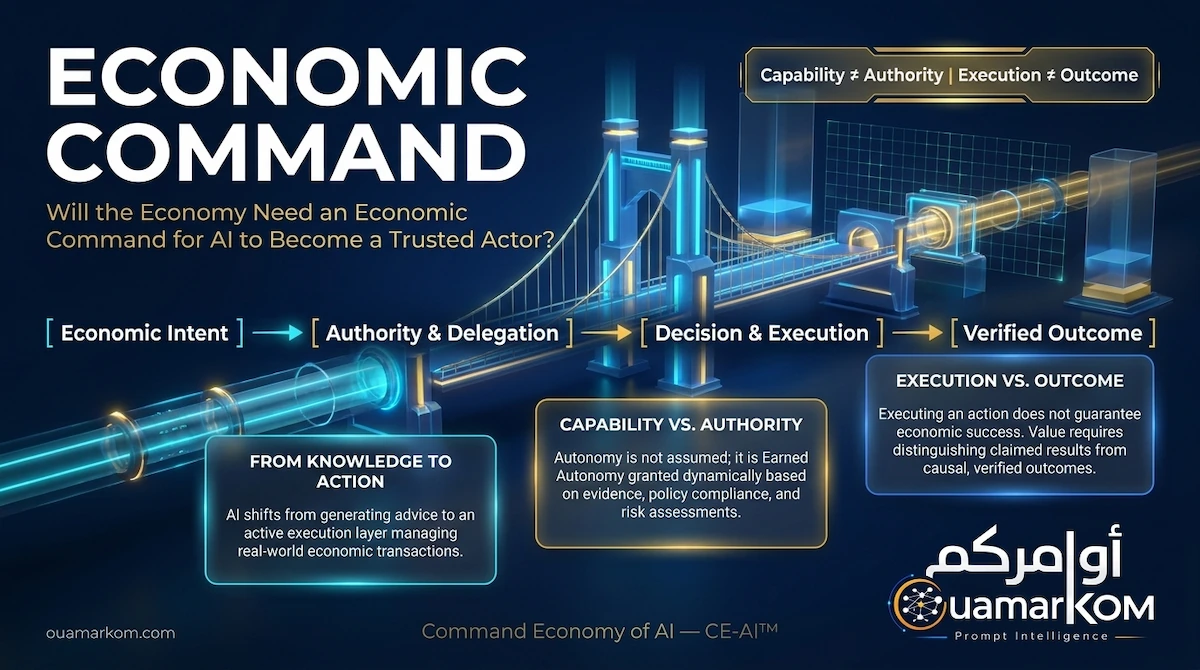
From the Information Economy to the Execution Economy
For decades, the role of computing in the economy evolved from calculation and information processing to coordination, automation, and decision support. More recently, artificial intelligence has expanded the capabilities of machines to analyze information, generate predictions, produce recommendations, and support increasingly complex decisions.
The next transition may be more consequential.
As AI systems become increasingly agentic, they are no longer necessarily limited to producing information or recommending what a human should do. They can increasingly plan, use tools, interact with enterprise systems, and execute actions in the real world.
An AI system may negotiate with suppliers, adjust marketing budgets, manage inventory, initiate procurement processes, coordinate logistics, or execute financial and operational workflows within defined boundaries.
At that point, the economic problem changes.
The central question is no longer simply: «Can AI make a good decision?»
It becomes: «Can an institution delegate real economic authority to AI while preserving control over intent, authority, policy, execution, evidence, accountability, and outcomes?»
This is where the concept of the Economic Command becomes an important hypothesis to investigate.
The argument does not begin by assuming that a new system called a “Command Economy” must exist. Naming a concept does not create a market, establish an architectural necessity, or prove an economic transformation.
The more fundamental question is:
1. When AI Becomes an Economic Actor
In the traditional enterprise model, technology processes information while humans retain responsibility for decisions and execution.
AI changes this relationship when it becomes capable of planning, deciding, using tools, and taking actions autonomously or semi-autonomously.
The critical issue then becomes delegation.
If an AI agent is authorized to execute a procurement transaction, who granted that authority? What is the scope of the authority? What financial limits apply? Which suppliers can it engage? Which policies govern its decisions? When must it escalate to a human? What happens if circumstances change? How can the institution prove that the action was authorized? And if an economic outcome occurs, how can the institution demonstrate what actually happened?
These are not merely technical questions. They are questions about the institutional architecture of economic agency.
An institution does not simply need intelligent systems capable of making decisions. It needs mechanisms through which intelligence can be delegated economic authority, constrained, observed, measured, and held accountable.
2. Why Might an Economic Command Become Necessary?
Modern enterprises already possess ERP systems, CRM platforms, identity and access management, workflow engines, policy systems, payment infrastructure, audit logs, analytics platforms, and AI systems.
An Economic Command therefore should not be understood as a replacement for these systems. Its potential role may be different: it could become a common economic coordination and accountability abstraction connecting information and actions distributed across multiple systems.
Consider a simple institutional objective: «“Reduce procurement costs by 5% during the next quarter.”»
This is not merely a software task. It contains an economic objective, a principal, delegated authority, financial boundaries, policies, risk constraints, an AI agent, permitted actions, prohibited actions, evidence requirements, and a definition of what constitutes a successful outcome.
The economic execution chain can therefore be represented as:
The hypothesis is that, as AI-driven economic execution expands, institutions may require a persistent unit capable of maintaining this economic context across the entire execution lifecycle. That unit may be the Economic Command.
3. Execution Is Not the Same as Outcome
One of the most important distinctions in the emerging AI economy may be the difference between successful execution and successful economic performance.
Suppose an AI agent negotiates with a supplier and secures an 8% price reduction. The system may be able to prove that it contacted the supplier, negotiated the price, and completed the transaction. But does that prove that the institution achieved an 8% economic saving?
Not necessarily. Market prices may have declined during the same period. Shipping costs may have increased. Product quality may have changed. Payment terms may have deteriorated. The transaction may not have been completed at scale.
Consequently, economic systems may need to distinguish between:
These are not equivalent. This distinction becomes increasingly important as AI moves from recommending actions to executing economic activity.
The relevant question is no longer simply: What did the AI do? It becomes: What happened economically as a result, what can be verified, and what can reasonably be attributed to the system's actions?
This is where an execution architecture becomes fundamentally different from a simple activity log.
4. From Agentic AI to Governed Economic Agency
Agentic AI addresses a fundamental capability problem: enabling AI systems to plan, reason, use tools, and act. But the ability to act does not automatically confer the authority to act.
Several distinctions therefore become essential:
- Capability ≠ Authority
- Capability ≠ Trust
- Capability ≠ Autonomy
- Execution ≠ Outcome
- Outcome ≠ Causal Attribution
An AI system may technically be capable of executing a transaction worth millions of dollars. That does not mean an institution should grant it such authority. Likewise, a system may perform successfully across many cases without possessing sufficient evidence to justify broader autonomy.
This creates the possibility of Earned Autonomy. Under this model, autonomy is not granted simply because an AI system is technically capable. Authority can expand or contract according to demonstrated performance, evidence, policy compliance, risk, failures, and verified outcomes.
Autonomy therefore becomes something that can be earned through evidence, rather than assumed through capability. An Economic Command could potentially provide one of the structural mechanisms for organizing this relationship between institutional intent, delegated authority, execution, and evidence.
5. Is Economic Command Actually Necessary?
This is where intellectual discipline becomes essential. It is easy to build a system called an Economic Command. That does not demonstrate that the concept is economically necessary.
The real test should compare alternative architectures:
- Task-Centric Model: Relying on existing enterprise systems, workflow engines, agent platforms, identity systems, policy engines, and audit infrastructure.
- Command-Centric Model: Introducing a command-centric architecture in which the Economic Command becomes the organizing unit connecting intent, authority, execution, evidence, and outcomes.
These approaches can then be evaluated against measurable criteria: Traceability, Authority integrity, Evidence completeness, Outcome linkage, Audit efficiency, Human intervention, Failure recovery, Reproducibility, Cross-system coordination, Integration cost, and Scalability.
If repeated experiments demonstrate that the command-centric approach materially improves these dimensions, the Economic Command hypothesis becomes stronger. If existing systems can achieve equivalent results without such an abstraction, the hypothesis should be narrowed, modified, or rejected.
That possibility must remain open. Because the objective is not to defend a concept; the objective is to discover whether the concept is necessary.
6. From Operational Necessity to Structural Necessity
The potential need for an Economic Command can be examined at three distinct levels:
The abstraction makes a system easier to manage, understand, or integrate. This alone does not establish structural importance.
Level Two: Operational Necessity
Without the abstraction, execution becomes significantly more complex, expensive, or difficult to govern. This represents stronger evidence.
Level Three: Structural Necessity
The most important threshold occurs when institutions cannot reliably scale AI-driven economic execution without a common mechanism connecting intent, authority, execution, evidence, outcomes, and accountability.
At Level Three, Economic Command would no longer be merely a preferred architectural pattern. It could become a structural requirement for AI-driven economic execution. But reaching this conclusion cannot be assumed in advance. It must be demonstrated through empirical evidence.
7. From Economic Commands to Economic Interoperability
If Economic Commands prove valuable within individual institutions, another problem may eventually emerge at institutional boundaries.
Economic activity rarely occurs inside a single organization. A procurement decision may involve a buyer, supplier, logistics provider, financial institution, insurer, and other participants.
This creates the possibility of Economic Command Interoperability: the ability of independent institutions and systems to interpret, validate, exchange, and respond to economic commands according to shared semantics while preserving the authority and policies of each participant.
What can potentially cross organizational boundaries is economic meaning, coordination, context, and evidence—not institutional authority itself.
If repeated real-world execution demonstrates that existing protocols are insufficient for this type of economic interoperability, a new protocol layer may eventually become justified. But the sequence matters: Need → Evidence → Standard (Not: Standard → Hope → Market).
8. The Real Test Is the Economy
The necessity of an Economic Command will not be established by a compelling demo or an elegant architectural diagram. The real test is economic execution under real-world conditions.
That means incomplete data, legacy systems, conflicting policies, human approvals, financial limits, changing markets, operational failures, exceptions, and accountability requirements.
A useful minimum experiment could involve:
The purpose of such an experiment is to discover: Where the command abstraction creates value; Where it fails; Which architectural layers are actually necessary; Which layers are redundant; What existing infrastructure already solves; Where genuine structural gaps remain; And under what conditions Economic Command becomes necessary.
This turns architecture into an empirical question.
9. The Deeper Economic Question
The emergence of increasingly autonomous AI systems may ultimately force organizations to rethink the architecture of economic delegation itself.
For centuries, economic authority has been exercised primarily by humans and institutions. The next phase may introduce another class of economic actors: AI systems capable of acting within delegated authority on behalf of institutions.
That transition creates a new institutional problem: How do we specify what the AI is expected to accomplish? How do we define what it is authorized to do? How do we constrain it? How do we record its decisions? How do we verify its actions? How do we determine whether the intended economic outcome actually occurred? And how do we decide whether the system has earned more—or less—authority?
Economic Command is one possible answer. It is not yet a proven answer. That distinction matters.
Conclusion: The Question That May Define the Next Stage of AI Economics
The most consequential transition in artificial intelligence may not be the movement from one more capable model to another. It may be the transition:
When AI becomes capable of executing economic activity on behalf of institutions, intelligence alone will no longer be sufficient. Institutions will need mechanisms for delegation, authority, governance, execution, evidence, verification, accountability, and learning.
Economic Command may become one of the fundamental abstractions through which these functions are organized. But that conclusion should not be declared before the evidence exists.
The real research question is therefore not: “Can we define a system called the Command Economy?” It is:
If real-world evidence shows that institutions repeatedly require such a unit to govern and scale AI-driven economic execution, Economic Command may evolve from an architectural hypothesis into a fundamental economic primitive. If the evidence shows that existing systems can accomplish the same objectives without it, then the hypothesis should change—or disappear. Both outcomes are valuable. Because the purpose of the inquiry is not to protect a name, a framework, or an architecture. It is to discover what the economy actually requires.
The deeper question is therefore not merely what AI can do. It is:
And that question may ultimately be more important than the question of how intelligent AI becomes.
Ouamarkom™
Building the Infrastructure for AI-Executed Economies.
Establish Your Execution Infrastructure Now