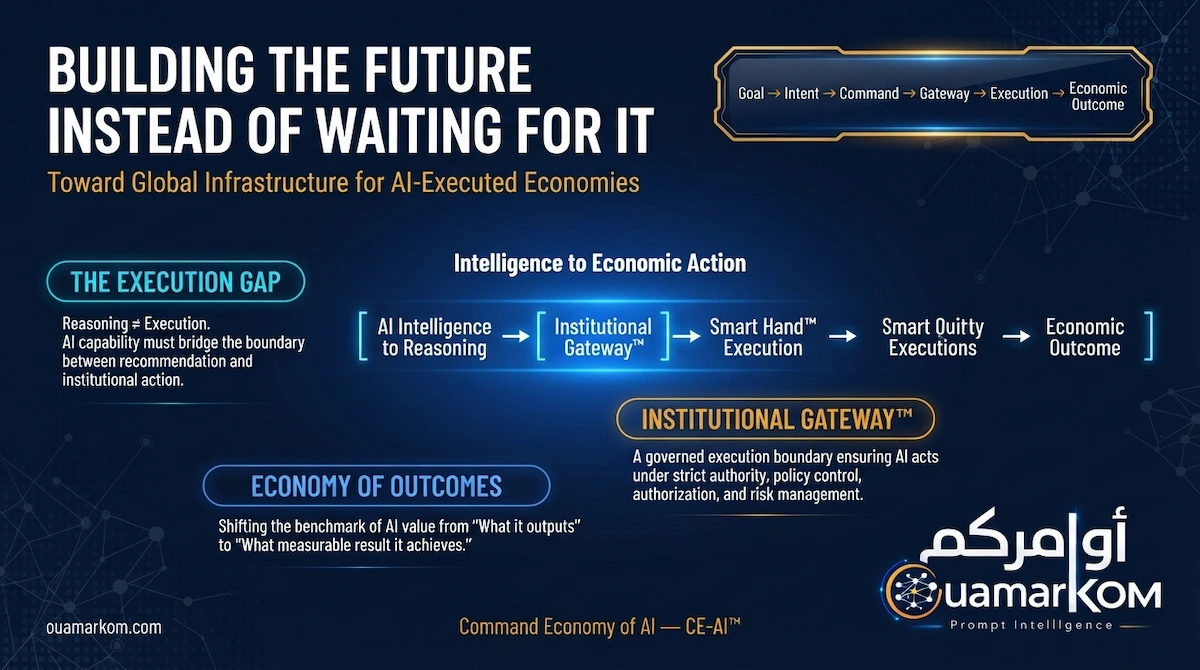
Building the Future Instead of Waiting for It

Toward Global Infrastructure for AI-Executed Economies

By Morad Nagib Alsahybi - Founder & CEO, Ouamarkom™

Building the Future Instead of Waiting for It
Introduction

The most important question in the age of artificial intelligence may no longer be:

Who has the most intelligent model?

A deeper question is beginning to emerge:

Who will build the infrastructure capable of turning intelligence into economic action that is reliable, governed, traceable, verifiable, and measurable?

Over the past several years, much of the technological race has focused on developing increasingly capable artificial intelligence models with stronger abilities in understanding, generation, analysis, programming, planning, and reasoning.

This progress has dramatically reduced the cost of producing digital knowledge and opened the path for AI to evolve from an assistive technology into an active participant in organizational processes.

Yet greater reasoning capability does not automatically translate into greater institutional execution capability.

An AI system may analyze sales data, recommend cost reductions, identify supply-chain opportunities, design a marketing campaign, or propose a customer strategy. But economies do not move on recommendations alone.

Economic value emerges when a recommendation moves from the screen into a system, from the system into an action, and from that action into an outcome that can be measured and verified.

«The gap between reasoning and execution.»

From Intelligence to Execution

A fundamental distinction can be expressed simply:

Reasoning ≠ Execution

An AI system may be capable of answering: What should we do?

An institution, however, must address a much broader set of questions:

  • Are we authorized to do it?
  • Who has the authority to approve or issue the action?
  • What policies and constraints apply?
  • Which systems need to change?
  • Which agent or tool should perform the operation?
  • What is the associated risk?
  • Is human approval required?
  • How should execution be monitored?
  • What happens if execution fails?
  • How can we verify that the intended outcome was actually achieved?

The path from intelligence to economic value may therefore look more like:

Goal Intent Command Policy Authorization Planning Coordination Execution Audit Verification Outcome

This is not merely a technical sequence. It represents a potential new value chain for institutions moving from using AI to produce information toward using AI, within defined governance boundaries, to participate in the execution of economic objectives.

The Economy Does Not Operate Inside the Model

Regardless of how capable an AI model becomes, most real economic activity does not take place inside the model. It takes place across the systems that operate institutions and markets:

  • Enterprise Resource Planning systems (ERP)
  • Customer Relationship Management systems (CRM)
  • Financial and accounting systems
  • Procurement platforms
  • Inventory systems
  • Human resources systems
  • Supply-chain infrastructure
  • E-commerce platforms
  • Databases & APIs
  • Operational and industrial systems

This creates an important paradox: AI may become increasingly capable of understanding an organization while its ability to act within that organization remains constrained by fragmented integrations, permissions, workflows, policies, and operational controls.

The next institutional challenge, therefore, may not simply be a lack of intelligence. It may be the absence of an appropriate execution layer.

AI Execution Infrastructure

This is where the concept of AI Execution Infrastructure becomes relevant.

AI Execution Infrastructure should not be confused with the infrastructure used to operate AI models in terms of computing, storage, and networking. That is: AI Compute Infrastructure.

AI Execution Infrastructure addresses a different question:

«How does a decision, plan, or instruction produced by AI become a real institutional action that is governed, traceable, verifiable, and measurable?»

The distinction is fundamental:

  • AI compute infrastructure asks: Where and how do we run the model?
  • AI execution infrastructure asks: How do we create a controlled path through which AI-generated intelligence can become action within the real economy?

The first provides the capacity to operate intelligence. The second seeks to provide the infrastructure through which intelligence can be translated into action.

Institutional Gateway

The Boundary Between Intelligence and the Economy

If AI represents a reasoning layer, while enterprise systems represent the environment in which resources, processes, and economic value move, then there may be a need for an intermediate layer capable of managing the boundary between the two. This concept can be described as an Institutional Gateway.

An Institutional Gateway is not simply an API gateway. It is not a dashboard, and it is not conventional workflow automation. Rather, it can be understood as a governed execution boundary positioned between:

AI Decision Institutional Gateway Institutional Action

Depending on the architecture, such a layer may provide capabilities including:

  • Identity & Authorization
  • Permissions & Policy enforcement
  • Risk classification & Human approvals
  • Agent orchestration & Tool selection
  • Execution control & Auditability
  • Verification & Outcome measurement

The objective is not to give AI unrestricted authority over institutional systems. It is the opposite: to provide AI with clearly defined and observable boundaries within which it can act.

From Automation to Economic Execution

Traditional automation often follows a relatively deterministic logic: If A happens → execute B.

AI-enabled economic execution operates at a different level of abstraction. Consider objectives such as:

  • «Reduce customer request processing time.»
  • «Improve lead conversion.»
  • «Reduce the cost of a specific operational process.»

These are not predefined execution commands; they are economic objectives. Turning such objectives into action requires a system capable of interpreting the objective, understanding its context, identifying constraints, developing a plan, selecting appropriate tools, validating permissions, coordinating agents and systems, executing actions, and monitoring outcomes.

This suggests a transition:

Task Automation → Goal-Oriented Execution

Such a transition may ultimately be more economically significant than simply increasing the number of individual tasks that AI can automate.

An Attempt to Build the Execution Layer

Within this context, Ouamarkom™ introduces Smart Hand™ as an attempt to explore and build an execution layer capable of bridging AI intelligence with the systems in which real economic activity takes place.

The objective is not to build another “brain” competing with the major AI models. The objective is to explore the layer that allows the capabilities of those models to cross into the operational world through controlled execution.

A conceptual architecture can be represented as:

AI Models Intent & Goal Command Institutional Gateway Policy & Authorization Agent / Tool Orchestration Enterprise Systems Execution Audit & Verification Economic Outcome

Within this architecture:

  • Intelligence supports reasoning and decision-making.
  • Intent and Goal define what the institution seeks to achieve.
  • Command translates the objective into an executable directive.
  • Institutional Gateway governs the boundary between AI and institutional systems.
  • Policy and Authorization determine what may be executed and under whose authority.
  • Orchestration coordinates agents, tools, and operational systems.
  • Enterprise Systems provide the environment in which economic activity actually occurs.
  • Execution turns plans into actions.
  • Audit and Verification provide evidence of what happened and whether execution succeeded.
  • Economic Outcome provides a basis for evaluating the value of execution.
«The value of AI may not end with the quality of its outputs. In some of the most economically significant applications, value may begin when those outputs become actions and measurable outcomes.»

From CE-AI to CEP

Within this broader vision, Command Economy of AI — CE-AI™ can be understood as the thesis and framework exploring the transition from using AI primarily to produce information toward using AI, within defined governance boundaries, to participate in executing economic objectives.

CEP™, within the Ouamarkom thesis, represents an attempt to translate recurring operational patterns into rules and executable specifications that can be applied more consistently and repeatedly.

The purpose is not simply to introduce another technical abstraction. It is to explore whether commands, objectives, decisions, policies, and execution patterns can be expressed in a more structured operational language between intelligence and institutional action.

An Economy of Outcomes, Not Outputs

One of the most important potential shifts may be the transition from evaluating AI according to what it produces to evaluating AI according to what it helps achieve.

Under a traditional model, organizations may ask:

  • How many requests did the system answer?
  • How many documents did it generate?
  • How many tasks did it automate?
  • How much code did it produce?

Under an economic execution model, the questions may become:

  • How much time was saved?
  • How much did process cost decrease?
  • How much did conversion improve?
  • How much manual work was eliminated?
  • How much did productivity increase?
  • How much did response time improve?
  • What was the measurable return on investment?
AI Output Economic Outcome

This shift could influence how organizations evaluate and prioritize AI initiatives. Organizations ultimately do not invest in AI simply to produce more outputs. They invest in it to achieve results.

Governance Is Not the Opposite of Execution

As intelligent systems become increasingly capable of planning, coordinating, and executing actions, governance becomes more important—not less.

«How do we allow intelligent systems to act without losing institutional control?»

This is not solely a technical question. It is simultaneously an engineering, economic, governance, and accountability question.

Building a layer between AI and enterprise systems should therefore not be interpreted as an attempt to grant machines unrestricted autonomy. It can instead serve the opposite purpose: to introduce AI into institutional environments through explicit boundaries of authority, responsibility, risk, and auditability.

From this perspective, the concept of an Execution Boundary may become an important component of AI-native institutional architecture.

From Owning Intelligence to Owning the Execution Path

The next phase of AI may not be determined entirely at the model layer. It may also be determined by the layers that make those models usable, controllable, repeatable, and measurable within the economy.

As AI becomes increasingly capable of understanding objectives, planning actions, and coordinating processes, another question becomes increasingly important: «How do we allow AI to act without losing control?»

This leads to a broader architectural concept: Execution Infrastructure—the infrastructure connecting a system's ability to reason with its ability to act within real-world institutional environments.

From this perspective:

  • Institutional Gateway represents the conceptual execution boundary between AI and institutional systems.
  • Smart Hand™ represents an attempt to embody the execution and orchestration layer.
  • CEP™ represents an attempt to translate recurring execution patterns into applicable specifications.
  • CE-AI™ represents the broader framework connecting these elements to a potential economic transformation:
«From an economy in which machines primarily produce information to an economy in which intelligent systems, within defined governance boundaries, can participate in executing objectives.»

Building the Future Instead of Waiting for It

Building the infrastructure for the next phase of AI does not require assuming that the future has already been determined. It requires identifying emerging gaps, developing hypotheses, building systems, and testing whether those hypotheses hold in real environments.

This is the approach Ouamarkom™ seeks to pursue. Not by claiming that AI Execution Infrastructure is already a global standard. Not by claiming that the Institutional Gateway is the only possible architecture. And not by claiming that Smart Hand™ represents a final solution.

Instead, Ouamarkom is exploring an engineering and economic hypothesis that is worth testing:

«If a governed execution layer can connect AI intelligence with institutional systems; if that layer can demonstrate measurable economic outcomes; and if its architecture can be replicated across organizations and industries, then a new infrastructure layer may emerge within the AI economy.»

This makes the ambition of Ouamarkom™ more precise than simply building another product. It is an attempt to explore a transition:

Intelligence Command Execution Evidence Economic Outcome

Only then can the larger question be addressed: «Can such a layer become part of the infrastructure underlying AI-executed economies?» The answer should not be a promise. It should be the result of testing.

Conclusion

The future of AI will not be defined only by how much intelligence machines possess. It may also be defined by the infrastructure that allows that intelligence to operate in the real world through explicit boundaries of authority, policy, risk, accountability, and verification.

The transition from AI Intelligence to AI Execution may therefore become one of the defining architectural questions for AI-enabled institutions.

If previous generations of infrastructure made computing, data, and intelligence increasingly accessible at scale, the next challenge may be to build the infrastructure that makes governed intelligent execution possible across organizations and economic systems.

This is not a settled conclusion. It is a hypothesis worth building and testing. And this is the essence of:

Building the Future Instead of Waiting for It.
We do not claim to own the standard. We build and test the infrastructure that may make earning it possible.

Ouamarkom™

Building the Infrastructure for AI-Executed Economies.

Establish Your Execution Infrastructure Now
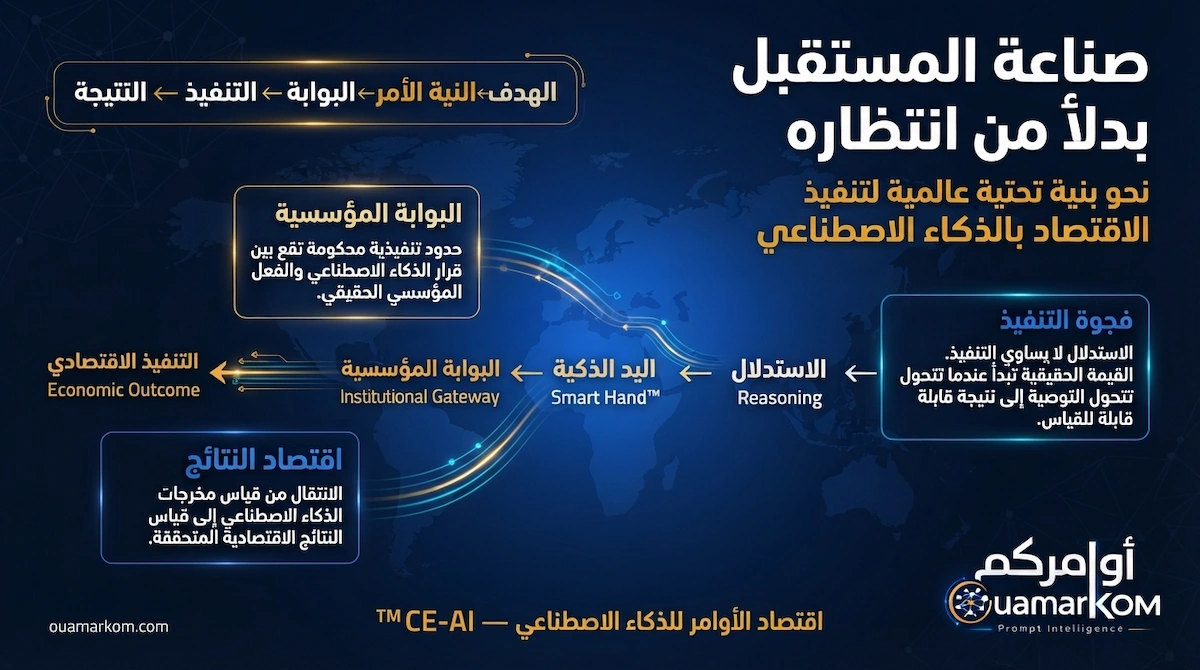
صناعة المستقبل بدلًا من انتظاره

نحو بنية تحتية عالمية لتنفيذ الاقتصاد بالذكاء الاصطناعي

بقلم م. مراد نجيب الصهيبي - المؤسس والرئيس التنفيذي لـ Ouamarkom™

صناعة المستقبل بدلًا من انتظاره
مقدمة

لم يعد السؤال الأكثر أهمية في عصر الذكاء الاصطناعي هو:

من يمتلك النموذج الأكثر ذكاءً؟

بل بدأ يظهر سؤال أكثر عمقًا:

من يمتلك القدرة على تحويل الذكاء إلى فعل اقتصادي موثوق، محكوم، قابل للتتبع والتحقق والقياس؟

خلال السنوات الماضية، تركز السباق التقني بدرجة كبيرة على بناء نماذج ذكاء اصطناعي أكثر قدرة على الفهم، والتوليد، والتحليل، والبرمجة، والتخطيط والاستدلال.

وقد أدى هذا التطور إلى خفض تكلفة إنتاج المعرفة الرقمية بصورة غير مسبوقة، وفتح الطريق أمام انتقال الذكاء الاصطناعي من أداة مساعدة إلى عنصر فاعل في عمليات المؤسسات.

لكن ارتفاع قدرة النظام على الاستدلال لا يعني بالضرورة ارتفاع قدرته على التنفيذ المؤسسي.

يمكن لنظام ذكاء اصطناعي أن يحلل بيانات المبيعات، ويقترح خفضًا في التكاليف، ويحدد فرصًا في سلسلة الإمداد، ويقترح حملة تسويقية، أو يضع استراتيجية للتعامل مع العملاء. لكن الاقتصاد لا يتحرك بالتوصيات وحدها.

القيمة الاقتصادية تظهر عندما تنتقل التوصية من الشاشة إلى النظام، ومن النظام إلى الفعل، ومن الفعل إلى نتيجة يمكن قياسها والتحقق منها.

«الفجوة بين الاستدلال والتنفيذ.»

من الذكاء إلى التنفيذ

يمكن اختزال جزء من هذا التحول في معادلة بسيطة:

Reasoning ≠ Execution

قد يستطيع الذكاء الاصطناعي الإجابة عن سؤال: ماذا ينبغي أن نفعل؟

لكن المؤسسة تحتاج إلى منظومة تستطيع التعامل مع مجموعة مختلفة وأكثر تعقيدًا من الأسئلة:

  • هل يُسمح لنا بفعل ذلك؟
  • من يملك صلاحية إصداره؟
  • ما السياسات والقيود التي تحكمه؟
  • ما الأنظمة التي يجب أن تتغير؟
  • أي Agent أو أداة يجب أن تنفذ العملية؟
  • ما مستوى المخاطر؟
  • هل تتطلب العملية موافقة بشرية؟
  • كيف تتم مراقبة التنفيذ؟
  • ماذا يحدث إذا فشل التنفيذ؟
  • وكيف نثبت أن النتيجة تحققت بالفعل؟

لذلك، قد يبدو المسار الحقيقي من الذكاء إلى القيمة الاقتصادية أقرب إلى:

الهدف النية الأمر السياسة التفويض التخطيط التنسيق التنفيذ التدقيق التحقق النتيجة

هذه ليست مجرد سلسلة تقنية. إنها تصور محتمل لسلسلة قيمة جديدة، يمكن أن تحدد كيفية انتقال المؤسسات من استخدام الذكاء الاصطناعي لإنتاج المعلومات إلى استخدامه للمشاركة، ضمن حدود الحوكمة، في تنفيذ الأهداف الاقتصادية.

الاقتصاد لا يتحرك داخل النموذج

مهما بلغت قدرة نموذج الذكاء الاصطناعي، فإن معظم النشاط الاقتصادي الحقيقي لا يحدث داخله. إنه يحدث في الأنظمة التي تدير المؤسسات والاقتصاد:

  • أنظمة تخطيط موارد المؤسسات (ERP)
  • إدارة علاقات العملاء (CRM)
  • الأنظمة المالية والمحاسبية
  • المشتريات
  • المخزون
  • الموارد البشرية
  • سلاسل الإمداد
  • منصات التجارة الإلكترونية
  • قواعد البيانات وواجهات البرمجة
  • الأنظمة التشغيلية والصناعية

وهنا تظهر مفارقة مهمة. يمكن للذكاء الاصطناعي أن يصبح أكثر قدرة على فهم المؤسسة، بينما تظل قدرته على التصرف داخلها محدودة أو موزعة بين طبقات متعددة من التكاملات والصلاحيات وسير العمل والسياسات.

ولهذا قد لا تكون المشكلة التالية في المؤسسات هي نقص الذكاء. قد تكون المشكلة هي غياب طبقة تنفيذ مناسبة.

AI Execution Infrastructure

من هنا يظهر مفهوم: AI Execution Infrastructure.

المقصود بهذا المفهوم ليس البنية التحتية التي تشغّل نماذج الذكاء الاصطناعي من حيث الحوسبة والتخزين والشبكات. تلك هي AI Compute Infrastructure.

أما AI Execution Infrastructure فتتعامل مع سؤال مختلف:

«كيف ينتقل ما قرره الذكاء الاصطناعي إلى فعل مؤسسي حقيقي، محكوم، قابل للتتبع، والتحقق والقياس؟»

وهذا الفرق جوهري:

  • البنية التحتية الحاسوبية تسأل: أين وكيف نشغّل النموذج؟
  • البنية التحتية التنفيذية تسأل: كيف نجعل القرار أو الخطة التي ينتجها الذكاء الاصطناعي قابلة للعبور المنضبط إلى الاقتصاد الحقيقي؟

الأولى توفر القدرة على تشغيل الذكاء. أما الثانية فتستهدف توفير مسار التنفيذ الذي يمكن من خلاله تحويل هذا الذكاء إلى فعل.

Institutional Gateway

البوابة بين الذكاء والاقتصاد

إذا كان الذكاء الاصطناعي يمثل طبقة الاستدلال، وكانت الأنظمة المؤسسية هي البيئة التي تتحرك فيها الموارد والعمليات والقيمة، فإن ذلك يطرح الحاجة إلى طبقة وسيطة تدير نقطة العبور بين الاثنين. يمكن تسمية هذا المفهوم: Institutional Gateway.

وهي ليست مجرد API Gateway. وليست لوحة تحكم. وليست نظام أتمتة تقليديًا. بل يمكن تصورها كـ Execution Boundary محكومة تقع بين:

AI Decision Institutional Gateway Institutional Action

وبحسب التصميم المستهدف، يمكن أن تتولى هذه الطبقة وظائف مثل:

  • الهوية والتفويض والصلاحيات
  • تطبيق السياسات وتصنيف المخاطر
  • الموافقات البشرية وتنسيق الوكلاء
  • اختيار الأدوات والتحكم في التنفيذ
  • التسجيل والتدقيق والتحقق من النتائج
  • قياس الأداء والنتائج الاقتصادية

وبذلك لا يحصل الذكاء الاصطناعي على سلطة مطلقة للتصرف داخل المؤسسة. بل يعمل من خلال حدود تنفيذية واضحة وقابلة للمراقبة. وقد يصبح هذا المفهوم أكثر أهمية مع انتقال الوكلاء من إنتاج النصوص والمعلومات إلى تنفيذ الإجراءات داخل الأنظمة المؤسسية.

من الأتمتة إلى التنفيذ الاقتصادي

الأتمتة التقليدية تقوم غالبًا على منطق: إذا حدث A ← نفذ B.

لكن التنفيذ الاقتصادي المدعوم بالذكاء الاصطناعي يتعامل مع أهداف أكثر تجريدًا. مثل:

  • «أريد خفض زمن معالجة طلبات العملاء.»
  • «أريد تحسين معدل تحويل العملاء المحتملين.»
  • «أريد خفض تكلفة عملية معينة.»

هذه ليست أوامر تنفيذية جاهزة؛ إنها أهداف اقتصادية. ولتحويلها إلى فعل، تحتاج المنظومة إلى تفسير الهدف، وفهم السياق، وتحديد القيود، وبناء خطة، وااختيار الأدوات، والتحقق من الصلاحيات، وتنسيق الوكلاء والأنظمة، ثم تنفيذ الإجراءات ومراقبة النتائج.

وهنا يظهر انتقال محتمل:

Task Automation → Goal-Oriented Execution

وهذا التحول قد يكون أكثر أهمية اقتصاديًا من مجرد زيادة عدد المهام التي يستطيع النظام أتمتتها.

محاولة لبناء طبقة التنفيذ

في هذا السياق، تقدم Ouamarkom™ مفهوم Smart Hand™ باعتباره محاولة لبناء طبقة تنفيذ تستهدف سد الفجوة بين الذكاء الاصطناعي والأنظمة التي يحدث فيها النشاط الاقتصادي الفعلي.

الفكرة ليست بناء «عقل» جديد ينافس النماذج الكبرى. بل بناء طبقة تجعل قدرات هذه النماذج قابلة للعبور المنضبط إلى العالم التشغيلي.

يمكن تصور المعمارية المقترحة على النحو التالي:

AI Models Intent & Goal Command Institutional Gateway Policy & Authorization Agent / Tool Orchestration Enterprise Systems Execution Audit & Verification Economic Outcome

في هذه البنية:

  • الذكاء يساعد على الفهم والاستدلال واتخاذ القرار.
  • النية والهدف يحددان ما الذي تسعى المؤسسة إلى تحقيقه.
  • الأمر يحول الهدف إلى صيغة قابلة للتوجيه والتنفيذ.
  • البوابة المؤسسية تتحكم في العبور.
  • السياسات والتفويض تحدد ما يمكن فعله ومن يملك صلاحية فعله.
  • طبقة التنسيق تختار الأدوات والوكلاء وتنسق العمليات.
  • الأنظمة المؤسسية تمثل البيئة التي يحدث فيها النشاط الحقيقي.
  • التنفيذ يحول الخطة إلى فعل.
  • التدقيق والتحقق يوفران الأدلة اللازمة لفهم ما حدث وما إذا كان قد نجح.
  • Economic Outcome بوصفها المعيار النهائي للقيمة.
«قد لا تنتهي قيمة الذكاء الاصطناعي عند جودة مخرجاته؛ ففي بعض الاستخدامات الاقتصادية، قد تبدأ القيمة الحقيقية عندما تتحول تلك المخرجات إلى أفعال ونتائج قابلة للقياس.»

من CE-AI إلى CEP

ضمن هذه الرؤية، يمكن فهم Command Economy of AI — CE-AI™ باعتباره الأطروحة والإطار الذي يستكشف الانتقال من استخدام الذكاء الاصطناعي لإنتاج المعلومات إلى استخدامه للمشاركة، ضمن حدود الحوكمة، في تنفيذ الأهداف الاقتصادية.

أما CEP™ فيمثل، في أطروحة Ouamarkom، محاولة لتحويل الأنماط التشغيلية المتكررة إلى قواعد ومواصفات تنفيذية يمكن تطبيقها بصورة أكثر اتساقًا وقابلية للتكرار.

وبذلك لا يمثل CEP مجرد اختصار تقني آخر، بل جزءًا من محاولة بناء لغة تشغيلية يمكن أن تساعد على وصف كيفية انتقال الأوامر والقرارات والأهداف من طبقة الذكاء إلى طبقة التنفيذ.

اقتصاد النتائج، لا اقتصاد المخرجات

قد يكون أحد أهم التحولات القادمة هو الانتقال من قياس الذكاء الاصطناعي بناءً على ما ينتجه إلى قياسه بناءً على ما يساهم في تحقيقه.

في النموذج التقليدي، قد نسأل:

  • كم طلبًا أجاب عنه النظام؟
  • كم وثيقة أنشأ؟
  • كم مهمة أتمت؟
  • كم رمزًا برمجيًا ولّد؟

لكن في نموذج التنفيذ الاقتصادي، قد تصبح الأسئلة مختلفة:

  • كم من الوقت تم توفيره؟
  • كم انخفضت تكلفة العملية؟
  • كم تحسن معدل التحويل؟
  • كم انخفض العمل اليدوي؟
  • كم ارتفعت الإنتاجية؟
  • كم تحسنت سرعة الاستجابة؟
  • ما مستوى الدقة؟ وما العائد على الاستثمار؟
AI Output Economic Outcome

وهذا التحول يمكن أن يعيد تعريف الطريقة التي تقيس بها المؤسسات قيمة مشاريع الذكاء الاصطناعي. فالمؤسسة لا تستثمر في الذكاء الاصطناعي لمجرد الحصول على مخرجات أكثر. إنها تستثمر فيه، في النهاية، لتحقيق نتائج.

الحوكمة ليست عائقًا للتنفيذ

كلما أصبحت الأنظمة الذكية أكثر قدرة على التخطيط والتنسيق والتنفيذ، يصبح السؤال عن الحوكمة أكثر أهمية، وليس أقل.

«كيف نسمح للأنظمة الذكية بالتصرف دون أن نفقد السيطرة؟»

هذا السؤال ليس تقنيًا فقط. إنه سؤال هندسي واقتصادي وحوكمي في الوقت نفسه.

ولهذا فإن بناء طبقة بين الذكاء الاصطناعي والأنظمة المؤسسية لا ينبغي أن يُفهم باعتباره محاولة لمنح الآلة استقلالًا مطلقًا. بل يمكن أن يكون العكس تمامًا: إدخال الذكاء الاصطناعي إلى المؤسسات من خلال حدود واضحة للسلطة والمسؤولية والمخاطر والتدقيق.

ومن هنا يمكن أن يصبح مفهوم Execution Boundary عنصرًا أساسيًا في تصميم الأنظمة المؤسسية المدعومة بالذكاء الاصطناعي.

من امتلاك الذكاء إلى امتلاك مسار التنفيذ

قد لا تُحسم المرحلة القادمة من الذكاء الاصطناعي بالكامل في طبقة النماذج. قد تُحسم أيضًا في الطبقات التي تجعل هذه النماذج قابلة للاستخدام الآمن، المتكرر، والقابل للقياس داخل الاقتصاد.

كلما أصبح الذكاء الاصطناعي أكثر قدرة على فهم الأهداف والتخطيط والتنسيق، ازدادت أهمية سؤال مختلف: «كيف نسمح له بالتصرف دون أن نفقد السيطرة؟»

هذا السؤال يقود إلى مفهوم أوسع: Execution Infrastructure—أي البنية التي تربط بين قدرة النظام على التفكير وقدرته على الفعل داخل بيئات حقيقية.

ومن هذا المنظور:

  • Institutional Gateway يمثل مفهوم الحدود التنفيذية بين الذكاء والأنظمة المؤسسية.
  • Smart Hand™ تمثل محاولة لتجسيد طبقة التنفيذ والتنسيق.
  • CEP™ يمثل محاولة لتحويل الأنماط التنفيذية المتكررة إلى مواصفات قابلة للتطبيق.
  • CE-AI™ يمثل الإطار الأوسع الذي يربط هذه العناصر بتحول اقتصادي محتمل:
«من اقتصاد تنتج فيه الآلات المعلومات، إلى اقتصاد تستطيع فيه الأنظمة الذكية، ضمن حدود الحوكمة، المشاركة في تنفيذ الأهداف.»

صناعة المستقبل بدلًا من انتظاره

إن بناء البنية التحتية للمرحلة القادمة من الذكاء الاصطناعي لا يعني افتراض أن المستقبل قد حُسم. بل يعني تحديد الفجوات التي قد تظهر، ثم بناء الفرضيات والأنظمة اللازمة لاختبارها.

وهذا هو المنهج الذي تسعى Ouamarkom™ إلى اتباعه. ليس باعتبار أن AI Execution Infrastructure أصبحت بالفعل معيارًا عالميًا. وليس باعتبار أن Institutional Gateway هو التصميم الوحيد الممكن. وليس باعتبار أن Smart Hand™ تمثل الحل النهائي.

بل باعتبار أن هناك فرضية هندسية واقتصادية تستحق الاختبار:

«إذا أمكن بناء طبقة تنفيذ محكومة تربط الذكاء الاصطناعي بالأنظمة المؤسسية، وإذا أمكن إثبات قدرتها على تحقيق نتائج اقتصادية قابلة للقياس، وإذا أمكن تكرار معماريتها عبر مؤسسات وقطاعات مختلفة، فقد تنشأ طبقة بنية تحتية جديدة في اقتصاد الذكاء الاصطناعي.»

وهنا يصبح طموح Ouamarkom™ أكثر دقة من مجرد بناء منتج. إنها محاولة لاستكشاف طبقة قد تكون ضرورية للانتقال:

الذكاء الأمر التنفيذ الدليل النتيجة الاقتصادية

وعندها فقط يمكن طرح السؤال الأكبر: «هل يمكن لهذه الطبقة أن تصبح جزءًا من البنية التحتية التي يقوم عليها الاقتصاد المدعوم بالذكاء الاصطناعي؟» الإجابة لا ينبغي أن تكون وعدًا. بل نتيجةً للاختبار.

الخلاصة

المستقبل لا يُصنع بمجرد امتلاك ذكاء أكثر. قد يُصنع أيضًا بامتلاك البنية التي تسمح لهذا الذكاء بالعمل داخل العالم الحقيقي، ضمن حدود واضحة للسلطة والسياسة والمخاطر والمسؤولية.

ولهذا فإن الانتقال من AI Intelligence إلى AI Execution قد يمثل أحد التحولات المهمة في تطور المؤسسات المدعومة بالذكاء الاصطناعي.

وإذا كانت الأجيال السابقة من البنية التحتية قد جعلت الحوسبة والبيانات والذكاء متاحة على نطاق واسع، فقد يكون التحدي التالي هو بناء البنية التي تجعل التنفيذ الذكي المحكوم ممكنًا على نطاق المؤسسة والاقتصاد.

هذه ليست نتيجة محسومة. إنها فرضية تستحق البناء والاختبار. وهذا هو جوهر:

صناعة المستقبل بدلًا من انتظاره.
لا ندّعي امتلاك المعيار. نبني ونختبر البنية التي قد تجعل استحقاقه ممكنًا.

أوامركم™

نبني البنية التحتية للتنفيذ الاقتصادي في عصر الذكاء الاصطناعي.

ابنِ بنيتك التحتية للتنفيذ الآن