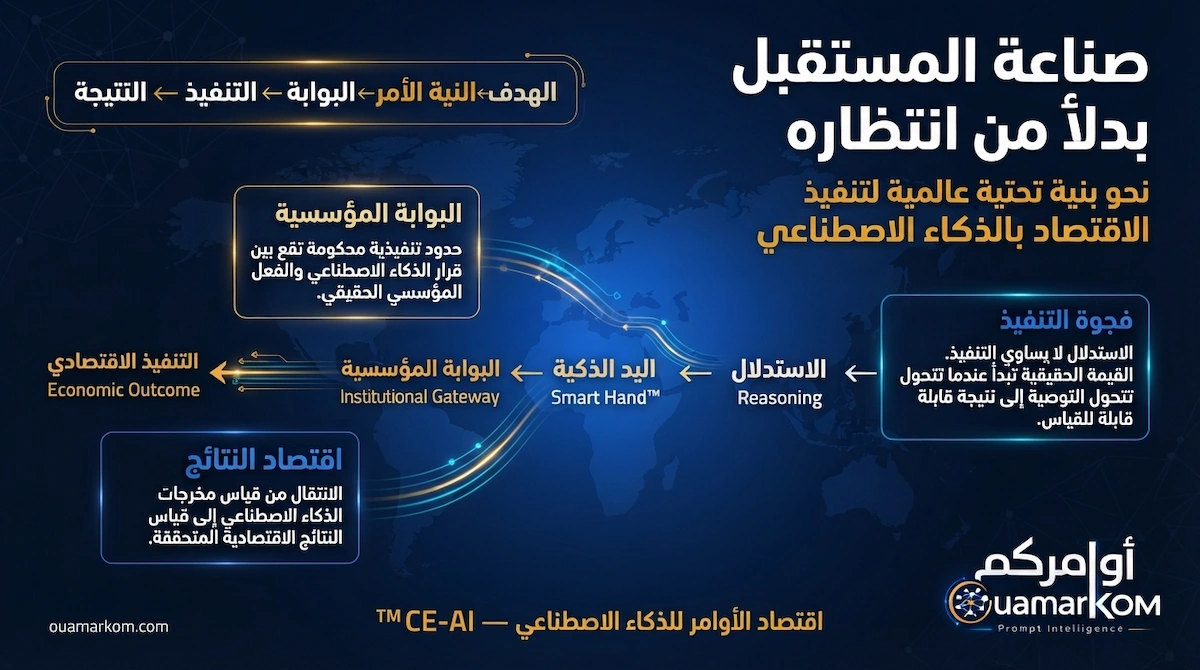
The most important question in the age of artificial intelligence may no longer be:
Who has the most intelligent model?
A deeper question is beginning to emerge:
Who will build the infrastructure capable of turning intelligence into economic action that is reliable, governed, traceable, verifiable, and measurable?
Over the past several years, much of the technological race has focused on developing increasingly capable artificial intelligence models with stronger abilities in understanding, generation, analysis, programming, planning, and reasoning.
This progress has dramatically reduced the cost of producing digital knowledge and opened the path for AI to evolve from an assistive technology into an active participant in organizational processes.
Yet greater reasoning capability does not automatically translate into greater institutional execution capability.
An AI system may analyze sales data, recommend cost reductions, identify supply-chain opportunities, design a marketing campaign, or propose a customer strategy. But economies do not move on recommendations alone.
Economic value emerges when a recommendation moves from the screen into a system, from the system into an action, and from that action into an outcome that can be measured and verified.
From Intelligence to Execution
A fundamental distinction can be expressed simply:
An AI system may be capable of answering: What should we do?
An institution, however, must address a much broader set of questions:
- Are we authorized to do it?
- Who has the authority to approve or issue the action?
- What policies and constraints apply?
- Which systems need to change?
- Which agent or tool should perform the operation?
- What is the associated risk?
- Is human approval required?
- How should execution be monitored?
- What happens if execution fails?
- How can we verify that the intended outcome was actually achieved?
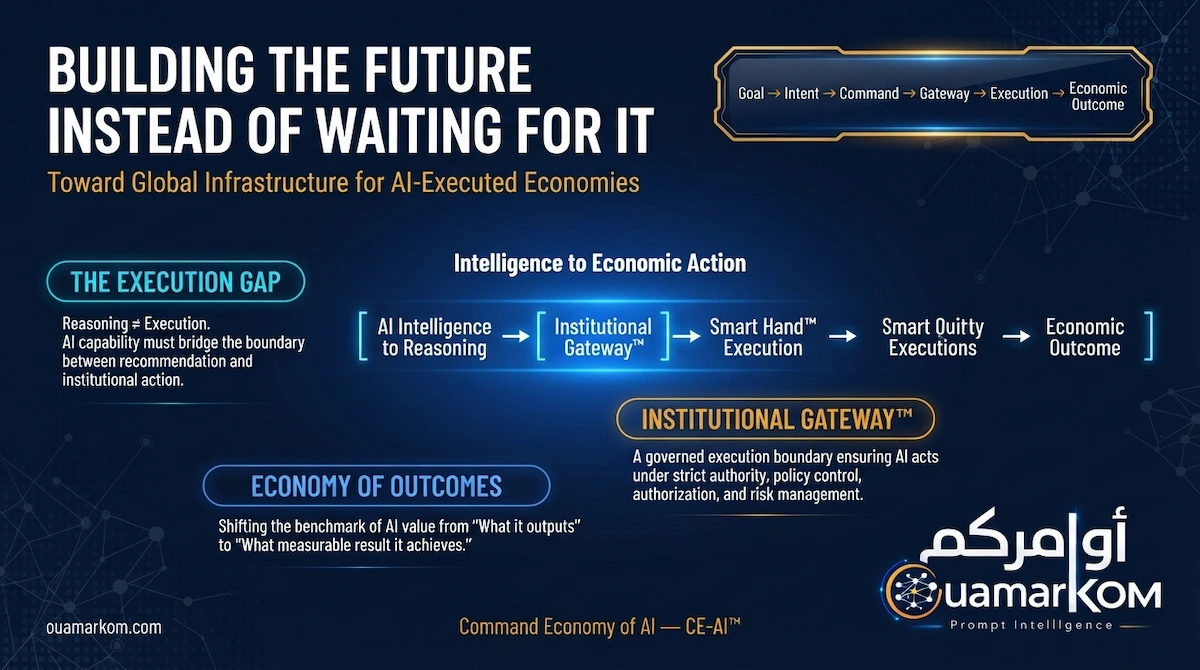
The path from intelligence to economic value may therefore look more like:
This is not merely a technical sequence. It represents a potential new value chain for institutions moving from using AI to produce information toward using AI, within defined governance boundaries, to participate in the execution of economic objectives.
The Economy Does Not Operate Inside the Model
Regardless of how capable an AI model becomes, most real economic activity does not take place inside the model. It takes place across the systems that operate institutions and markets:
- Enterprise Resource Planning systems (ERP)
- Customer Relationship Management systems (CRM)
- Financial and accounting systems
- Procurement platforms
- Inventory systems
- Human resources systems
- Supply-chain infrastructure
- E-commerce platforms
- Databases & APIs
- Operational and industrial systems
This creates an important paradox: AI may become increasingly capable of understanding an organization while its ability to act within that organization remains constrained by fragmented integrations, permissions, workflows, policies, and operational controls.
AI Execution Infrastructure
This is where the concept of AI Execution Infrastructure becomes relevant.
AI Execution Infrastructure should not be confused with the infrastructure used to operate AI models in terms of computing, storage, and networking. That is: AI Compute Infrastructure.
AI Execution Infrastructure addresses a different question:
The distinction is fundamental:
- AI compute infrastructure asks: Where and how do we run the model?
- AI execution infrastructure asks: How do we create a controlled path through which AI-generated intelligence can become action within the real economy?
The first provides the capacity to operate intelligence. The second seeks to provide the infrastructure through which intelligence can be translated into action.
Institutional Gateway
The Boundary Between Intelligence and the Economy
If AI represents a reasoning layer, while enterprise systems represent the environment in which resources, processes, and economic value move, then there may be a need for an intermediate layer capable of managing the boundary between the two. This concept can be described as an Institutional Gateway.
An Institutional Gateway is not simply an API gateway. It is not a dashboard, and it is not conventional workflow automation. Rather, it can be understood as a governed execution boundary positioned between:
Depending on the architecture, such a layer may provide capabilities including:
- Identity & Authorization
- Permissions & Policy enforcement
- Risk classification & Human approvals
- Agent orchestration & Tool selection
- Execution control & Auditability
- Verification & Outcome measurement
The objective is not to give AI unrestricted authority over institutional systems. It is the opposite: to provide AI with clearly defined and observable boundaries within which it can act.
From Automation to Economic Execution
Traditional automation often follows a relatively deterministic logic: If A happens → execute B.
AI-enabled economic execution operates at a different level of abstraction. Consider objectives such as:
- «Reduce customer request processing time.»
- «Improve lead conversion.»
- «Reduce the cost of a specific operational process.»
These are not predefined execution commands; they are economic objectives. Turning such objectives into action requires a system capable of interpreting the objective, understanding its context, identifying constraints, developing a plan, selecting appropriate tools, validating permissions, coordinating agents and systems, executing actions, and monitoring outcomes.
This suggests a transition:
Such a transition may ultimately be more economically significant than simply increasing the number of individual tasks that AI can automate.
An Attempt to Build the Execution Layer
Within this context, Ouamarkom™ introduces Smart Hand™ as an attempt to explore and build an execution layer capable of bridging AI intelligence with the systems in which real economic activity takes place.
The objective is not to build another “brain” competing with the major AI models. The objective is to explore the layer that allows the capabilities of those models to cross into the operational world through controlled execution.
A conceptual architecture can be represented as:
Within this architecture:
- Intelligence supports reasoning and decision-making.
- Intent and Goal define what the institution seeks to achieve.
- Command translates the objective into an executable directive.
- Institutional Gateway governs the boundary between AI and institutional systems.
- Policy and Authorization determine what may be executed and under whose authority.
- Orchestration coordinates agents, tools, and operational systems.
- Enterprise Systems provide the environment in which economic activity actually occurs.
- Execution turns plans into actions.
- Audit and Verification provide evidence of what happened and whether execution succeeded.
- Economic Outcome provides a basis for evaluating the value of execution.
From CE-AI to CEP
Within this broader vision, Command Economy of AI — CE-AI™ can be understood as the thesis and framework exploring the transition from using AI primarily to produce information toward using AI, within defined governance boundaries, to participate in executing economic objectives.
CEP™, within the Ouamarkom thesis, represents an attempt to translate recurring operational patterns into rules and executable specifications that can be applied more consistently and repeatedly.
The purpose is not simply to introduce another technical abstraction. It is to explore whether commands, objectives, decisions, policies, and execution patterns can be expressed in a more structured operational language between intelligence and institutional action.
An Economy of Outcomes, Not Outputs
One of the most important potential shifts may be the transition from evaluating AI according to what it produces to evaluating AI according to what it helps achieve.
Under a traditional model, organizations may ask:
- How many requests did the system answer?
- How many documents did it generate?
- How many tasks did it automate?
- How much code did it produce?
Under an economic execution model, the questions may become:
- How much time was saved?
- How much did process cost decrease?
- How much did conversion improve?
- How much manual work was eliminated?
- How much did productivity increase?
- How much did response time improve?
- What was the measurable return on investment?
This shift could influence how organizations evaluate and prioritize AI initiatives. Organizations ultimately do not invest in AI simply to produce more outputs. They invest in it to achieve results.
Governance Is Not the Opposite of Execution
As intelligent systems become increasingly capable of planning, coordinating, and executing actions, governance becomes more important—not less.
This is not solely a technical question. It is simultaneously an engineering, economic, governance, and accountability question.
Building a layer between AI and enterprise systems should therefore not be interpreted as an attempt to grant machines unrestricted autonomy. It can instead serve the opposite purpose: to introduce AI into institutional environments through explicit boundaries of authority, responsibility, risk, and auditability.
From this perspective, the concept of an Execution Boundary may become an important component of AI-native institutional architecture.
From Owning Intelligence to Owning the Execution Path
The next phase of AI may not be determined entirely at the model layer. It may also be determined by the layers that make those models usable, controllable, repeatable, and measurable within the economy.
As AI becomes increasingly capable of understanding objectives, planning actions, and coordinating processes, another question becomes increasingly important: «How do we allow AI to act without losing control?»
This leads to a broader architectural concept: Execution Infrastructure—the infrastructure connecting a system's ability to reason with its ability to act within real-world institutional environments.
From this perspective:
- Institutional Gateway represents the conceptual execution boundary between AI and institutional systems.
- Smart Hand™ represents an attempt to embody the execution and orchestration layer.
- CEP™ represents an attempt to translate recurring execution patterns into applicable specifications.
- CE-AI™ represents the broader framework connecting these elements to a potential economic transformation:
Building the Future Instead of Waiting for It
Building the infrastructure for the next phase of AI does not require assuming that the future has already been determined. It requires identifying emerging gaps, developing hypotheses, building systems, and testing whether those hypotheses hold in real environments.
This is the approach Ouamarkom™ seeks to pursue. Not by claiming that AI Execution Infrastructure is already a global standard. Not by claiming that the Institutional Gateway is the only possible architecture. And not by claiming that Smart Hand™ represents a final solution.
Instead, Ouamarkom is exploring an engineering and economic hypothesis that is worth testing:
This makes the ambition of Ouamarkom™ more precise than simply building another product. It is an attempt to explore a transition:
Only then can the larger question be addressed: «Can such a layer become part of the infrastructure underlying AI-executed economies?» The answer should not be a promise. It should be the result of testing.
Conclusion
The future of AI will not be defined only by how much intelligence machines possess. It may also be defined by the infrastructure that allows that intelligence to operate in the real world through explicit boundaries of authority, policy, risk, accountability, and verification.
The transition from AI Intelligence to AI Execution may therefore become one of the defining architectural questions for AI-enabled institutions.
If previous generations of infrastructure made computing, data, and intelligence increasingly accessible at scale, the next challenge may be to build the infrastructure that makes governed intelligent execution possible across organizations and economic systems.
This is not a settled conclusion. It is a hypothesis worth building and testing. And this is the essence of:
We do not claim to own the standard. We build and test the infrastructure that may make earning it possible.
Ouamarkom™
Building the Infrastructure for AI-Executed Economies.
Establish Your Execution Infrastructure Now