
Abstract
The digital economy is undergoing a significant transformation, moving beyond the use of artificial intelligence as a tool for information processing, content generation, and decision support toward increasingly autonomous systems capable of planning, interacting with external tools, initiating operations, and performing actions with direct economic and institutional consequences.
This transition introduces challenges that extend beyond model accuracy and reasoning capabilities. It raises fundamental questions concerning delegated authority, execution boundaries, policy enforcement, transactional integrity, and the independent verification of outcomes.
One of the central challenges is the absence of systematic integration among existing technical disciplines. AI agent architectures, identity and access management, authorization mechanisms, policy engines, distributed transaction processing, cryptographic evidence mechanisms, and verification systems each provide specialized capabilities. However, their individual availability does not necessarily establish a coherent governance architecture for autonomous economic execution.
This article examines the economic and architectural implications of this integration gap and introduces CE-AI™ as a proposed research framework for examining the relationships between commands, delegated economic authority, governed execution, and verifiable outcomes. It further explores the potential role of an independently controlled execution architecture in separating probabilistic AI reasoning from the enforcement of economic permissions and constraints.
Keywords: Agentic AI, Economic Engineering of AI, Systematic Integration, Delegated Economic Authority, Governed Execution, AI Governance, Distributed Systems, Transaction Integrity, Outcome Verification.
1. From Analytical Artificial Intelligence to Autonomous Economic Action
Artificial intelligence is evolving beyond its traditional role as a system for processing information, generating content, and supporting human decision-making.
Contemporary AI agent architectures increasingly support multi-step planning, tool utilization, external system interaction, and the execution of complex operational tasks.
This evolution represents a fundamental shift in the relationship between intelligence and economic activity. The value of AI is no longer determined exclusively by its ability to generate knowledge or recommendations. It is increasingly associated with its capacity to translate those outputs into operational actions.
However, the transition from recommendation to execution introduces a fundamental question:
Does the ability of an AI system to formulate an economic decision automatically grant it the authority to execute that decision?
The distinction between technical capability and institutional authority is essential.
An AI system may be capable of selecting a supplier, determining a transaction amount, preparing a procurement request, or initiating a financial operation. Yet, none of these capabilities inherently establishes the legal, financial, or operational authorization required to perform the corresponding action.
This distinction creates a need to reconsider the architecture connecting AI systems to economic and institutional environments.
2. The Absence of Systematic Integration: Defining the Problem
The integration problem does not necessarily originate from the absence of individual technologies. Rather, it emerges from the lack of systematically established relationships among the capabilities required to govern autonomous economic actions.
AI agent systems provide reasoning and planning capabilities. Identity and access management systems establish identities and permissions. Authorization mechanisms evaluate delegated privileges. Policy engines assess operational constraints. Transaction processing systems manage execution states, while cryptographic and verification mechanisms support the integrity and examination of recorded evidence.
Nevertheless, the correctness of individual components does not automatically guarantee the correctness of the integrated system.
Consider an AI procurement agent authorized to operate within a purchasing environment. Its access to that environment does not necessarily grant it unrestricted purchasing authority.
Similarly, a financial request may pass an initial authorization check while the underlying delegation changes before execution begins. Two concurrent transactions may independently satisfy an available-budget check while collectively exceeding the institution's financial limit.
These scenarios reveal an important distinction between component-level correctness and system-level governance.
The central integration problem therefore concerns the establishment of consistent operational relationships among agent identity, delegated authority, economic constraints, execution states, and externally verifiable outcomes.
Such consistency must also be examined under concurrency, failure, revocation, and changing authorization conditions.
3. The Economic Implications of Integration Gaps
The absence of systematic integration is not exclusively an engineering concern. It has direct implications for economic efficiency, institutional accountability, and operational risk.
Second: Increased Governance and Audit Costs. When decisions, execution events, and authorization records are distributed across disconnected systems, reconstructing operational events and establishing accountability can become increasingly complex.
Third: Institutional Agency Risk. Granting autonomous systems operational capabilities without explicitly defining their authority may widen the gap between the institution responsible for an action and the technical system initiating it.
Fourth: Reduced Operational Trust. Organizations cannot sustainably expand their reliance on autonomous agents if they cannot establish whether executed actions complied with delegated authority and institutional policies.
Fifth: Opportunity Costs. Organizations may respond to these uncertainties by restricting agent autonomy or requiring extensive human approval for individual transactions, potentially reducing the economic benefits of automation.
Consequently, execution governance should not be viewed solely as an additional compliance expense. Properly designed governance mechanisms may become enabling infrastructure for improving operational efficiency while managing economic exposure.
4. Toward a Systematic Approach: Economic Engineering of AI
These challenges call for an approach that considers AI not merely as an isolated computational model, but as a participant within an economic system involving commands, delegated authority, constraints, execution, and accountability.
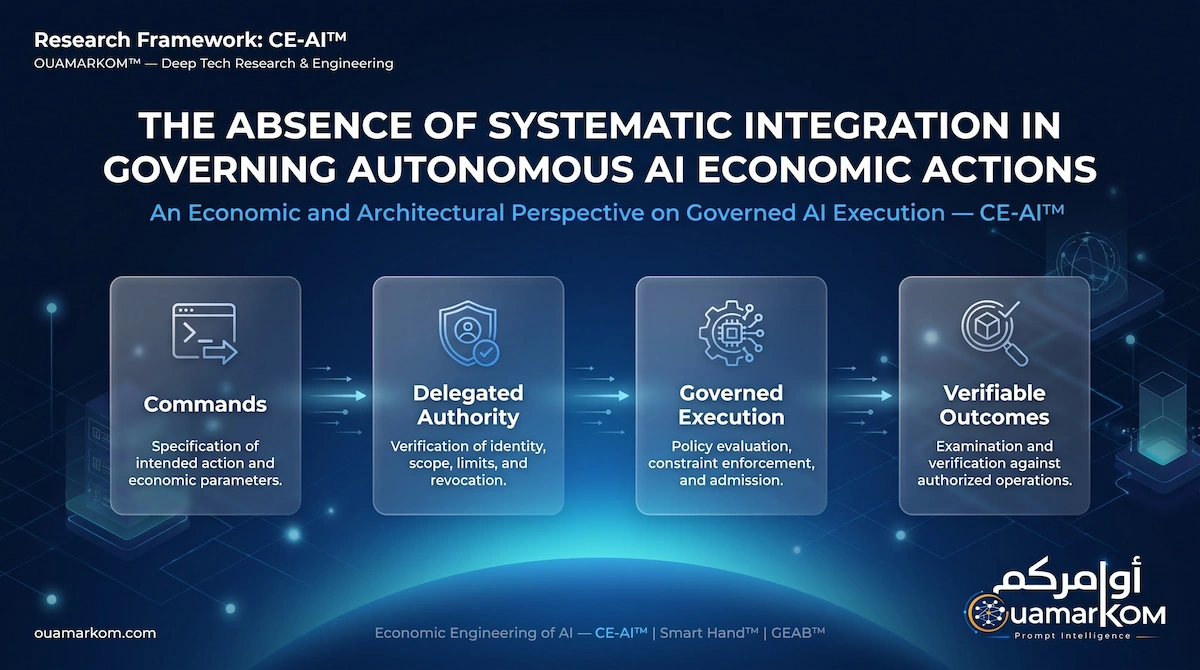
Within this context, CE-AI™ - Command Economy of AI - proposes a research framework for examining the architectural and operational relationships among these elements.
Its conceptual model is organized around four interconnected stages:
1. Commands: The specification of an intended action, its operational context, and its economic parameters.
2. Delegated Authority: The identification and verification of the authority granted to an AI agent, including its scope, limits, validity, and revocation conditions.
3. Governed Execution: The evaluation and enforcement of applicable policies and constraints, resulting in admission, rejection, or escalation of an execution request.
4. Verifiable Outcomes: The examination of execution states and the verification of actual outcomes against the originally authorized operation.
The significance of this model lies in maintaining distinctions between concepts that are frequently treated as interchangeable: Technical capability does not establish authority. Authority does not constitute execution. Execution does not, by itself, establish successful completion or independently verified outcomes.
5. The Proposed Architectural Approach: Separating Reasoning from Enforcement
One potential engineering approach involves establishing a control layer that operates independently, or with a defined degree of separation, from the AI agent's reasoning environment.
The purpose of this separation is to ensure that economic authorization and policy enforcement are not determined exclusively by the same probabilistic process that generates the proposed action.
The Out-of-Band Control Plane represents a proposed architectural direction for investigating this separation.
Its intended role is to evaluate delegated authority, enforce economic constraints, and govern access to execution pathways before an AI-generated request becomes an authorized operational action.
Such an architecture may include: An Authority Registry, A Policy Evaluation Engine, A Deterministic Enforcement Engine, An Execution Gateway, A Revocation Controller, A Transaction State Manager, and An Evidence Recording Mechanism.
However, architectural separation alone does not establish an absolute security guarantee. Its effectiveness depends on several conditions, including the enforcement coverage of relevant execution pathways, protection against unauthorized parameter modifications, concurrency management, secure communication, and appropriate handling of failures and retries.
6. From Architectural Proposals to Experimental Validation
The scientific value of an integration framework cannot be established solely through conceptual definitions or architectural diagrams.
It requires experimental environments capable of examining system behavior, measuring performance, and comparing outcomes against relevant alternative approaches.
Within the OUAMARKOM™ research direction, Smart Hand™ is proposed as an experimental environment for investigating scenarios involving economic limit violations, concurrent execution requests, delegated authority revocation, unauthorized transaction parameter modifications, communication failures, duplicate execution attempts, and transaction state inconsistencies.
GEAB™ is proposed as an experimental evaluation framework for measuring relevant outcomes, including Unauthorized Execution Rate, Policy Enforcement Coverage, Revocation Enforcement Latency, Budget Overspend, Concurrent Request Safety, Evidence Completeness, and Outcome Verification Coverage.
Scientific credibility requires these measurements to be evaluated against clearly defined baselines and experimental conditions.
7. Conclusion: Systematic Integration as a Foundation for Economic Trust
The transition toward an economy increasingly supported by autonomous AI agents requires more than improved reasoning capabilities.
It requires institutional and engineering architectures capable of defining who or what is authorized to act, establishing the boundaries of that authority, enforcing those boundaries during execution, and verifying the resulting outcomes.
The absence of systematic integration among these functions represents a significant research and engineering challenge that must be addressed as autonomous economic activity expands.
This creates an opportunity for Economic Engineering of AI as a research direction concerned with the systematic integration of existing technical disciplines into coherent architectures for governing AI-initiated economic actions.
CE-AI™ proposes a conceptual contribution to this direction by examining the relationships between commands, delegated authority, governed execution, and verifiable outcomes.
Ultimately, the economic value of autonomous artificial intelligence will not be determined solely by the decisions its systems can formulate, but also by the extent to which their authority can be defined, their actions controlled, and their outcomes independently verified.
Trust in autonomous economic action begins when authority is explicit, execution is governed, and outcomes are verifiable.
References
- Autio, C., et al. (2024). Artificial Intelligence Risk Management Framework: Generative Artificial Intelligence Profile. NIST AI 600-1. National Institute of Standards and Technology. https://doi.org/10.6028/NIST.AI.600-1
- Pang, R., et al. (2019). Zanzibar: Google's Consistent, Global Authorization System. 2019 USENIX Annual Technical Conference, 33–46.
- OWASP Foundation. (2025). OWASP Top 10 for Large Language Model Applications - Excessive Agency. OWASP GenAI Security Project.
- National Institute of Standards and Technology. (2023). Artificial Intelligence Risk Management Framework (AI RMF 1.0). NIST AI 100-1. https://doi.org/10.6028/NIST.AI.100-1
Research and Institutional Attribution
OUAMARKOM™
Deep Tech Research & Engineering
Research Direction: Economic Engineering of AI
Foundational Research Framework: CE-AI™ - Command Economy of AI
Proposed Engineering Architecture: CEP™ Control Plane
Research Status: Conceptual Research and Proposed Architectural Approach. Experimental Validation: Subject to Implementation and Comparative Evaluation. This article presents a conceptual research perspective and proposed architectural direction. It does not claim independently established experimental results, formal standardization, or demonstrated universal superiority over existing architectures.